PREVIOUS-YEAR QUESTIONS

IISER IAT 2020 question paper with solutions

60 questions across Biology, Chemistry, Mathematics and Physics. Read the retyped questions, attempt them independently and open each freshly written solution when ready.

Try each question before opening its answer. Answer letters refer to the option order displayed here. A marked qualification identifies a source defect or a modelling assumption; see the explanation before scoring that item.

Open the displayed answer key
SubjectQuestion: answer
Biology1: D · 2: A · 3: A · 4: D · 5: D · 6: B† · 7: D · 8: C · 9: D · 10: A · 11: B · 12: A · 13: D · 14: C · 15: B
Chemistry1: D† · 2: B · 3: D · 4: C · 5: C · 6: B · 7: C · 8: B · 9: D · 10: A · 11: D · 12: B · 13: D · 14: C · 15: C†
Mathematics1: D · 2: D · 3: B · 4: C · 5: —† · 6: A · 7: A · 8: C · 9: D · 10: D · 11: C · 12: B · 13: C · 14: D · 15: B
Physics1: A† · 2: A · 3: B · 4: C† · 5: D† · 6: B · 7: C† · 8: D · 9: A · 10: A · 11: A · 12: D · 13: D† · 14: B · 15: D

— = no valid listed option. † = read the qualification beside the solution.

Biology

Question 1

IAT 2020 · Biology

Which of the following root modifications is observed in maize?

  1. Fibrous roots
  2. Lateral root
  3. Prop roots
  4. Stilt
Answer & worked solution
Answer D
Maize develops supporting adventitious roots from its lower stem nodes. These grow obliquely into the soil and are called stilt roots. Fibrous roots describe its general root-system type, but the supporting modification asked for here is the stilt root; prop roots, as in banyan, descend from branches.

Question 2

IAT 2020 · Biology
Which of the following chemical intermediates are products of light in photosynthesis?
  1. ATP and NADPH
  2. H2O and NADPH
  3. CO2 and NADPH
  4. CO2 and ATP
Answer & worked solution
Answer A
The light reactions convert light energy into chemical energy by producing ATP and reducing NADP⁺ to NADPH. These products supply energy and reducing power for carbon fixation. Water is consumed as an electron source, while carbon dioxide is fixed in the subsequent carbon-assimilation reactions.

Question 3

IAT 2020 · Biology
Which of the following organisms produce Cry proteins?
  1. Bacillus thuringiensis
  2. Saccharomyces cerevisiae
  3. Escherichia coli
  4. Pseudomonas syringe
Answer & worked solution
Answer A
Cry proteins are insecticidal crystal proteins naturally produced by Bacillus thuringiensis. Genes encoding selected Cry proteins are used in Bt crops. Although laboratory bacteria can be engineered to express these genes, the naturally associated organism among the options is B. thuringiensis.

Question 4

IAT 2020 · Biology
A hypothetical plant species shows two flower colour phenotypes- red and white. Red is dominant over white. In a population, this flower colour locus was found to be in HardyWeinberg equilibrium. If 490 out of a total population size of 1000 plants were found to be white-flowered, how many of the red-flowered plants will be heterozygous?
  1. 700
  2. 90
  3. 580
  4. 420
Answer & worked solution
Answer D
White flowers are recessive, so q2=490/1000=0.49q^2=490/1000=0.49. Thus q=0.7q=0.7 and p=0.3p=0.3. Heterozygotes have frequency 2pq=2(0.3)(0.7)=0.422pq=2(0.3)(0.7)=0.42. There are therefore 420 heterozygous red-flowered plants. The other 90 red plants are homozygous dominant.

Question 5

IAT 2020 · Biology
Troponin controls binding of actin to myosin motor, thereby regulating muscle contraction. Binding of which metal ions to troponin is crucial for this purpose?
  1. 𝑁𝑎
  2. 𝐾
  3. 𝑀𝑔
  4. Ca
Answer & worked solution
Answer D
Calcium ions bind to troponin C and change the position of the troponin–tropomyosin complex. This exposes the myosin-binding sites on actin, allowing cross-bridge formation. Sodium and potassium help generate electrical signals, but calcium is the direct regulatory ion in this step of contraction.

Question 6

IAT 2020 · Biology

The following word diagram depicts a food chain in a forest.

 Trees (Aspen, willow)  Herbivore (Elk)  Predator (Wolf) 

Which is the most likely outcome of depletion in predator population?

  1. Increased browsing by the herbivores stimulates the plant growth leading to increased primary productivity
  2. Overgrowth of herbivore population causing reduction in tree populations and therefore, if the process continues the entire ecosystem will breakdown
  3. No change in the ecosystem as the herbivore and the tree populations will continue to maintain equilibrium
  4. Overgrowth of herbivore population without any change in the remaining part of the ecosystem
Answer & worked solution
Answer B · qualification below

The predicted direction is sound; complete ecosystem collapse is not inevitable.

Reducing the wolf population weakens predation on elk. More elk can then browse the aspen and willow, reducing tree recruitment and abundance. This is a trophic cascade. B identifies the expected direction of the changes; its prediction of complete ecosystem breakdown is a possible extreme outcome, rather than an inevitable consequence of every predator decline.

Question 7

IAT 2020 · Biology
Which of the following is the correct description of interferon?
  1. A synthetic neurotransmitter used to treat neuronal diseases
  2. A class of proteins secreted by B-lymphocytes that categorically attack and destroy virusinfected cells
  3. Signalling molecules that interfere with its own synthesis inside a secretory cell
  4. A class of proteins secreted by virus infected cells and are involved in protecting uninfected cells
Answer & worked solution
Answer D
Virus-infected cells release interferons that signal neighbouring cells to activate antiviral defences. These proteins help limit viral replication and spread. They are not antibodies secreted by B cells, nor are they synthetic neurotransmitters. Their name reflects interference with viral infection, not inhibition of their own synthesis.

Question 8

IAT 2020 · Biology
Which of the following products are expected when lipase acts on diglycerides?
  1. Fatty acids and glucose
  2. Glucose and galactose
  3. Fatty acids and glycerol
  4. Monoglycerides and glycerol
Answer & worked solution
Answer C
A diglyceride contains two fatty-acid ester bonds to glycerol. Complete hydrolysis of both bonds by lipase releases two fatty acids and glycerol. Partial hydrolysis can produce a monoglyceride plus a fatty acid, but the complete-hydrolysis products represented among these options are fatty acids and glycerol.

Question 9

IAT 2020 · Biology
Radial symmetry is NOT found in which of the following taxa?
  1. Echinodermata
  2. Cnidaria
  3. Ctenophora
  4. Cyclostomata
Answer & worked solution
Answer D
Cyclostomes are vertebrates with a bilateral body plan. Radial organisation occurs in cnidarians and adult echinoderms; ctenophores are commonly described as biradial. Echinoderm larvae are bilateral, but the adult body plan is the relevant comparison in this question.

Question 10

IAT 2020 · Biology
Reabsorption of which of these molecules in kidney occurs via passive transport?
  1. Urea
  2. Glucose
  3. Sodium ions
  4. Amino acids
Answer & worked solution
Answer A
Urea can move passively down its concentration gradient, including through facilitated urea transporters in appropriate nephron segments. Glucose and amino-acid reabsorption depend primarily on sodium-linked transport, and sodium transport is driven by active mechanisms. Therefore urea is the intended passive-reabsorption example.

Question 11

IAT 2020 · Biology

 Match the human cell types (column I) to the number of chromatids (column II) 

Column I Column II
(a) Col𝐺2 phase cells  (i) 46
(b) 𝐺1 phase cells  (ii) 92
(c) Spermatogonia (pre-replication)
(iii) 23
(d) Ovum
  1. a-ii, b-i, c-iii, d-iii
  2. 𝑎𝑖𝑖,𝑏𝑖,𝑐𝑖,𝑑𝑖𝑖𝑖
  3. a-ii, b-iii, c-i, d-iii
  4. a-i, b-ii, c-iii, d-iii

Transcription note: Removed stray table text introduced by transcription; cell types and counts are unchanged.

Answer & worked solution
Answer B
DNA has already replicated in a diploid G₂ cell, giving 46 chromosomes but 92 chromatids. A G₁ cell and a spermatogonium before replication each have 46 chromatids. A mature ovum is haploid with 23 single-chromatid chromosomes. Hence a–ii, b–i, c–i and d–iii is the correct match.

Question 12

IAT 2020 · Biology
Which of the following processes is NOT involved in functionalisation of mRNA (from hnRNA) in eukaryotes?
  1. Amino acylation
  2. 5-end capping
  3. Polyadenylation
  4. Splicing
Answer & worked solution
Answer A
Eukaryotic pre-mRNA processing includes addition of a 5′ cap, a poly-A tail and removal of introns by splicing. Aminoacylation attaches an amino acid to its corresponding tRNA. It is essential to translation but is not a step that converts hnRNA into mature mRNA.

Question 13

IAT 2020 · Biology
Which of the following processes increases the uptake of water and minerals by roots in legumes?
  1. Active uptake by xylem
  2. Pumping through plasmodesmata
  3. Pumping through cortical cells
  4. Formation of mycorrhizae
Answer & worked solution
Answer D
Mycorrhizal fungi extend the effective absorbing network beyond the root surface. Their hyphae improve access to water and mineral nutrients, particularly phosphate, in exchange for plant-derived carbon. This differs from nitrogen fixation in legume nodules, which addresses a different nutrient-acquisition process.

Question 14

IAT 2020 · Biology
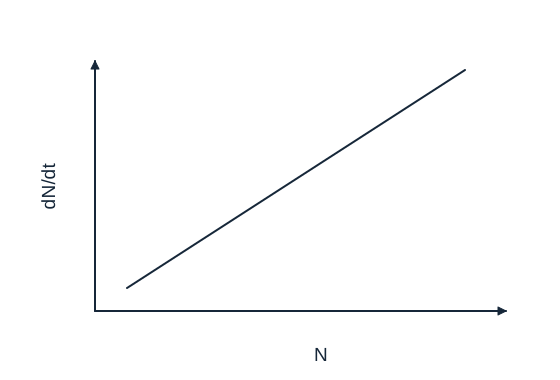
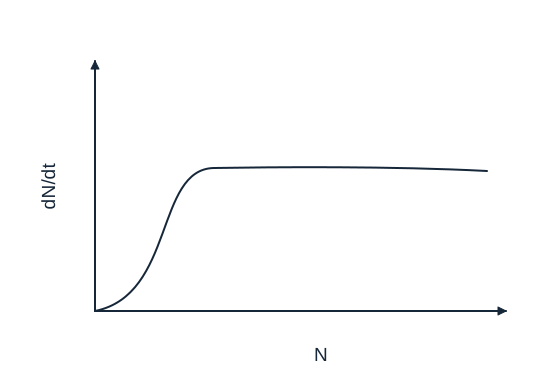
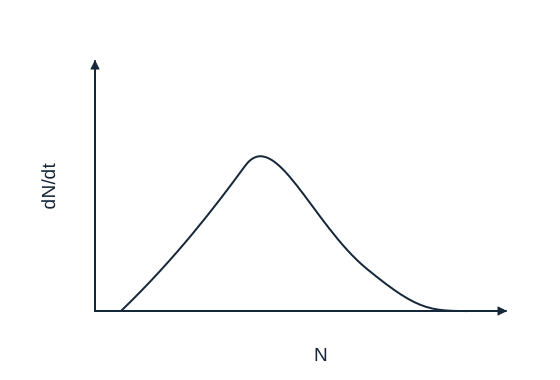
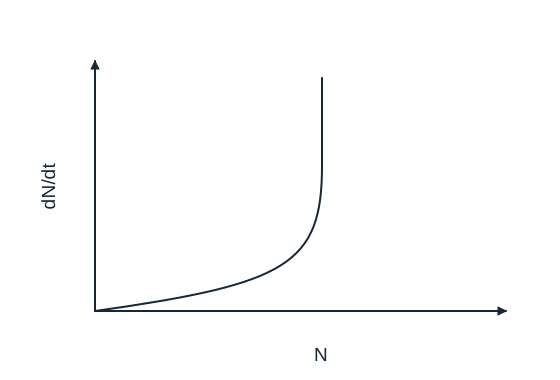
Which of the following graphs correctly represents the relationship between population growth rate (dN/dt) and population size (N), if the population shows logistic growth?
  1. IAT 2020, Biology, question 14 — option A
  2. IAT 2020, Biology, question 14 — option B
  3. IAT 2020, Biology, question 14 — option C
  4. IAT 2020, Biology, question 14 — option D
Answer & worked solution
Answer C
For logistic growth, dN/dt=rN(1N/K)dN/dt=rN(1-N/K). As a function of N this is a downward-opening quadratic: it is zero at N=0N=0 and N=KN=K and reaches its maximum at N=K/2N=K/2. C is the qualitative rise-and-fall sketch. The ideal mathematical curve is a parabola, even though the reproduced sketch is not drawn precisely to that shape.

Question 15

IAT 2020 · Biology
Which of the following processes gives rise to new organisms from unfertilized ova in some species of plants and animals?
  1. Autogamy and parthenogenesis
  2. Parthenogenesis and apomixis
  3. Syngamy and apomixis
  4. Xenogamy and autogamy
Answer & worked solution
Answer B
Parthenogenesis is development of an individual from an unfertilised egg. In plants, apomixis includes forms of seed formation without fertilisation, including parthenogenetic development of an egg. Autogamy and xenogamy are pollination processes, and syngamy is fusion of gametes, so they do not describe the requested unfertilised development.

Chemistry

Question 1

IAT 2020 · Chemistry

 How many atoms are present in a hexagonal close-packed unit cell? 

  1. 4
  2. 2
  3. 8
  4. 6
Answer & worked solution
Answer D · qualification below

Uses the conventional hexagonal-prism unit cell.

In the conventional hexagonal-prism HCP cell, 12 corner atoms contribute 12/6=212/6=2, the two basal-face centres contribute 2/2=12/2=1, and three atoms lie wholly inside. The total is 2+1+3=62+1+3=6. This answer uses the conventional cell; the smaller primitive HCP cell has a two-atom basis.

Question 2

IAT 2020 · Chemistry
The molar conductivity of 0.00241 M acetic acid is 32.87Scm2 mol1. If the limiting molar conductivity at 298 K is 390.5Scm2 mol1, what is the dissociation constant ( molL1 )?
  1. 5.36×10⁵
  2. 1.86×10⁵
  3. 5.36×10⁴
  4. 1.86×10⁴
Answer & worked solution
Answer B
The degree of dissociation is α=Λm/Λm=32.87/390.50.08417\alpha=\Lambda_m/\Lambda_m^\circ=32.87/390.5\approx0.08417. For a weak monoprotic acid, Ka=cα2/(1α)K_a=c\alpha^2/(1-\alpha). Substituting c=0.00241c=0.00241 gives Ka1.86×105 molL1K_a\approx1.86\times10^{-5}\ \mathrm{mol\,L^{-1}}, matching B.

Question 3

IAT 2020 · Chemistry

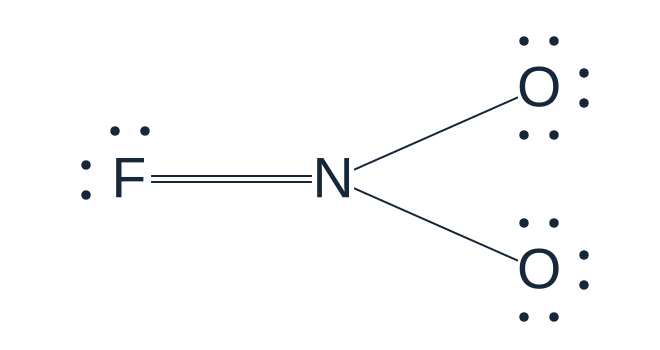
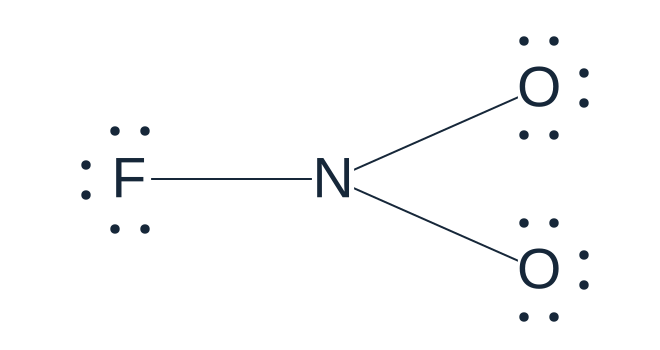
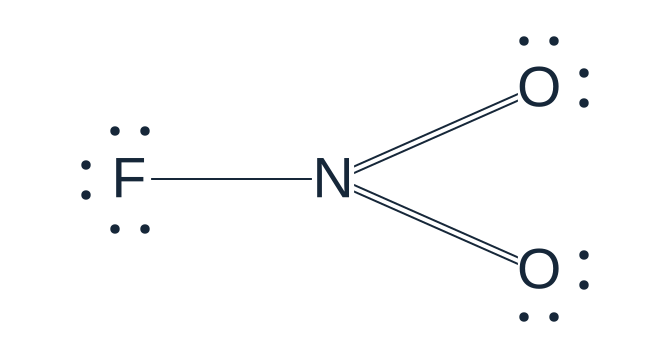
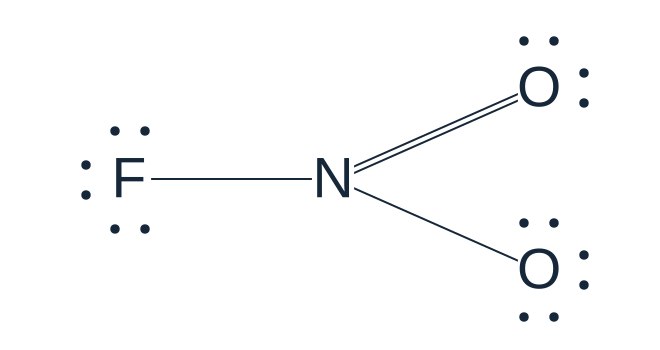
 What is the most appropriate Lewis structure of NO2 F ? 

  1. IAT 2020, Chemistry, question 3 — option A
  2. IAT 2020, Chemistry, question 3 — option B
  3. IAT 2020, Chemistry, question 3 — option C
  4. IAT 2020, Chemistry, question 3 — option D
Answer & worked solution
Answer D
The total valence-electron count is 5+2(6)+7=245+2(6)+7=24. Nitrogen cannot exceed an octet, so it should have one N=O bond, one N–O bond and one N–F bond. This assigns formal charges +1+1 to N and 1-1 to the singly bonded oxygen, with resonance between the two oxygens. D represents this arrangement; two N=O bonds plus N–F would put ten electrons around nitrogen.

Question 4

IAT 2020 · Chemistry
Common disaccharide sucrose is held together by a glycosidic linkage between
  1. C1 of 𝛽-D-glucose and C2 of 𝛼-D-fructose.
  2. C2 of 𝛼-D-glucose and C1 of 𝛽-D-fructose.
  3. C1 of 𝛼-D-glucose and C2 of 𝛽-D-fructose.
  4. C1 of 𝛼-D-glucose and C2 of 𝛼-D-fructose.
Answer & worked solution
Answer C
Sucrose joins the anomeric carbon C1 of α-D-glucose to the anomeric carbon C2 of β-D-fructose. The linkage is therefore α(1→2)β. Because both anomeric centres participate, sucrose has no free reducing hemiacetal group.

Question 5

IAT 2020 · Chemistry
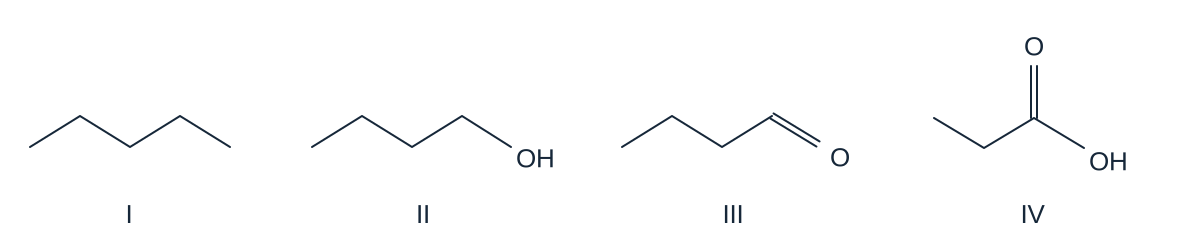
Select the correct option based on the increasing order of boiling point of the molecules given below. IAT 2020, Chemistry, question 5 — question diagram
  1. 𝐼<𝐼𝐼𝐼<𝐼𝑉<𝐼𝐼

  2. 𝐼𝐼<𝐼<𝐼𝑉<𝐼𝐼𝐼
  3. 𝐼<𝐼𝐼𝐼<𝐼𝐼<𝐼𝑉
  4. III < I < II < IV
Answer & worked solution
Answer C
The alkane I has only dispersion forces and boils first. Aldehyde III has dipole–dipole attraction but cannot hydrogen-bond strongly to itself as a donor. Alcohol II forms intermolecular hydrogen bonds. Carboxylic acid IV forms strongly associated hydrogen-bonded dimers. For these specific compounds the order is I<III<II<IVI<III<II<IV.

Question 6

IAT 2020 · Chemistry
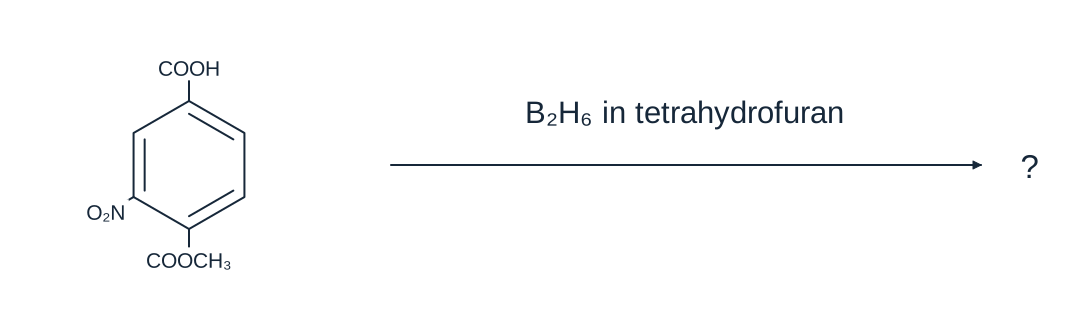
Identify the major product that forms easily and faster in the following reaction. (Tetrahydrofuran= solvent) IAT 2020, Chemistry, question 6 — question diagram
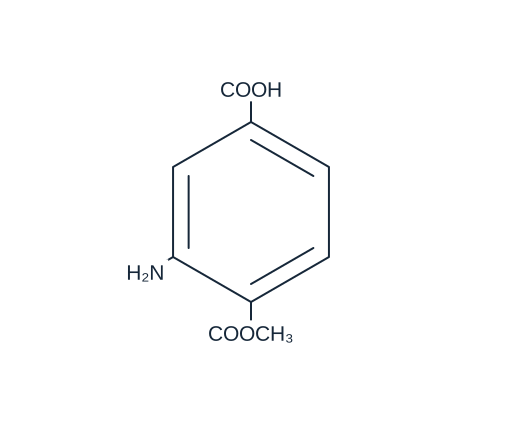
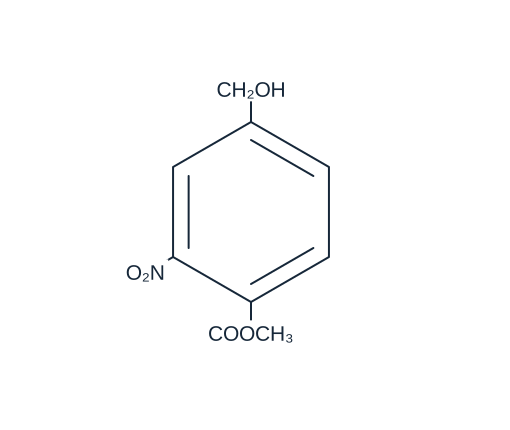
  1. IAT 2020, Chemistry, question 6 — option A
  2. IAT 2020, Chemistry, question 6 — option B
  3. IAT 2020, Chemistry, question 6 — option C
  4. IAT 2020, Chemistry, question 6 — option D
Answer & worked solution
Answer B
Borane generated from diborane in THF reduces carboxylic acids rapidly and selectively. The free –COOH group becomes –CH₂OH, while the ester and nitro substituents remain in the product selected here. This gives B. Reducing the ester or nitro group instead would miss the reagent's preferential reaction with the acid under these conditions.

Question 7

IAT 2020 · Chemistry
A first-order reaction is found to have a half-life of one second (sec). What will be the time required for 99.9% completion of the reaction?
  1. 0.693 sec
  2. 2 sec
  3. 10 sec
  4. 69.3 sec
Answer & worked solution
Answer C
A first-order reaction leaves fraction (1/2)t/t1/2(1/2)^{t/t_{1/2}} unreacted. For 99.9% conversion the remaining fraction is 0.0010.001. With a one-second half-life, t=log2(1000)=9.966t=\log_2(1000)=9.966\ldots s, approximately 10 s. This is about ten half-lives, not one thousand half-lives.

Question 8

IAT 2020 · Chemistry
The total number of nodes for a given principal quantum number 𝑛, and azimuthal quantum number , are
  1. sum of angular nodes and 𝑛+1 radial nodes
  2. sum of angular nodes and 𝑛1 radial nodes
  3. sum of +1 angular nodes and 𝑛1 radial nodes
  4. sum of +1 angular nodes and 𝑛+1 radial nodes
Answer & worked solution
Answer B
A hydrogen-like orbital has \ell angular nodes and n1n-\ell-1 radial nodes. Adding them gives a total of n1n-1. The radial count excludes the origin and infinity, where the wavefunction may vanish without defining an additional radial nodal surface.

Question 9

IAT 2020 · Chemistry
Which among the following is NOT correct?
  1. H3PO4 is a tribasic acid
  2. H3PO3 is a dibasic acid.
  3. H3PO2 is a monobasic acid.
  4. H3PO2 is a tribasic acid
Answer & worked solution
Answer D
For these phosphorus oxyacids, acidic hydrogens are those attached to oxygen. H3PO4\mathrm{H_3PO_4} has three O–H groups, H3PO3\mathrm{H_3PO_3} has two and H3PO2\mathrm{H_3PO_2} has one. P–H hydrogens are not counted in their ordinary acid basicity. Thus calling hypophosphorous acid tribasic is incorrect.

Question 10

IAT 2020 · Chemistry
Which among the following is NOT correct regarding the first ionization potential (IP1) of period 𝐼𝐼𝐼 elements 𝑀𝑔,𝐴𝑙,𝑆𝑖,𝑃 and 𝑆 ?
  1. 𝑃<𝑆
  2. 𝐴𝑙<𝑀𝑔
  3. 𝐴𝑙<𝑆𝑖
  4. 𝑆𝑖<𝑃
Answer & worked solution
Answer A
Phosphorus has a half-filled 3p33p^3 subshell. Sulfur has 3p43p^4, with one paired set of electrons; removing a paired electron is relatively easier. Consequently the first ionisation energy of P is greater than that of S, so P<SP<S is the incorrect comparison. The other stated inequalities agree with the period's trend and the Mg–Al subshell exception.

Question 11

IAT 2020 · Chemistry
Which one of the following aqueous solutions gives the most intense colour?
  1. 0.1M[Mn(H2O)6]Cl2
  2. 0.1M[Mn(NH3)6]Cl3
  3. 0.1M[Mn(NH3)5Cl]Cl
  4. 0.1MKMnO4
Answer & worked solution
Answer D
Permanganate has intense ligand-to-metal charge-transfer absorption, producing a strong purple colour even though Mn(VII) is d0d^0. Such allowed charge-transfer transitions are much stronger than ordinary, often forbidden, dddd transitions in the listed manganese complexes. The number of unpaired electrons alone does not determine colour intensity.

Question 12

IAT 2020 · Chemistry
What is the correct relation between the heat capacity at constant volume (𝐶𝑣) and heat capacity at constant pressure (𝐶𝑝) for an ideal gas? ( 𝑅= Universal gas constant)
  1. 𝐶𝑣+𝐶𝑝=2𝑅
  2. 𝐶𝑃𝐶𝑉=𝑅
  3. 𝐶𝑣𝐶𝑝=2𝑅
  4. 𝐶𝑣+𝐶𝑝=𝑅
Answer & worked solution
Answer B
For one mole of ideal gas, H=U+RTH=U+RT. Differentiating with respect to temperature gives the molar relation Cp=Cv+RC_p=C_v+R. Hence CpCv=RC_p-C_v=R. If the symbols instead meant total heat capacities of n moles, the difference would be nRnR; the options use molar heat capacities.

Question 13

IAT 2020 · Chemistry

 The number of unpaired electron(s) in the square planar complex [Ni(CN)4]2 is/are  :

  1. 2
  2. 1
  3. 4
  4. 0
Answer & worked solution
Answer D
In [Ni(CN)4]2[\mathrm{Ni(CN)_4}]^{2-}, nickel is +2+2 and has a d8d^8 configuration. The strong-field square-planar splitting leaves the highest dx2y2d_{x^2-y^2} orbital empty while the lower four d orbitals are doubly occupied. All electrons are paired, so the number of unpaired electrons is zero.

Question 14

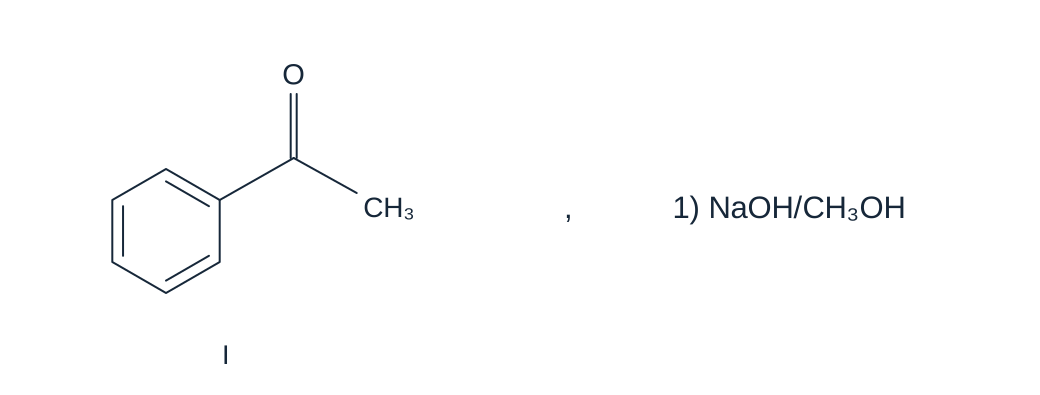
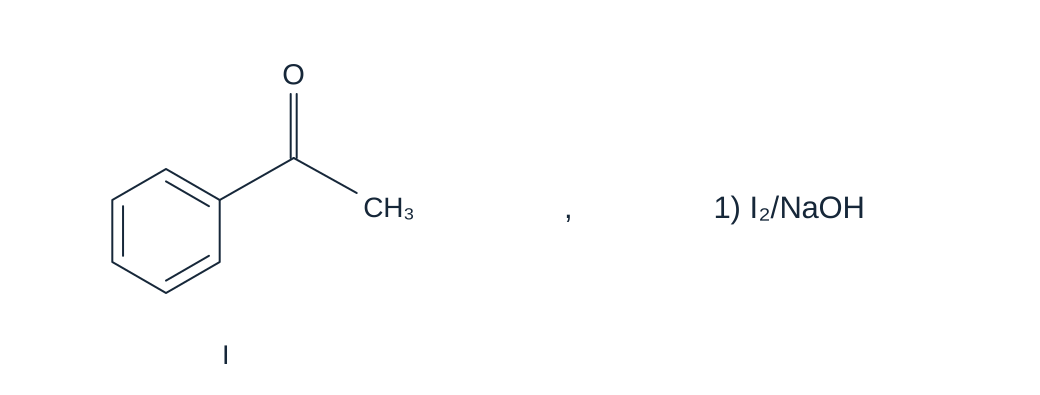
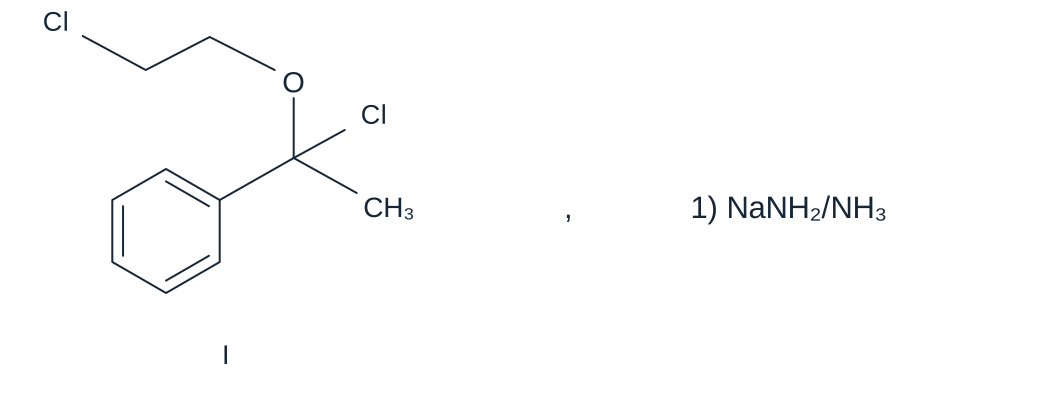
IAT 2020 · Chemistry

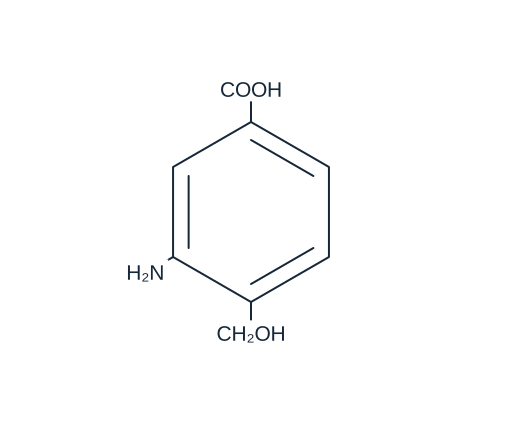
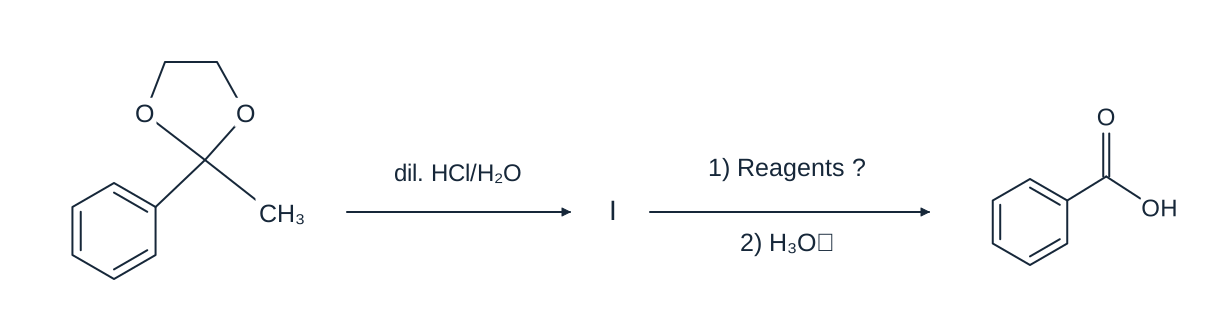
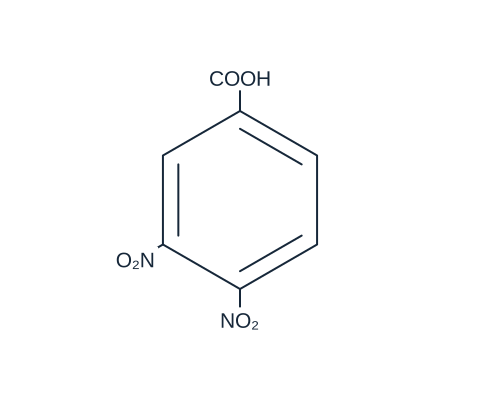
 Select the most appropriate compound I and the reagents for the synthesis of compound II 

IAT 2020, Chemistry, question 14 — question diagram
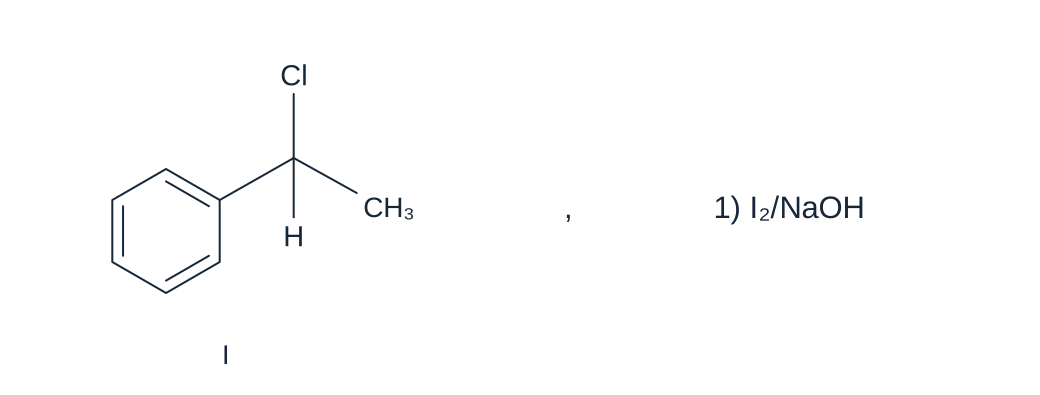
  1. IAT 2020, Chemistry, question 14 — option A
  2. IAT 2020, Chemistry, question 14 — option B
  3. IAT 2020, Chemistry, question 14 — option C
  4. IAT 2020, Chemistry, question 14 — option D
Answer & worked solution
Answer C
The cyclic ketal first hydrolyses in aqueous acid to acetophenone I. A methyl ketone undergoes the haloform reaction with iodine and base, producing benzoate and iodoform. Acidification then gives benzoic acid II. Therefore I must be acetophenone and the reagent set must include I2/NaOH\mathrm{I_2/NaOH}, as in C.

Question 15

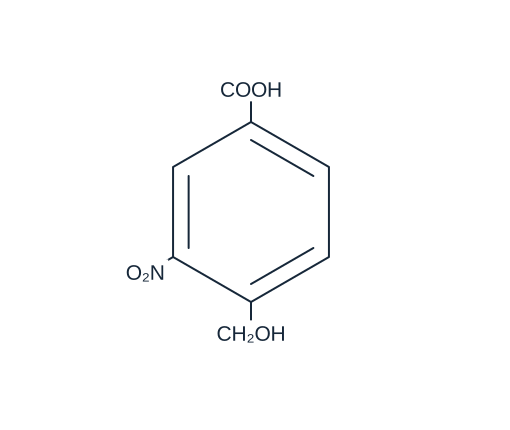
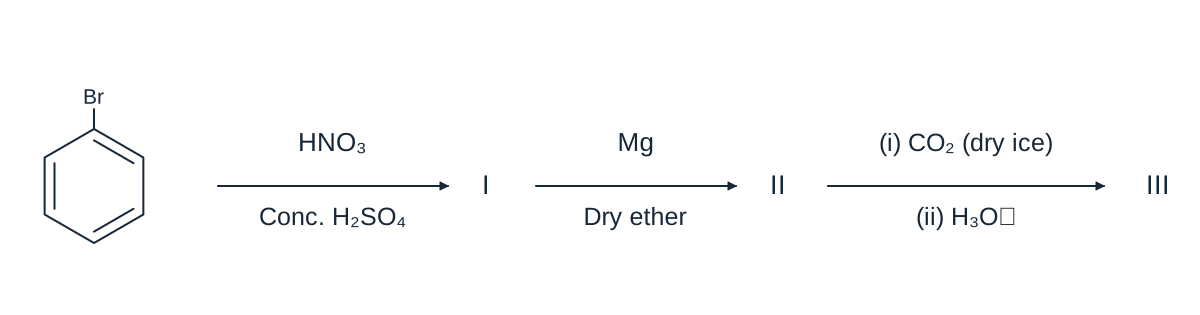
IAT 2020 · Chemistry

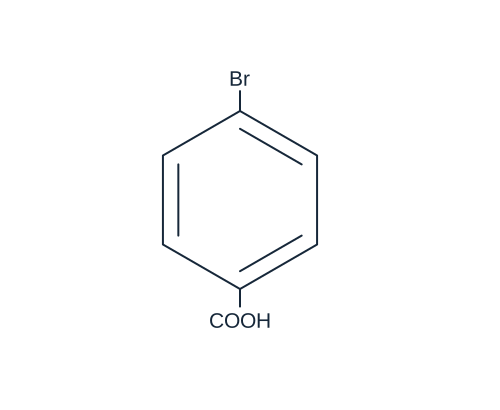
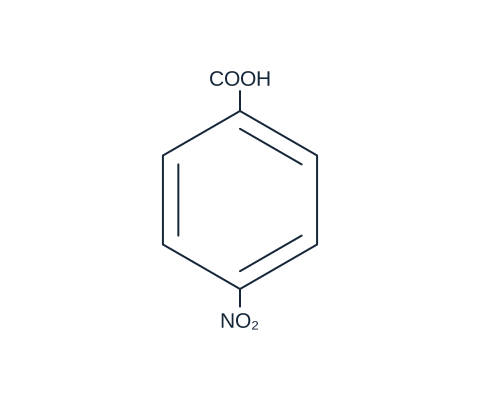
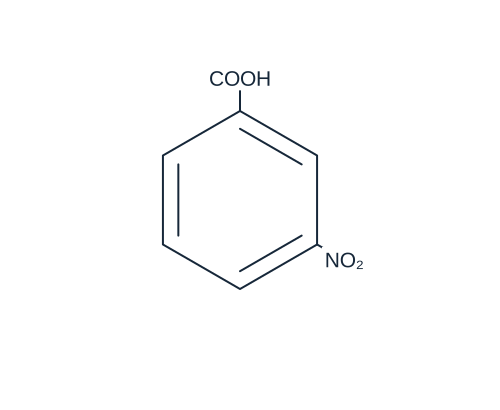
 Identify the final major product III in the following reaction sequence: 

IAT 2020, Chemistry, question 15 — question diagram
  1. IAT 2020, Chemistry, question 15 — option A
  2. IAT 2020, Chemistry, question 15 — option B
  3. IAT 2020, Chemistry, question 15 — option C
  4. IAT 2020, Chemistry, question 15 — option D
Answer & worked solution
Answer C · qualification below

Intended formal product; the unprotected nitro group makes routine Grignard preparation problematic.

The formal exam sequence first nitrates bromobenzene mainly para to Br. Replacing that Br by a magnesium-halide group, then carboxylating and acidifying, would give para-nitrobenzoic acid, C. There is a chemical limitation: an unprotected nitro group is incompatible with routine Grignard preparation using Mg in ether. Thus C is the intended formal product, but the stated sequence should not be taught as a reliable practical synthesis without special conditions or a redesigned route.

Mathematics

Question 1

IAT 2020 · Mathematics
If S is the set of all points (𝑥,𝑦) satisfying the equation sin𝑥=cos𝑦, then which of the following statements is correct?
  1. 𝑆 contains all points of a parabola.
  2. 𝑆 contains all points of a circle.
  3. 𝑆 contains all points of a hyperbola.
  4. 𝑆 contains all points of a straight line.
Answer & worked solution
Answer D
Use cosy=sin(π/2y)\cos y=\sin(\pi/2-y). One family of solutions is x=π/2y+2kπx=\pi/2-y+2k\pi, so every point on each line x+y=π/2+2kπx+y=\pi/2+2k\pi belongs to S. Another family is also linear. Thus S contains an entire straight line, making D correct.

Question 2

IAT 2020 · Mathematics
If 𝐴=[1𝑎001𝑏001], then the determinant of 𝐼𝐴+𝐴2𝐴3+𝐴4+𝐴2020 is
  1. 2020
  2. 𝑎2020𝑏𝑎2019+𝑏2019𝑎+𝑏2020
  3. 20203
  4. 1
Answer & worked solution
Answer D
A and every power of A are upper triangular with diagonal entries 1. The alternating sum has 2021 terms, beginning and ending with a positive sign. Each diagonal entry is therefore 11+1+1=11-1+1-\cdots+1=1. Its determinant, the product of the three diagonal entries, is 1, regardless of a and b.

Question 3

IAT 2020 · Mathematics
Let 𝑆={(𝑎,𝑏):𝑎,𝑏𝑄} and be the line 𝑦=𝑚𝑥+𝑐. Which of the following statements is not correct?
  1. If passes through two points of 𝑆, then 𝑚 must be rational.
  2. If 𝑚 is rational and 𝑐 is irrational, then passes through at least one point of 𝑆.
  3. If passes through exactly one point of 𝑆, then 𝑚 must be irrational.
  4. If 𝑚 is irrational and 𝑐 is rational, then passes through exactly one point of 𝑆.
Answer & worked solution
Answer B
If m and x are rational while c is irrational, then mx+cmx+c is irrational. No point on that line can have both coordinates rational, so B is false. Two distinct rational points give a rational slope; with irrational slope and rational intercept, the only rational point is (0,c)(0,c). These observations verify the other statements.

Question 4

IAT 2020 · Mathematics

If 𝑝(𝑡)=𝑡(𝑡1)(𝑡2019)2019!, then the value of

01(1𝑡+1+1𝑡+2++1𝑡+2020)𝑝(𝑡1)𝑑𝑡

is:

  1. 20192
  2. 2019
  3. 20202
  4. 2020
Answer & worked solution
Answer C
Define F(t)=p(t1)=j=12020(t+j)/2019!F(t)=p(-t-1)=\prod_{j=1}^{2020}(t+j)/2019!, since the number of minus signs is even. Its logarithmic derivative is F/F=j=120201/(t+j)F'/F=\sum_{j=1}^{2020}1/(t+j). The integral is therefore F(1)F(0)=2021!/2019!2020!/2019!=20202F(1)-F(0)=2021!/2019!-2020!/2019!=2020^2.

Question 5

IAT 2020 · Mathematics
Let 𝑎,𝑏 be nonzero real numbers. If 𝑝(𝑥)=𝑥𝑛+𝑐𝑛1𝑥𝑛1++𝑐0, where 𝑐𝑛1,,𝑐0 are integers and 𝑛3, then which of the following statements is correct?
  1. If 𝑎+𝑖𝑏 is a root of 𝑝(𝑥), then 𝑛 must be even.
  2. If 𝑎 is a root of 𝑝(𝑥), then 𝑛 must be odd.
  3. If 𝑎+𝑖𝑏 is a root of 𝑝(𝑥), then (𝑎+𝑖𝑏)2 can never be a root of 𝑝(𝑥).
  4. If 𝑎 is a root of 𝑝(𝑥), then 𝑎 must be an integer.
Answer & worked solution
No valid listed option

No valid listed option for the stated real-number condition.

None of the four statements is always true for the real numbers stated. A fails for the cubic (x1)(x22x+2)(x-1)(x^2-2x+2), which has root 1+i1+i. B and D both fail for (x22)(x2+1)(x^2-2)(x^2+1), an even-degree monic integer polynomial with real root 2\sqrt2. C fails for (x22x+2)(x2+4)(x^2-2x+2)(x^2+4): both 1+i1+i and (1+i)2=2i(1+i)^2=2i are roots. D would follow from the rational-root theorem if a were required to be rational, but the reproduced question says real. The source's D key is therefore not valid for the wording shown.

Question 6

IAT 2020 · Mathematics
The number of skew-symmetric matrices 𝐴=[𝑎𝑖𝑗]3×3, where 𝑎𝑖𝑗{3,2,1,0,1,2,3} is:
  1. 73
  2. 37
  3. 213
  4. 76
Answer & worked solution
Answer A
Skew-symmetry requires AT=AA^T=-A. Every diagonal entry is zero, while the three entries above the diagonal can each be chosen freely from the seven allowed values. The corresponding entries below are then fixed as their negatives. Thus there are 737^3 matrices.

Question 7

IAT 2020 · Mathematics

 Define binary operation * on 𝑄 by 𝑎𝑏=𝑎+𝑏3. The inverse of 2 with respect to * is 

  1. 4
  2. 2
  3. 3
  4. 5
Answer & worked solution
Answer A
The identity e must satisfy ae=aa*e=a, so a+e3=aa+e-3=a and e=3e=3. The inverse b of 2 must then satisfy 2b=32*b=3, giving 2+b3=32+b-3=3 and b=4b=4. Checking 424*2 also gives the identity 3.

Question 8

IAT 2020 · Mathematics

    Let [𝑥] denote the greatest integer less than or equal to 𝑥. The number of positive integer solutions of the equation

    [𝑥19]=[𝑥20]

    are:

  1. 190
  2. 188
  3. 189
  4. 187

Transcription note: Removed a stray solution fragment appended to the option; the scanned paper gives only 187.

Answer & worked solution
Answer C
Let the common floor be k. Then 20kx19k+1820k\le x\le19k+18. For k=0k=0, the positive solutions are 1 through 18. For k=1,,18k=1,\ldots,18, there are 19k19-k solutions; larger k give none. The total is 18+(18+17++1)=18+171=18918+(18+17+\cdots+1)=18+171=189.

Question 9

IAT 2020 · Mathematics

Let 𝑓: and 𝑔: be two functions such that

𝑔𝑓(𝑥)={𝑥2, if 𝑥0𝑒𝑥1, if 𝑥<0

Then which of the following statements is correct?

  1. 𝑔 is onto.
  2. 𝑓 is onto.
  3. 𝑔 is one-one.
  4. 𝑓 is one-one.
Answer & worked solution
Answer D
The composite is strictly increasing on each side of zero. Its negative-side outputs lie in (1,0)(-1,0) and its nonnegative-side outputs in [0,)[0,\infty), so it is also injective across the join. If f(x1)=f(x2)f(x_1)=f(x_2), applying g gives equal composite values and therefore x1=x2x_1=x_2. Thus f must be one-to-one. The properties listed for g or surjectivity of f are not forced.

Question 10

IAT 2020 · Mathematics

𝐹(𝑥)=0𝑒𝑥(𝑡3+2𝑡2𝑡2)𝑑𝑡, then for how many real numbers 𝑥 does 𝐹(𝑥)=0 ?

  1. 0
  2. 3
  3. 2
  4. 1
Answer & worked solution
Answer D
By the fundamental theorem and chain rule, F(x)=ex[(ex)3+2(ex)2ex2]F'(x)=e^x[(e^x)^3+2(e^x)^2-e^x-2]. The cubic factors as (t+2)(t+1)(t1)(t+2)(t+1)(t-1). Since t=ext=e^x is positive, only t=1t=1 is possible, giving exactly one real solution, x=0x=0.

Question 11

IAT 2020 · Mathematics

Let 𝐶 be a circle which passes through (2,1) and (0,3) and whose centre lies on the line 𝑦𝑥=1. Then which of the following points lies on 𝐶 ?

  1. (2+1,1)
  2. (1,2+1)
  3. (1,3+1)
  4. (1,31)
Answer & worked solution
Answer C
Write the centre as (h,h+1)(h,h+1). Equating its squared distances from (2,1)(-2,1) and (0,3)(0,3) gives (h+2)2+h2=h2+(h2)2(h+2)^2+h^2=h^2+(h-2)^2, so h=0h=0. The circle is x2+(y1)2=4x^2+(y-1)^2=4. At x=1x=1, y=1±3y=1\pm\sqrt3, and C is the listed point satisfying this equation.

Question 12

IAT 2020 · Mathematics
For what value of 𝑡 does 𝑓(𝑥)=𝑥3+𝑡𝑥2+(2𝑡)𝑥3 have only real roots?
  1. 𝑡=0.
  2. 𝑡=4.
  3. 𝑡=2.
  4. 𝑡=1
Answer & worked solution
Answer B
The polynomial always has root 1 and factors as (x1)[x2+(t+1)x+3](x-1)[x^2+(t+1)x+3]. The remaining two roots are real when (t+1)2120(t+1)^2-12\ge0. Among t=0,4,2,1t=0,4,2,-1, only t=4t=4 satisfies this condition. Repeated roots, if present at a boundary value, would also count as real.

Question 13

IAT 2020 · Mathematics
If 𝑓(𝑥)=𝑎𝑥2+𝑏𝑥+𝑐 and 𝑓(1𝑛)=𝑛+1𝑛2 for all 𝑛𝑁, then what is the value of lim𝑥0𝑓(𝑥) ?
  1. 2
  2. 0
  3. 1
  4. -1
Answer & worked solution
Answer C
Multiplying the given identity by n2n^2 gives a+bn+cn2=n+1a+bn+cn^2=n+1 for infinitely many positive integers n. The two polynomials must be identical, so a=1a=1, b=1b=1 and c=0c=0. Therefore f(x)=2x+1f'(x)=2x+1 and its limit at zero is 1.

Question 14

IAT 2020 · Mathematics

A bag contains 8 balls, of which 5 are green and 3 are red. The probability that two balls chosen at random are of the same colour is :

  1. 12/28
  2. 14/28
  3. 15/28
  4. 13/28
Answer & worked solution
Answer D
Without replacement, there are (82)=28\binom82=28 unordered pairs. Same-colour pairs number (52)+(32)=10+3=13\binom52+\binom32=10+3=13. The required probability is 13/2813/28. Green–red pairs are the complementary 15 outcomes.

Question 15

IAT 2020 · Mathematics
Consider the differential equation 𝑓+𝑝𝑓+𝑞𝑓=0 where 𝑝 and 𝑞 are constants, 𝑝2=4𝑞 and 𝑞0. If y is a nonzero solution of the equation, then which of the following statements is correct?
  1. (1+𝑥)𝑦 can never be a solution
  2. 𝑦2 can never be a solution
  3. 𝑦 can never be a solution
  4. 𝑥𝑦 can never be a solution
Answer & worked solution
Answer B
The repeated characteristic root is r=p/20r=-p/2\ne0, so every solution is (A+Bx)erx(A+Bx)e^{rx}. Squaring a nonzero solution produces (A+Bx)2e2rx(A+Bx)^2e^{2rx}, which cannot have that same exponential-linear form when r0r\ne0. In contrast, derivatives of solutions are solutions, and for y=erxy=e^{rx} both xyxy and (1+x)y(1+x)y are solutions. Hence only B is always true.

Physics

Question 1

IAT 2020 · Physics

The potential energy of a point particle of mass 𝑚 undergoing rectilinear motion along the 𝑥-axis is given by

𝑉(𝑥)=𝐴𝑥+𝐵𝑥2

What is the maximum speed attained by the particle if it starts from rest at 𝑥=𝐴𝐵 ?

  1. 3𝐴2𝐵𝑚

  2. 𝐴2𝐵𝑚

  3. 2𝐴𝐵𝑚

  4. 𝐴2𝐵𝑚

Answer & worked solution
Answer A · qualification below

The finite maximum assumes B > 0; the listed sign assumes A > 0.

For B>0B>0, complete the square: V=B(x+A/(2B))2A2/(4B)V=B(x+A/(2B))^2-A^2/(4B). Its minimum is A2/(4B)-A^2/(4B), while the initial energy is V(A/B)=2A2/BV(A/B)=2A^2/B. Thus mvmax2/2=9A2/(4B)mv_{\mathrm{max}}^2/2=9A^2/(4B) and vmax=3A/2Bmv_{\mathrm{max}}=3|A|/\sqrt{2Bm}. Option A assumes positive A, as the options implicitly do. If B is not positive, a bounded oscillation with this finite maximum is not guaranteed.

Question 2

IAT 2020 · Physics

Two identical containers kept at the same temperature carry the same gas with different molecular mean free paths 𝑙1 and 𝑙2. The gas from the first container is completely transferred into the second at the same temperature. What is the molecular mean free path of the resultant mixture in the second container?

  1. 𝑙1𝑙2𝑙1+𝑙2
  2. 𝑙1𝑙2
  3. 𝑙1+𝑙2
  4. 𝑙12+𝑙22
Answer & worked solution
Answer A
For the same gas, mean free path is inversely proportional to number density: =1/(2σn)\ell=1/(\sqrt2\,\sigma n). Equal container volumes imply that transferring all gas adds the number densities, n=n1+n2n=n_1+n_2. Therefore 1/=1/1+1/21/\ell=1/\ell_1+1/\ell_2, giving =12/(1+2)\ell=\ell_1\ell_2/(\ell_1+\ell_2).

Question 3

IAT 2020 · Physics

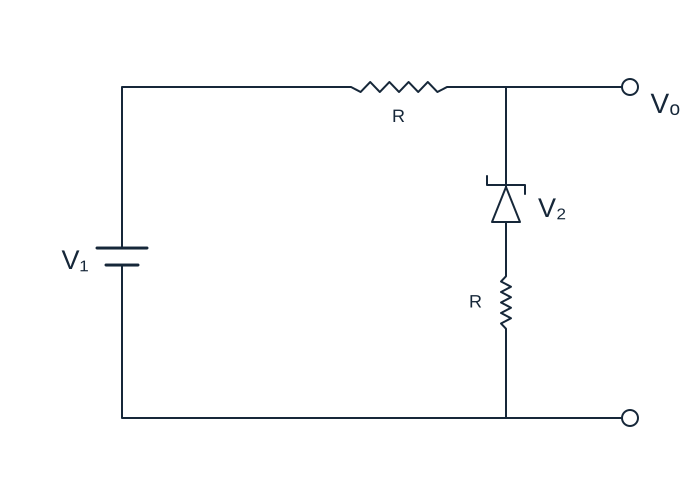
Consider the circuit with a Zener diode whose breakdown voltage 𝑉𝑧=4 V. What is the voltage 𝑉0 if 𝑉𝑖=20 V ?

IAT 2020, Physics, question 3 — question diagram
  1. 8V
  2. 12V
  3. 10V
  4. 16V
Answer & worked solution
Answer B
In reverse breakdown the ideal Zener maintains 4 V across itself. The remaining 204=1620-4=16 V is shared by the two equal series resistors, so each drops 8 V. The output includes the Zener plus the lower resistor: V0=4+8=12V_0=4+8=12 V. It is not merely the Zener voltage because the output terminals span both components.

Question 4

IAT 2020 · Physics

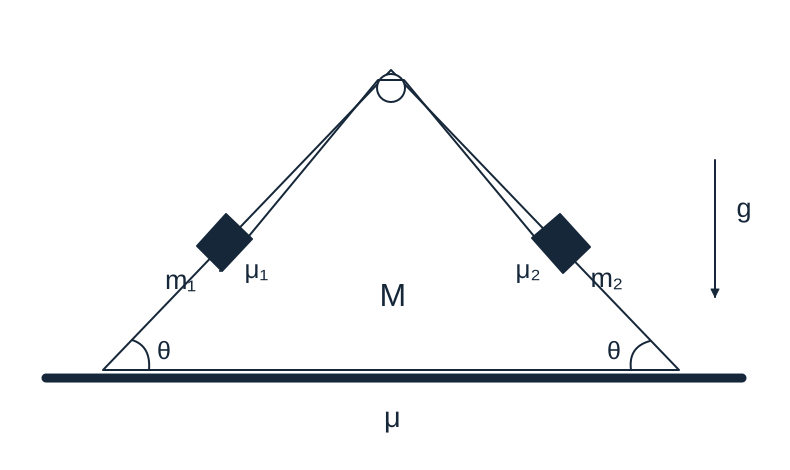
Consider a mass-pulley system as shown in the figure. There is a wedge of mass 𝑀 and equal wedge angles 𝜃 lying on a rigid horizontal table. The coefficient of friction between the wedge and the table is 𝜇. There are two blocks of mass 𝑚1 and 𝑚2 lying on the incline of the wedge. The coefficients of friction between the blocks and wedge are 𝜇1 and 𝜇2 as shown in the figure. Consider 𝑚1>𝑚2 and the coefficients of friction ( 𝜇,𝜇1 and 𝜇2 ) to be less than tan𝜃. Gravity is acting downwards with acceleration due to gravity 𝑔. What should be the value of 𝑚1𝑚2 so that the system is in equilibrium?

IAT 2020, Physics, question 4 — question diagram
  1. 𝜇1𝜇2cos𝜃+sin𝜃sin𝜃𝜇cos𝜃
  2. 𝜇1cos𝜃+sin𝜃sin𝜃𝜇2cos𝜃
  3. 𝜇2cos𝜃+sin𝜃sin𝜃𝜇1cos𝜃
  4. 𝜇cos𝜃+sin𝜃sin𝜃𝜇1cos𝜃
Answer & worked solution
Answer C · qualification below

The listed result is the limiting upper mass ratio, not every possible equilibrium ratio.

At the limiting condition where the heavier block is about to descend, friction on m1m_1 acts up its slope and friction on m2m_2 acts down its slope. Equal tension gives m1g(sinθμ1cosθ)=m2g(sinθ+μ2cosθ)m_1g(\sin\theta-\mu_1\cos\theta)=m_2g(\sin\theta+\mu_2\cos\theta). Their ratio is the expression in C. More generally, static equilibrium permits a range of ratios; C is its upper limiting value for the specified tendency. The table friction does not enter this balance for an entirely stationary system.

Question 5

IAT 2020 · Physics

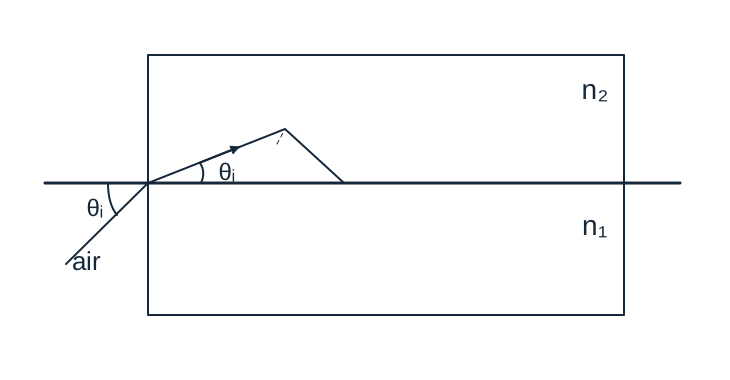
What is the maximum angle of incidence 𝜃𝑖 in the figure for which the ray would satisfy the condition for total internal reflection at the boundary of media of refractive indices 𝑛1 and 𝑛2, where 𝑛1>𝑛2 ?

+ IAT 2020, Physics, question 5 — question diagram
  1. 𝜃𝑖=sin1(𝑛12𝑛22)
  2. 𝜃𝑖=sin1(𝑛1𝑛2)2
  3. 𝜃𝑖=sin1(𝑛2𝑛1)
  4. 𝜃𝑖=sin1(𝑛12𝑛22)
Answer & worked solution
Answer D · qualification below

The inverse-sine expression requires its argument to be at most one.

Let the refracted ray make angle r with the horizontal normal at entry. Snell's law gives sinθi=n1sinr\sin\theta_i=n_1\sin r. Its incidence angle on the horizontal interface is 90r90^\circ-r. At the limiting critical condition, cosr=n2/n1\cos r=n_2/n_1, so sinθi=n12n22\sin\theta_i=\sqrt{n_1^2-n_2^2}. This gives D when the square root is at most one. Otherwise all accessible entry angles satisfy the condition; strict total reflection occurs on the appropriate side of the critical boundary.

Question 6

IAT 2020 · Physics
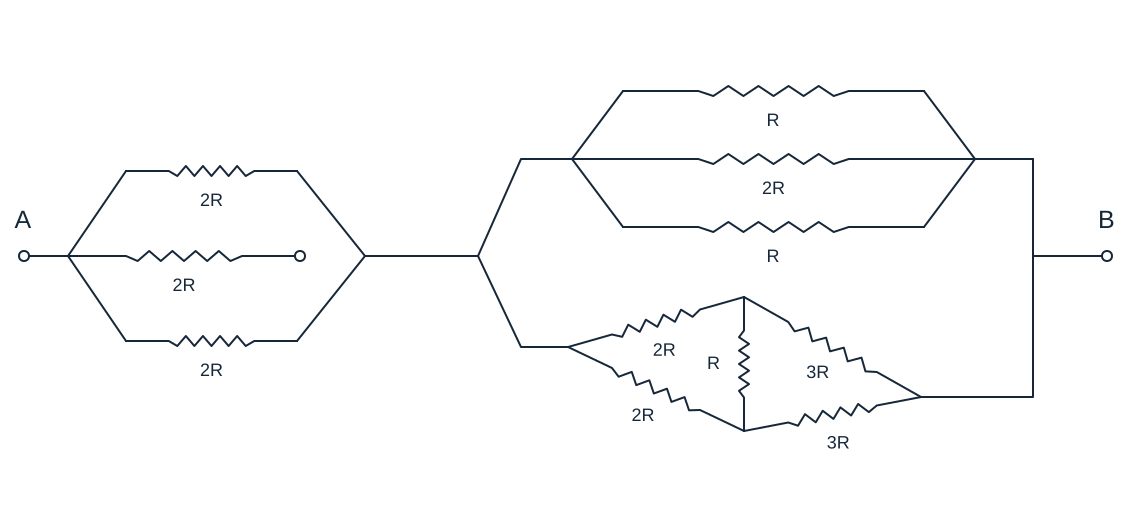
What is the equivalent resistance between the points A and B in the figure?IAT 2020, Physics, question 6 — question diagram
  1. 39𝑅/10
  2. 39𝑅/29
  3. 68𝑅/87
  4. 87𝑅/68

Transcription note: Restored the circuit from the scanned 2020 paper; the uppermost right resistor is R, not 2R as in the secondary diagram.

Answer & worked solution
Answer B
The dangling middle resistor on the left carries no current, leaving 2R2R=R2R\parallel2R=R. In the upper right group, R2RR=2R/5R\parallel2R\parallel R=2R/5. The lower bridge is balanced, so its middle resistor carries no current and the two 5R5R paths give 5R/25R/2. These two right-hand groups in parallel give 10R/2910R/29. Adding the left R yields 39R/2939R/29. The uppermost resistor label has been restored to R from the scanned paper; a secondary diagram incorrectly labelled it 2R.

Question 7

IAT 2020 · Physics
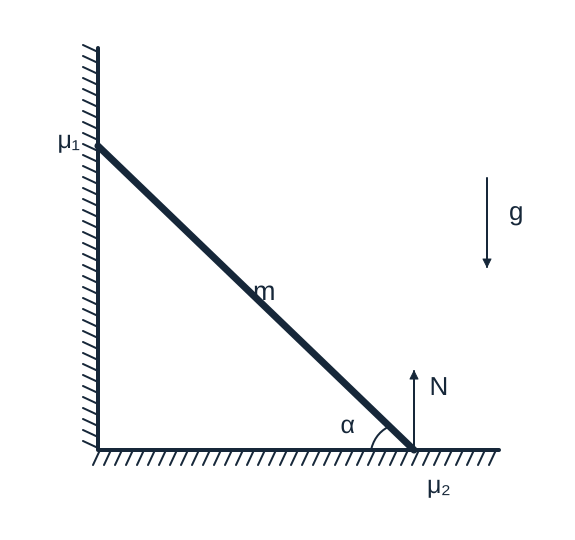
Consider a solid rod of mass 𝑚 and uniform density resting against a vertical wall and horizontal floor as shown in the figure. The coefficients of friction of the rod with the wall and with the floor are given to be 𝜇1 and 𝜇2 respectively. Gravity is acting downwards with acceleration due to gravity 𝑔. What should be the value of the inclination angle 𝛼 so that the rod stays in equilibrium? IAT 2020, Physics, question 7 — question diagram
  1. tan1(𝜇1𝜇2)
  2. tan1(1𝜇22𝜇1𝜇2)
  3. tan1(1𝜇1𝜇22𝜇2)
  4. tan1(μ2/μ1)\tan^{-1}(\mu_2/\mu_1)

Transcription note: Removed a stray force-balance equation appended to option D; it is not part of that option in the scanned paper.

Answer & worked solution
Answer C · qualification below

The result is a limiting minimum angle, not a unique static-equilibrium angle.

At limiting equilibrium, horizontal balance gives Nw=μ2NfN_w=\mu_2N_f, and vertical balance gives Nf+μ1Nw=mgN_f+\mu_1N_w=mg. Taking moments about the lower end gives NwLsinα+μ1NwLcosα=(mgL/2)cosαN_wL\sin\alpha+\mu_1N_wL\cos\alpha=(mgL/2)\cos\alpha. Eliminate the reactions to obtain tanα=(1μ1μ2)/(2μ2)\tan\alpha=(1-\mu_1\mu_2)/(2\mu_2). C is the limiting minimum angle when this is positive; larger angles can also remain at rest. It is not a unique angle for all static equilibria.

Question 8

IAT 2020 · Physics
The charge distribution inside a sphere of radius 𝑅=2𝑎/𝑏 is given by the volume charge density 𝜌=𝑎𝑟2𝑏𝑟3, where 𝑎 and 𝑏 are constants and 𝑟 is the radial distance from the center of the sphere. At what distance from the center of the sphere, will the electric field go to zero?
  1. 4𝑎/3𝑏
  2. 3𝑎/2𝑏
  3. 𝑎/𝑏
  4. 6𝑎/5𝑏
Answer & worked solution
Answer D
The charge enclosed within radius r is Q(r)=4π0r(as2bs3)s2ds=4π(ar5/5br6/6)Q(r)=4\pi\int_0^r(as^2-bs^3)s^2\,ds=4\pi(ar^5/5-br^6/6). Gauss's law gives E(r)=ar3/(5ϵ0)br4/(6ϵ0)E(r)=ar^3/(5\epsilon_0)-br^4/(6\epsilon_0). Apart from the centre, it vanishes at r=6a/(5b)r=6a/(5b), which lies inside R=2a/bR=2a/b for the intended positive constants.

Question 9

IAT 2020 · Physics

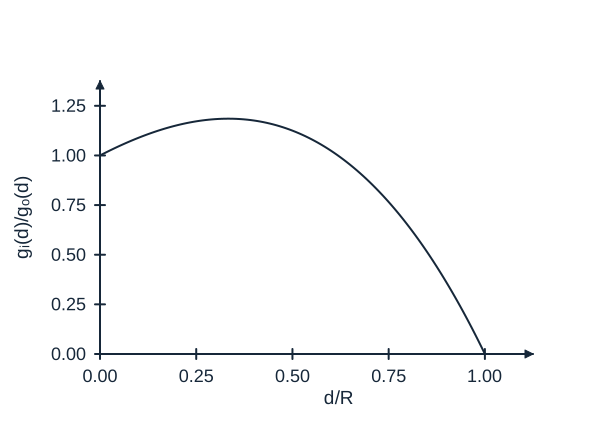
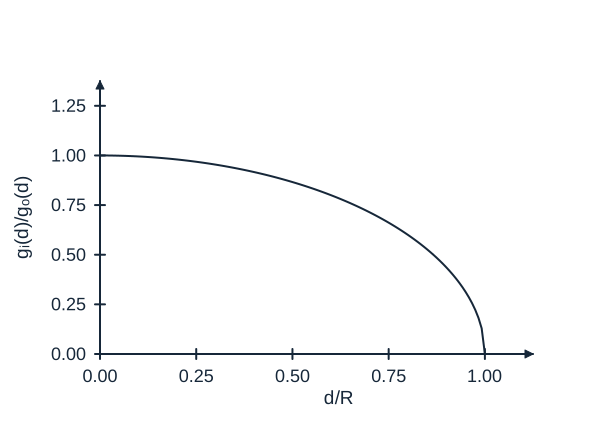
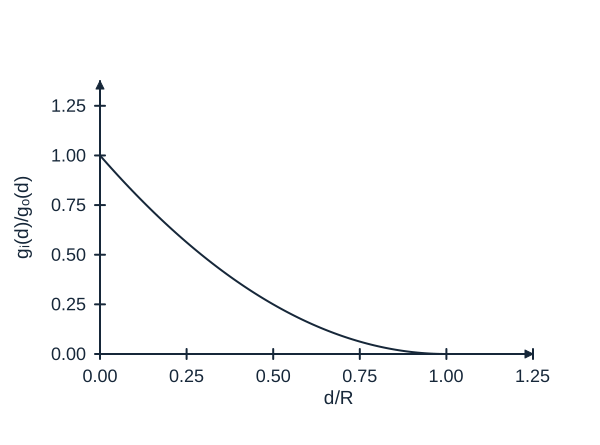
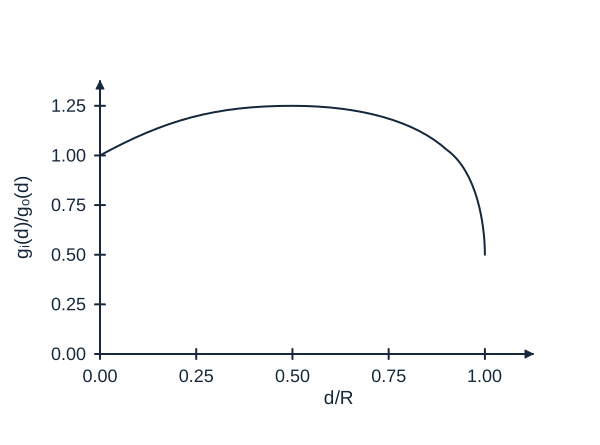
The acceleration due to earth's gravity on a point particle at a height above the surface of the earth is denoted by 𝑔𝑜() and at a depth 𝑑 below the surface of the earth is denoted by 𝑔𝑖(𝑑). Consider the earth to be a sphere of radius 𝑅 with uniform mass density. Which of the following correctly represents the ratio 𝑔𝑖(𝑑)/𝑔𝑜(𝑑) ?

  1. IAT 2020, Physics, question 9 — option A
  2. IAT 2020, Physics, question 9 — option B
  3. IAT 2020, Physics, question 9 — option C
  4. IAT 2020, Physics, question 9 — option D
Answer & worked solution
Answer A
For a uniform Earth, gi(d)=gs(1d/R)g_i(d)=g_s(1-d/R), while go(d)=gs/(1+d/R)2g_o(d)=g_s/(1+d/R)^2. With x=d/Rx=d/R, their ratio is (1x)(1+x)2(1-x)(1+x)^2. It starts at 1, reaches a maximum 32/2732/27 at x=1/3x=1/3, and falls to zero at x=1x=1. A has these features; D has an incorrect near-surface curvature and location of the peak.

Question 10

IAT 2020 · Physics

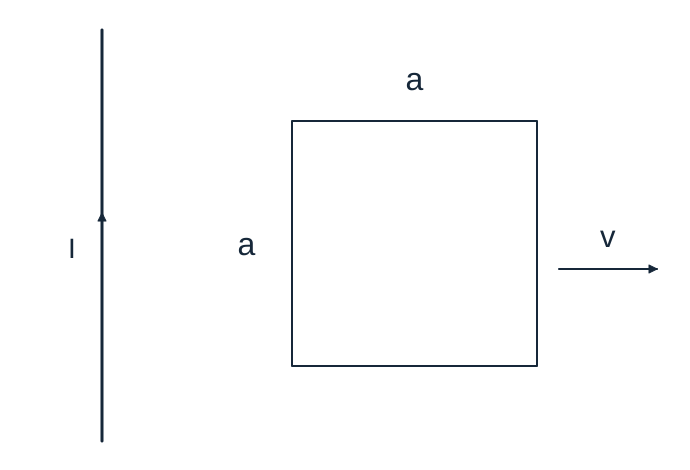
Consider an infinite one-dimensional wire carrying a uniform current 𝐼 as shown in the figure. A square loop of side 𝑎 is initially placed such that the center of the loop is at a distance 𝑅 from the wire, where 𝑅>𝑎2. The square loop is then moved rightwards with a uniform speed as shown in the figure. What is the induced emf in the loop as a function of time 𝑡 ?

IAT 2020, Physics, question 10 — question diagram

  1. 𝜇0𝐼𝑎2𝑣2𝜋[(𝑅+𝑣𝑡)2𝑎24]
  2. 3𝜇0𝐼𝑎2𝑣4𝜋[(𝑅+𝑣𝑡)2𝑎24]
  3. 𝜇0𝐼𝑎2𝑣4𝜋[(𝑅+𝑣𝑡)2𝑎24]
  4. 3𝜇0𝐼𝑎2𝑣2𝜋[(𝑅+𝑣𝑡)2𝑎24]
Answer & worked solution
Answer A
At time t the loop centre is s=R+vts=R+vt from the wire. Integrating B=μ0I/(2πr)B=\mu_0I/(2\pi r) over the square gives Φ=(μ0Ia/2π)log[(s+a/2)/(sa/2)]\Phi=(\mu_0Ia/2\pi)\log[(s+a/2)/(s-a/2)]. Differentiate and take the magnitude: E=μ0Ia2v/[2π(s2a2/4)]|\mathcal E|=\mu_0Ia^2v/[2\pi(s^2-a^2/4)], matching A. Lenz's law determines the circulation direction.

Question 11

IAT 2020 · Physics

The electric field of an electromagnetic wave is given by 𝐸(𝑥,𝑡)=𝐸0𝑧ˆcos(𝑎𝑥+𝑏𝑡)

If 𝑐 is the speed of light, then the value of 𝑏 is

  1. 𝑎𝑐
  2. 2𝜋𝑎𝑐
  3. 2𝑎𝑐
  4. 𝑎𝑐2𝜋
Answer & worked solution
Answer A
The wave equation requires ω2=c2k2\omega^2=c^2k^2. In the phase ax+btax+bt, a is the wave number and b the angular frequency, so b=ca|b|=c|a|. With the positive quantities used in the options, b=acb=ac. The plus sign between position and time indicates propagation in the negative x direction.

Question 12

IAT 2020 · Physics

An electron of mass 𝑚𝑒 has a speed 𝑢𝑛 in the 𝑛th  Bohr orbit of a hydrogen atom. The normalized speed 𝑉𝑛 is given as 𝑉𝑛=𝑢𝑛/𝑐=1/685 and the mass of the electron in the units of energy is given as 𝑀𝑒=𝑚𝑒𝑐2=0.51×10⁶eV, where 𝑐 is the velocity of light in a vacuum. It is given that 𝑒22𝜖0𝑐=1/137. The Planck's constant h is given as 4.13×10¹⁵eVsec. The electron makes a transition from 𝑛th  orbit to the ground state of the atom. What is the frequency of the emitted photon?

  1. 3.29×10¹⁵ Hz
  2. 2.47×10¹⁵ Hz
  3. 2.93×10¹⁵ Hz
  4. 3.16×10¹⁵ Hz
Answer & worked solution
Answer D
The Bohr speed is un/c=α/n=1/(137n)u_n/c=\alpha/n=1/(137n). Equating this to 1/6851/685 gives n=5n=5. The ground-state binding energy is Meα2/213.586M_e\alpha^2/2\approx13.586 eV. The transition releases 13.586(11/25)13.04313.586(1-1/25)\approx13.043 eV, so ν=ΔE/h3.16×1015\nu=\Delta E/h\approx3.16\times10^{15} Hz.

Question 13

IAT 2020 · Physics
In the photoelectric effect experiment, the frequency of the incident light is changed from red to blue while keeping the energy per unit area per unit time of the incident radiation fixed. What will happen to the saturation current?
  1. Saturation current doesn't depend on frequency and therefore will be same for red and blue light
  2. Saturation current depends on intensity and therefore will be same for red and blue light
  3. Saturation current for blue colour light is larger than red colour light
  4. Saturation current for blue colour light is smaller than red colour light
Answer & worked solution
Answer D · qualification below

The comparison assumes equal quantum efficiency and both colours above threshold.

At fixed incident power per unit area I, the photon arrival rate is I/(hν)I/(h\nu). Blue photons carry more energy, so fewer arrive per second than red photons. Assuming both colours exceed threshold and have the same photoemission efficiency, the saturation current is smaller for blue light. A frequency-dependent quantum efficiency would require additional material data; the stated comparison uses the standard one-photon model.

Question 14

IAT 2020 · Physics
An ideal rigid diatomic gas undergoes expansion at constant pressure when Δ𝑄 heat is added to it. What is the ratio of the change in the internal energy Δ𝑈 to the heat supplied Δ𝑄 ?
  1. Δ𝑈Δ𝑄=35
  2. Δ𝑈Δ𝑄=57
  3. Δ𝑈Δ𝑄=79
  4. Δ𝑈Δ𝑄=23
Answer & worked solution
Answer B
A rigid diatomic gas has five active degrees of freedom, so CV=5R/2C_V=5R/2 and CP=7R/2C_P=7R/2. At constant pressure, ΔQ=nCPΔT\Delta Q=nC_P\Delta T, while ΔU=nCVΔT\Delta U=nC_V\Delta T. Their ratio is CV/CP=5/7C_V/C_P=5/7. Vibrational modes are excluded by the rigid-diatomic assumption.

Question 15

IAT 2020 · Physics
The fundamental constants are given to be permittivity constant (𝜖0), Planck's constant (), velocity of light (𝑐), Newton's constant (𝐺) and Boltzmann's constant (𝑘𝐵). Which of the following quantities constructed out of the above constant has the dimensions of an electric charge?
  1. 𝐺𝜖03
  2. 𝑐
  3. 𝑘𝐵𝑐
  4. 𝜖0𝑐
Answer & worked solution
Answer D
From Coulomb's law, [ϵ0]=Q2T2/(ML3)[\epsilon_0]=Q^2T^2/(ML^3). Also [h]=ML2/T[h]=ML^2/T and [c]=L/T[c]=L/T. Multiplying gives [ϵ0hc]=Q2[\epsilon_0hc]=Q^2, so ϵ0hc\sqrt{\epsilon_0hc} has the dimensions of charge. The other proposed combinations do not supply the required electrical dimension.

Read the review method and correction register →

Privacy and analytics

IISER.in is an independent study guide by Mathiit. With your permission, we use Google Analytics through Google Tag Manager to understand visits, paper reading, solution use and clicks to Mathiit.

Analytics uses cookies and information such as the page visited, device, approximate location and referral source. We record the paper year, subject and question number when you use a solution. We do not send the words you type in the paper search, names, email addresses or phone numbers in our study events.

We keep event data for up to 14 months. Advertising personalisation and Google signals are disabled for this setup. Our hosting provider may keep routine security and access logs independently of optional analytics.

Your choice is remembered on this browser for six months. You can change it here at any time. Declining does not affect access to questions or solutions. Links to other sites follow their own privacy practices.

How Google uses data from sites using its services. For a privacy query, contact Mathiit using the details on our About & contact page.