PREVIOUS-YEAR QUESTIONS

IISER IAT 2025 question paper with solutions

60 questions across Biology, Chemistry, Mathematics and Physics. Read the retyped questions, attempt them independently and open each freshly written solution when ready.

Try each question before opening its answer. Answer letters refer to the option order displayed here. A marked qualification identifies a source defect or a modelling assumption; see the explanation before scoring that item.

Open the displayed answer key
SubjectQuestion: answer
Biology1: A · 2: A · 3: A · 4: C · 5: A · 6: B · 7: A · 8: A · 9: B · 10: A · 11: A · 12: D · 13: A · 14: A · 15: D
Chemistry1: A · 2: A · 3: A · 4: A · 5: A · 6: A · 7: A · 8: A · 9: A · 10: A · 11: A · 12: A · 13: D · 14: A · 15: A
Mathematics1: A · 2: A · 3: A · 4: A · 5: A · 6: A · 7: A · 8: A · 9: A · 10: A · 11: A · 12: A · 13: A · 14: A · 15: A
Physics1: A · 2: A · 3: A · 4: A · 5: A · 6: A · 7: A · 8: A · 9: A · 10: A · 11: A† · 12: A · 13: A · 14: A · 15: A†

— = no valid listed option. † = read the qualification beside the solution.

Biology

Question 1

IAT 2025 · Biology

 Match the entries in column I and column II. 

Column I Column II
P. Notochord and hollow nerve cord present i. Cyclostomata
Q. Ectoparasite with 6-15 pairs of gills and closed circulation ii. Chondrichthyes
R. Marine animals with persistent notochord and placoid scales iii. Hemichordata
S. Animals with open circulatory systems, and stomochord iv. Chordata
Which one of the following combinations is correct?
  1.  P - iv;  Q - i; Rii;Siii

  2. P - iv; Q - ii; R - i; S - iii

  3. Pi;Qiii;Rii;Siv

  4. Piii;Qi;Rii;Siv

Answer & worked solution
Answer A
A notochord and dorsal hollow nerve cord define chordates, so P–iv. Ectoparasitic jawless fishes with multiple gill pairs are cyclostomes, so Q–i. Persistent notochord and placoid scales identify cartilaginous fishes, R–ii. Stomochord and an open circulatory system identify hemichordates, S–iii. These matches give A.

Question 2

IAT 2025 · Biology

Chromosomes are classified as metacentric, sub-metacentric, acrocentric and telocentric. This classification is based on the position of which one of the following structures?

  1. Centromere

  2. Centrosome

  3. Centriole

  4. Telomere

Answer & worked solution
Answer A
The centromere is the primary constriction dividing the chromosome into arms. Its position determines whether the arms are equal, unequal, very unequal, or effectively one-sided, producing the four named categories. Centrosomes and centrioles are cellular structures rather than the position used to classify a chromosome.

Question 3

IAT 2025 · Biology

Which one of the following options describes a triglyceride?

  1. Three fatty acid chains linked to a molecule of glycerol

  2. Three glycerol molecules linked to a fatty acid chain

  3. Three saturated fatty acid chains linked to a molecule of cholesterol

  4. Three glyceride molecules linked to a molecule of phospholipid

Answer & worked solution
Answer A
Glycerol contains three hydroxyl groups. Esterification of each with a fatty acid produces a triacylglycerol, also called a triglyceride. The three fatty acids need not all be saturated. Thus the defining composition is three fatty-acid chains attached to one glycerol molecule.

Question 4

IAT 2025 · Biology

Which one of the following statements about a plant carotenoid is FALSE?

  1. It provides precursor for the synthesis of stress hormone in plants.

  2. It protects chlorophyll 𝑎 from photo-oxidation.

  3. It is an accessory pigment which absorbs light at 600700 nm.

  4. It accumulates in chromoplasts during fruit ripening.

Answer & worked solution
Answer C
Carotenoids mainly absorb in the blue to blue-green part of the spectrum, rather than the 600–700 nm red region stated in C. They act as accessory pigments and protect the photosynthetic apparatus from photo-oxidative damage. They also contribute to chromoplast colour and provide precursors for abscisic acid, making C the false statement.

Question 5

IAT 2025 · Biology

A cell suspension of actively respiring mitochondria is treated with either chemical X (experiment 1) or chemical Y (experiment 2), or left untreated (experiment 3 ).

Chemical X selectively inhibits electron transport from Complex I to ubiquinone, while chemical Y selectively inhibits electron transport from Complex III to cytochrome C.

Which one of the following options represents the correct order of relative number of ATP synthesised in mitochondria?

  1. Experiment 2< Experiment 1< Experiment 3

  2. Experiment 1< Experiment 2< Experiment 3

  3. Experiment 1= Experiment 2= Experiment 3

  4. Experiment 2< Experiment 1= Experiment 3

Answer & worked solution
Answer A
Blocking Complex I prevents NADH-linked entry but still permits electrons to reach ubiquinone through Complex II. Blocking Complex III interrupts the common downstream route from ubiquinone towards cytochrome c, suppressing more respiratory ATP production. The untreated mitochondria retain both routes. Thus experiment 2 produces less ATP than experiment 1, which produces less than experiment 3.

Question 6

IAT 2025 · Biology

Which one of the following autoregulatory mechanisms is employed by the kidney when glomerular filtration rate is reduced?

  1. Levels of renin and aldosterone are reduced.

  2. Levels of renin, angiotensin I and II and aldosterone are increased.

  3. Levels of renin are increased, while those of angiotensin I and II and

    aldosterone are reduced.

  4. Levels of angiotensin I and II are increased, while that of aldosterone are

    reduced.

Answer & worked solution
Answer B
Reduced renal perfusion or filtration can stimulate renin release. Renin initiates formation of angiotensin I, which is converted to angiotensin II; angiotensin II also stimulates aldosterone release. These responses help restore pressure and sodium retention. The coordinated increase in all four listed components is B.

Question 7

IAT 2025 · Biology

Which one of the following conditions will favour maximum dissociation of oxygen from the oxyhaemoglobin in the tissues?

  1. higher [H+]; higher temperature

  2. higher [H+]; lower temperature

  3. lower [H+]; higher temperature

  4. lower [H+]; lower temperature

Answer & worked solution
Answer A
Higher hydrogen-ion concentration lowers haemoglobin's oxygen affinity through the Bohr effect. Higher temperature also shifts the oxygen-dissociation curve towards greater unloading. Both changes occur in active tissues, so their combination in A favours the greatest dissociation among the listed conditions.

Question 8

IAT 2025 · Biology
Which one of the following statements is correct?
  1. Red muscle fibres produce ATP aerobically under normal oxygen conditions.
  2. Mitochondria are more in white than in red muscle fibres.
  3. Lactic acid accumulates more in red than in white muscle fibres under similar conditions.
  4. All muscle fibres primarily produce ATP anaerobically.

Transcription note: Rejoined an option split incorrectly in the secondary transcription; checked against the 2025 question-paper PDF.

Answer & worked solution
Answer A
Red muscle fibres contain abundant myoglobin, mitochondria and oxidative enzymes, enabling sustained aerobic ATP production when oxygen is available. White fibres have fewer mitochondria and rely more heavily on glycolytic ATP during intense activity. Therefore the aerobic description of red fibres is correct; the comparisons reversing mitochondrial abundance or lactate tendency are not.

Question 9

IAT 2025 · Biology

Which one of the following organisms produces the female gamete by mitosis of haploid cells?

  1. Honey bee

  2. Garden pea

  3. Chicken

  4. Fruit fly

Answer & worked solution
Answer B
In flowering plants, a haploid megaspore divides mitotically to form the female gametophyte or embryo sac, including the egg cell. Garden pea is the plant among these options. The female animals listed produce eggs through a meiotic process in their diploid germ line.

Question 10

IAT 2025 · Biology

Which amino acid will be charged on the tRNA with anticodon 5-GUU- 3 ?

  1. Asparagine (codon AAC)

  2. Valine (codon GUU)

  3. Leucine (codon UUG)

  4. Glutamine (codon CAA)

Answer & worked solution
Answer A
Codon and anticodon pair antiparallel. Reverse the anticodon orientation from 5′-GUU-3′ to 3′-UUG-5′; its complementary codon is then 5′-AAC-3′. AAC codes for asparagine. Simply reading GUU as a codon would incorrectly identify valine.

Question 11

IAT 2025 · Biology

Two double heterozygous plants ( PpQq ), derived from two different pairs of true-breeding parents of unknown genotype, produce gametes in the proportions as given below.
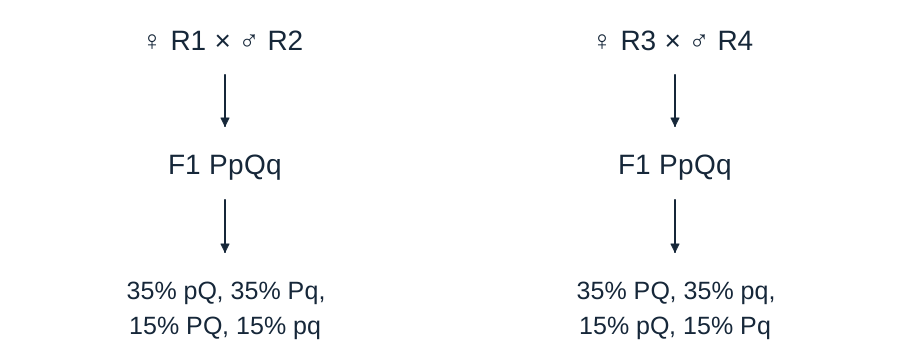
IAT 2025, Biology, question 11 — question diagramWhich one of the following options correctly represents the genotype of the parents?

  1. R1=ppQQ;R2=PPqq;R3=PPQQ;R4=ppqq

  2. R1=PPQQ;R2=ppqq;R3=ppQQ;R4=PPqq

  3. R1=ppQQ;R2=PPqq;R3=PPqq;R4=ppQQ

  4. R1=PPQQ;R2=ppqq;R3=ppqq;R4=PPQQ

Answer & worked solution
Answer A
The more frequent gametes reveal the parental combinations. In the first cross, pQ and Pq each occur at 35%, so the true-breeding parents are ppQQ and PPqq. In the second, PQ and pq predominate, so the parents are PPQQ and ppqq. The 15% classes in each case are recombinants. This assigns R1–R4 as in A.

Question 12

IAT 2025 · Biology

What are retroviruses?

  1. A group of viruses with RNA genome and no reverse transcriptase activity

  2. A group of viruses with DNA genome and no reverse transcriptase activity

  3. A group of viruses with DNA genome and reverse transcriptase activity

  4. A group of viruses with RNA genome and reverse transcriptase activity

Answer & worked solution
Answer D
Retroviruses package an RNA genome and use reverse transcriptase to make a DNA copy during infection. That DNA can integrate into the host genome. Both RNA and reverse-transcriptase activity are essential parts of the definition, so D is correct.

Question 13

IAT 2025 · Biology

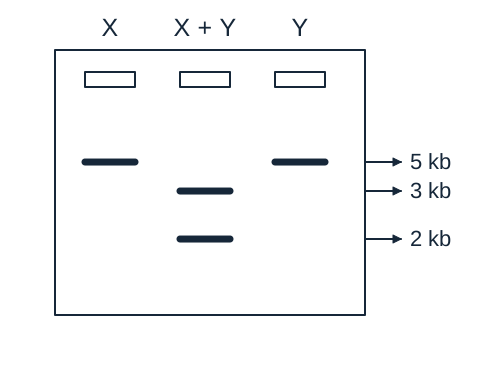
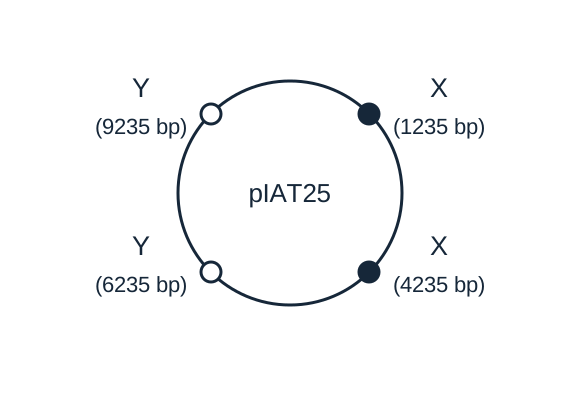
The given picture was obtained from an agarose gel electrophoresis of a plasmid after digestion with restriction enzymes either X,Y or both X and Y.

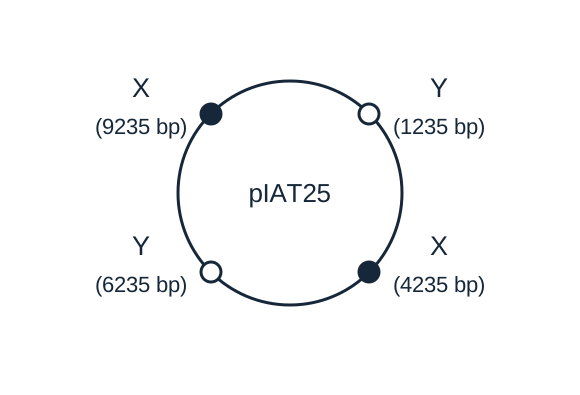
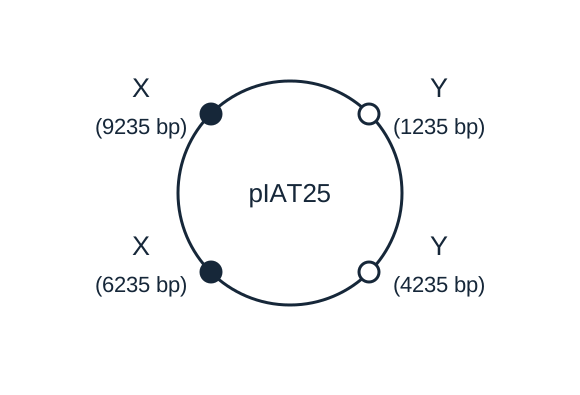
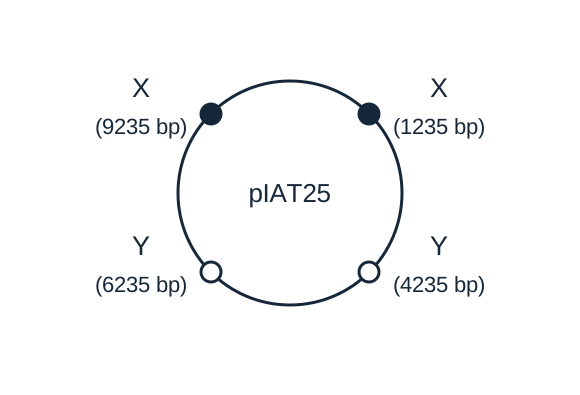
IAT 2025, Biology, question 13 — question diagramWhich one of the following diagrams correctly represents the position of the restriction enzyme sites (X,Y) on the 10,000 bp plasmid?

  1. IAT 2025, Biology, question 13 — option A
  2. IAT 2025, Biology, question 13 — option B
  3. IAT 2025, Biology, question 13 — option C
  4. IAT 2025, Biology, question 13 — option D
Answer & worked solution
Answer A
Each single-enzyme lane shows a 5 kb band, consistent with two equal 5 kb fragments from a 10 kb circle. Map A places the two X sites 5000 bp apart and likewise the two Y sites 5000 bp apart. Cutting at all four positions gives alternating 2000 and 3000 bp fragments, explaining the two bands in the double digest. The other maps fail a single-enzyme spacing check.

Question 14

IAT 2025 · Biology

Honey bee males are haploid and females are diploid. Which one of the following statements is INCORRECT about honey bees?

  1. Honey bee males cannot have daughters but can have sons.

  2. Honey bee males are produced from unfertilized eggs and females are produced from fertilized eggs.

  3. A honey bee male does not have a father but has a grandfather.

  4. Honey bee males form gametes by mitosis and females form gametes by meiosis.

Answer & worked solution
Answer A
A haploid male develops from an unfertilised egg, so it has a mother but no father. Its sperm can fertilise an egg and produce a diploid daughter; a son comes from an unfertilised egg and therefore has no father. A reverses these relationships and is the incorrect statement.

Question 15

IAT 2025 · Biology

Which one of the following statements is FALSE?

  1. The movement of energy is unidirectional in the ecological pyramid of energy.

  2. Only 10% of energy is transferred to each of the higher trophic levels in grazing food chain.

  3. All organisms of a trophic level should be included for estimation of energy content of that trophic level.

  4. More than 80% of the solar energy incident on earth is captured by plants and photosynthetic bacteria.

Answer & worked solution
Answer D
Only a small fraction of incident solar energy is fixed by photosynthesis; capture above 80% is incompatible with ecosystem energy budgets. Energy transfer is directional and decreases through trophic levels, with the 10% rule used as the textbook approximation. Therefore D is false.

Chemistry

Question 1

IAT 2025 · Chemistry

Which one of the following statements best describes the acidic/basic/amphoteric nature of ZnO and CaO ?

  1. ZnO is amphoteric, while CaO is basic.

  2. ZnO is basic, while CaO is amphoteric.

  3. Both ZnO and CaO are amphoteric.

  4. ZnO is acidic, while CaO is basic.

Answer & worked solution
Answer A
ZnO reacts with both acids and sufficiently strong bases, demonstrating amphoteric behaviour. CaO is a basic oxide: it forms calcium hydroxide with water and neutralises acids. Thus ZnO is amphoteric while CaO is basic.

Question 2

IAT 2025 · Chemistry

Which among the following processes is/are associated with increasing bond order but no change in diamagnetic/paramagnetic behaviour?

(i) N2 N2++e

(ii) O2O2++e

(iii) O2+eO2

  1. (ii) only

  2. (i) and (ii)
  3. (ii) and (iii)
  4. (iii) only
Answer & worked solution
Answer A
O2 has two unpaired electrons in antibonding π* orbitals. Removing one increases bond order from 2 to 2.5, while the remaining unpaired electron keeps the ion paramagnetic. Removing a bonding electron from N2 decreases bond order and changes its magnetic character; adding an electron to O2 decreases bond order. Only process ii satisfies both requirements.

Question 3

IAT 2025 · Chemistry

What is the value of 𝐸(Fe3+/Fe0) ?

[The standard reduction potential values are 𝐸(Fe3+/Fe2+)=0.77 V, and 𝐸(Fe2+/Fe0)=0.44 V]

  1. 0.04 V

  2. 0.33 V

  3. 0.11 V

  4. 0.11 V

Answer & worked solution
Answer A
Potentials must be combined through Gibbs energies rather than added directly. The first reduction uses one electron and the second uses two, so E=[1(0.77)+2(0.44)]/3=0.11/3=0.0367E^\circ=[1(0.77)+2(-0.44)]/3=-0.11/3=-0.0367 V. Rounded to the available choices, this is −0.04 V.

Question 4

IAT 2025 · Chemistry

 What are the correct orders of stability for the following compounds? 

  1. VF5>VCl5;CuCl2>CuI2

  2. VCl5>VF5;CuCl2>CuI2

  3. VCl5>VF5;CuI2>CuCl2

  4. VF5>VCl5;CuI2>CuCl2

Answer & worked solution
Answer A
Fluorine stabilises the high +5 oxidation state of vanadium more effectively than chlorine, favouring VF5 over VCl5. Iodide is readily oxidised by Cu(II), causing CuI2 to decompose towards Cu(I) iodide and iodine; CuCl2 is stable by comparison. Both stability orders are those in A.

Question 5

IAT 2025 · Chemistry

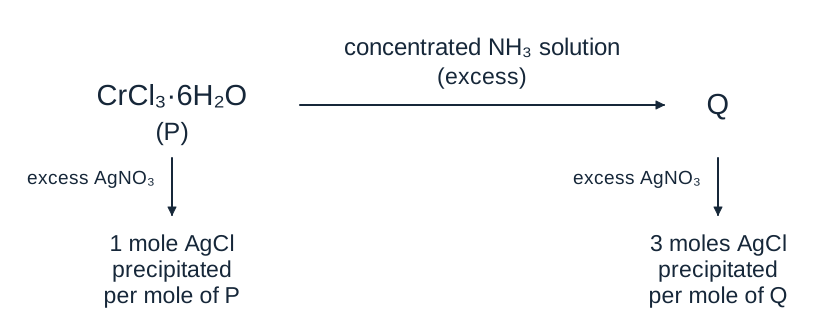
 Consider the following reaction scheme: 

IAT 2025, Chemistry, question 5 — question diagram Which among the following statements is correct? 

  1. 𝐏 shows geometrical isomerism and absorbs light of higher wavelength than that of 𝐐.

  2. Both 𝐏 and 𝐐 show geometrical isomerism and 𝐏 absorbs light of higher wavelength than that of 𝐐.

  3. Q shows geometrical isomerism and absorbs light of higher wavelength than that of 𝐏.

  4. 𝐏 shows geometrical isomerism and absorbs light of lower wavelength than that of 𝐐.

Answer & worked solution
Answer A
One precipitated chloride per formula unit identifies P=[Cr(H2O)4Cl2]Cl2H2OP=[\mathrm{Cr(H_2O)_4Cl_2}]\mathrm{Cl}\cdot2\mathrm{H_2O}, which has cis and trans arrangements. Excess ammonia gives Q=[Cr(NH3)6]Cl3Q=[\mathrm{Cr(NH_3)_6}]\mathrm{Cl_3} with all three chlorides outside the coordination sphere and no geometrical isomerism. The stronger ligand field of NH3 raises the splitting in Q, so it absorbs a shorter wavelength. P therefore shows geometrical isomerism and absorbs at a longer wavelength than Q.

Question 6

IAT 2025 · Chemistry

 How many 𝛽-hydrogen is/are present in 2-methyl-3-phenyl-pentan-1-al? 

  1. 4

  2. 1

  3. 3

  4. 2

Answer & worked solution
Answer A
Write the aldehyde as OHC–CH(CH3)–CH(Ph)–CH2–CH3. The carbon next to CHO is alpha; carbons attached to it are beta. There is one hydrogen on the beta CH(Ph) carbon and three on the beta methyl branch. Thus the total number of beta hydrogens is 1+3=41+3=4.

Question 7

IAT 2025 · Chemistry

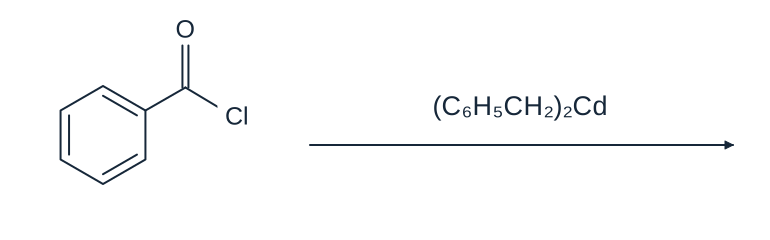
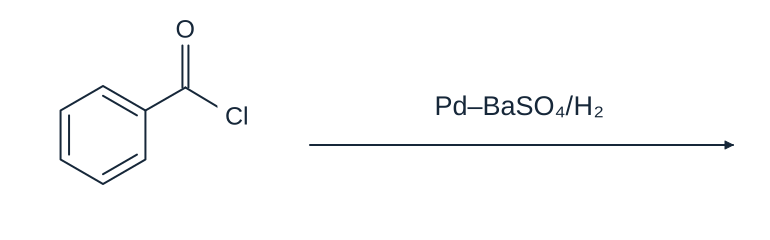
 Which of the following reactions do NOT provide an aldehyde as a product? 

  1. IAT 2025, Chemistry, question 7 — option A

  2. IAT 2025, Chemistry, question 7 — option B

  3. IAT 2025, Chemistry, question 7 — option C

  4. IAT 2025, Chemistry, question 7 — option D

Answer & worked solution
Answer A
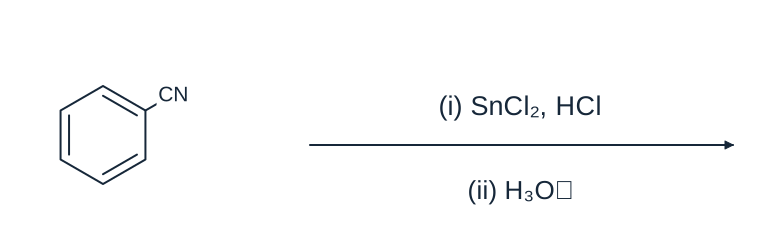
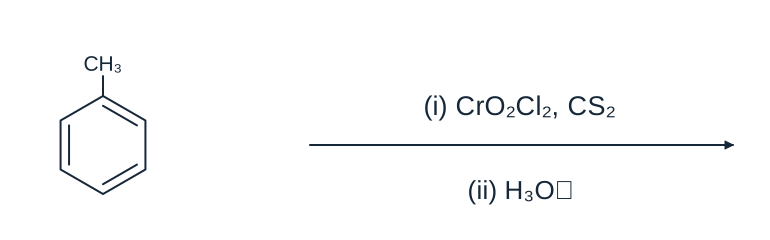
An acid chloride reacts with an organocadmium reagent to give a ketone, so A does not yield an aldehyde. B is Rosenmund reduction of an acid chloride, C is Stephen reduction of a nitrile followed by hydrolysis, and D is Etard oxidation of the methyl side chain. Each of B–D can produce the corresponding aldehyde.

Question 8

IAT 2025 · Chemistry

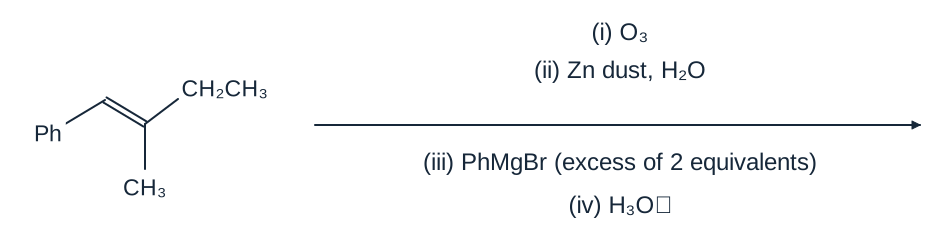
 What are the major products formed in the following reaction sequence? 

IAT 2025, Chemistry, question 8 — question diagram
  1. IAT 2025, Chemistry, question 8 — option A
  2. IAT 2025, Chemistry, question 8 — option B
  3. IAT 2025, Chemistry, question 8 — option C
  4. IAT 2025, Chemistry, question 8 — option D
Answer & worked solution
Answer A
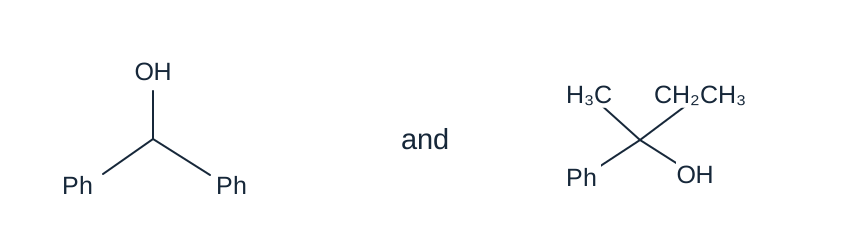
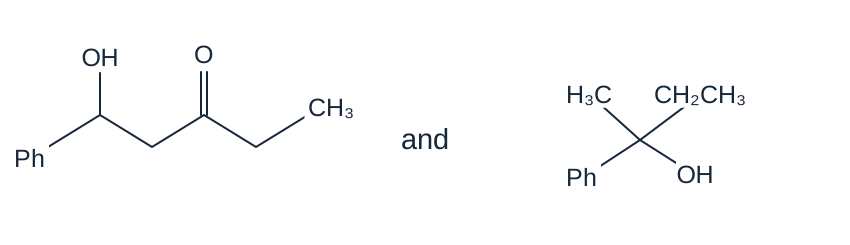
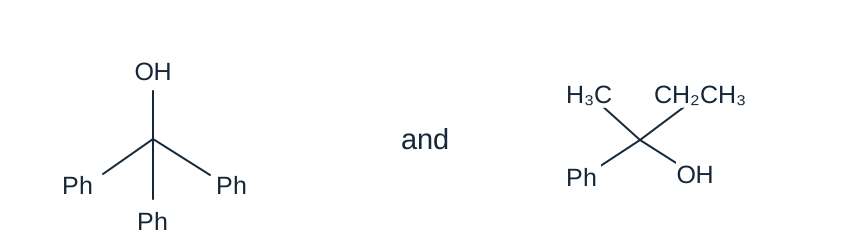
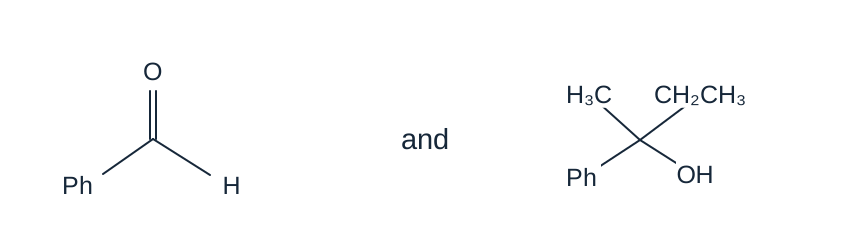
Reductive ozonolysis cleaves the alkene into benzaldehyde and butan-2-one. Phenylmagnesium bromide then adds to both carbonyl groups. After acid work-up, benzaldehyde gives diphenylmethanol and butan-2-one gives the tertiary alcohol bearing phenyl, methyl and ethyl groups. These two products appear together in A.

Question 9

IAT 2025 · Chemistry

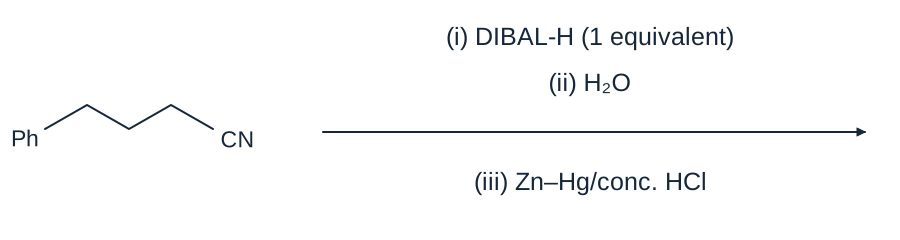
 What is the major product in the reaction sequence given below? 

IAT 2025, Chemistry, question 9 — question diagram
  1. IAT 2025, Chemistry, question 9 — option A
  2. IAT 2025, Chemistry, question 9 — option B
  3. IAT 2025, Chemistry, question 9 — option C
  4. IAT 2025, Chemistry, question 9 — option D

Answer & worked solution
Answer A
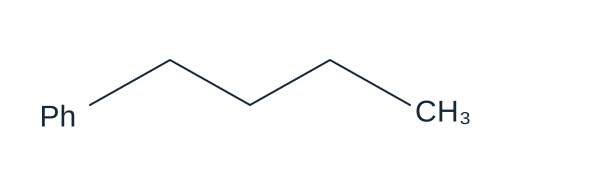
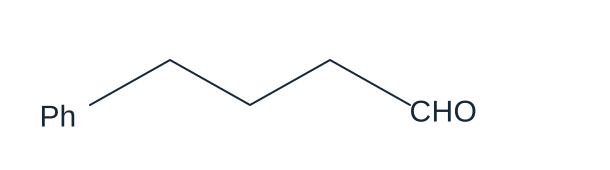
One equivalent of DIBAL-H followed by hydrolysis reduces the terminal nitrile to an aldehyde without removing its carbon. Clemmensen reduction with Zn–Hg/concentrated HCl then converts that CHO group to CH3. The carbon skeleton is retained, giving the alkylbenzene drawn in A.

Question 10

IAT 2025 · Chemistry

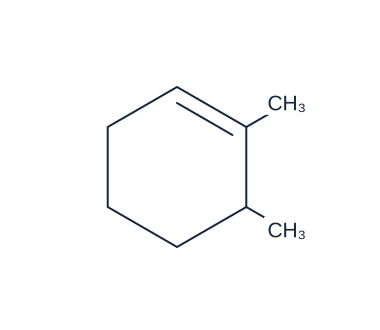
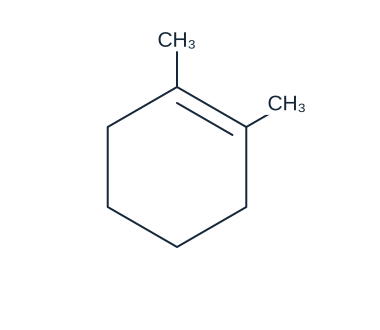
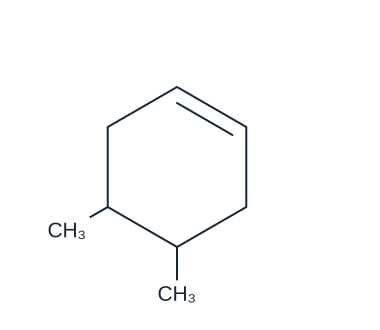
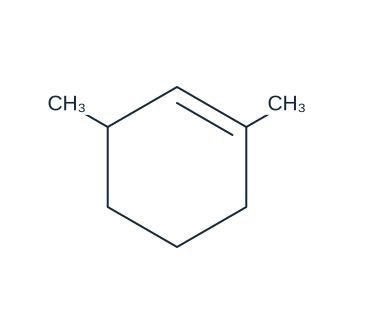
Compound 𝐈 undergoes hydroboration-oxidation reaction with (BH3)2 followed by treatment with H2O2 and aqueous NaOH to produce another compound II, which upon oxidation with CrO3 gives 2,3-dimethyl-cyclohexanone as the product. What is the structure of 𝐈 ?

  1. IAT 2025, Chemistry, question 10 — option A
  2. IAT 2025, Chemistry, question 10 — option B
  3. IAT 2025, Chemistry, question 10 — option C
  4. IAT 2025, Chemistry, question 10 — option D
Answer & worked solution
Answer A
Hydroboration–oxidation puts OH on the less substituted carbon of the alkene without rearrangement. In A this gives a secondary cyclohexanol whose methyl groups become positions 2 and 3 relative to OH. Oxidising that alcohol changes its carbon to the ketone carbonyl and yields the required 2,3-dimethylcyclohexanone.

Question 11

IAT 2025 · Chemistry

The work done when one mole of an ideal gas expands at constant temperature 𝑇 from volume 𝑉 to 2𝑉 (in two equal steps of volume in a linear fashion) is 712𝑅𝑇. How much more work would be done by the gas if it expands in three equal steps?

[ 𝑅 is the universal gas constant]

  1. 130R𝑇

  2. 38R𝑇

  3. 34R𝑇

  4. R𝑇ln(115)

Answer & worked solution
Answer A
In each step use the final equilibrium pressure as the constant external pressure. For three equal volume increments, W3=RT(1/4+1/5+1/6)=37RT/60W_3=RT(1/4+1/5+1/6)=37RT/60. The given two-step work is W2=7RT/12=35RT/60W_2=7RT/12=35RT/60. The extra work is therefore W3W2=RT/30W_3-W_2=RT/30.

Question 12

IAT 2025 · Chemistry

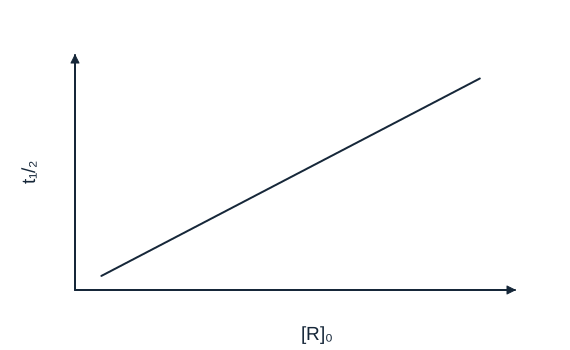
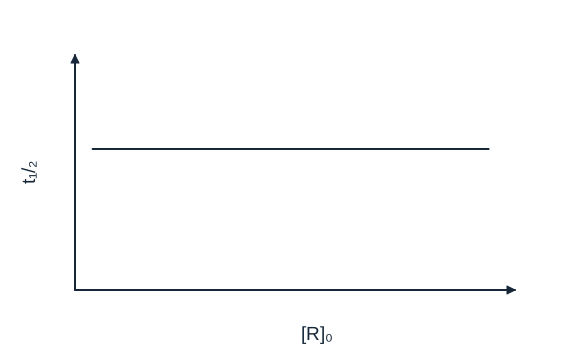
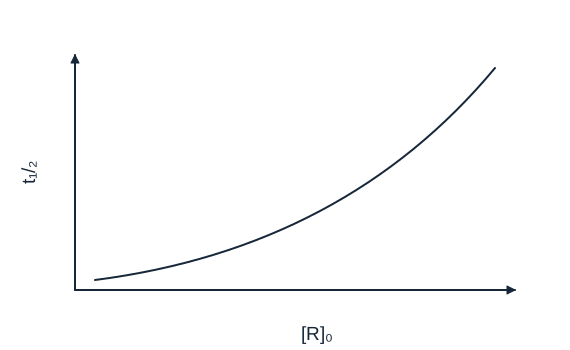
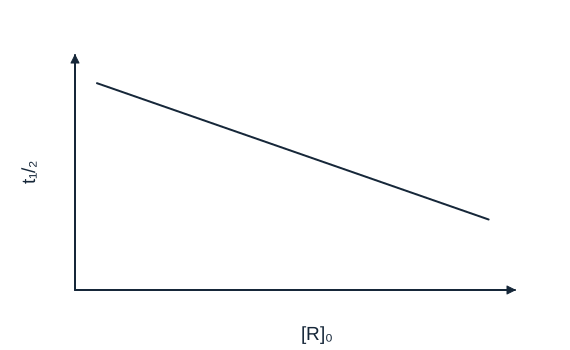
At a particular temperature, the magnitude of the rate constant of a reaction is 5×10⁵ and the unit of the pre-exponential factor of the Arrhenius equation for this reaction is molL1 min1. Which of the following plots is correct for this reaction?

[ Note: [R]0 is the initial concentration and 𝑡1/2 is the half-life of the reaction ]

  1. IAT 2025, Chemistry, question 12 — option A
  2. IAT 2025, Chemistry, question 12 — option B
  3. IAT 2025, Chemistry, question 12 — option C
  4. IAT 2025, Chemistry, question 12 — option D
Answer & worked solution
Answer A
The pre-exponential factor has the same units as the rate constant. Concentration per time is the unit for a zero-order reaction, whose integrated law is [R]=[R]0kt[R]=[R]_0-kt. Setting the concentration to half its initial value gives t1/2=[R]0/(2k)t_{1/2}=[R]_0/(2k). The plot is a straight line of positive slope through the origin, A.

Question 13

IAT 2025 · Chemistry

What is the time period of revolution of an electron in the fourth Bohr orbit of He+?

[Bohr radius =52.9 picometers, mass of an electron =9.11×1031 kg, Planck's constant =6.626×1034Js ]

  1. 0.24 femtoseconds
  2. 4.8 femtoseconds
  3. 24 femtoseconds
  4. 2.4 femtoseconds

Transcription note: Restored the missing decimal in the 0.24 fs distractor from the 2025 paper. Answer letters refer to the option order displayed here.

Answer & worked solution
Answer D
For a hydrogen-like ion, rn=a0n2/Zr_n=a_0n^2/Z. Quantisation gives mvrn=nh/(2π)mvr_n=nh/(2\pi), so the period is Tn=2πrn/v=4π2mrn2/(nh)T_n=2\pi r_n/v=4\pi^2mr_n^2/(nh). With n = 4 and Z = 2, rn=8a0=423.2r_n=8a_0=423.2 pm. Substitution yields Tn2.43×1015T_n\approx2.43\times10^{-15} s, or 2.4 femtoseconds.

Question 14

IAT 2025 · Chemistry

The dipole moments of three AB3-type molecules 𝐈,𝐈𝐈, and 𝐈𝐈𝐈 are measured to be 0.0D,0.2D, and 1.5 D , respectively. Which one of the following options is correct regarding the identity of 𝐈,𝐈𝐈, and 𝐈𝐈𝐈 ?

  1. I: BF3,𝐈𝐈:NF3,𝐈𝐈𝐈:NH3

  2. I: BF3,𝐈𝐈:NH3,𝐈𝐈𝐈:NF3

  3. I: ClF3,𝐈𝐈:NF3,𝐈𝐈𝐈:NH3

  4. I: BCl3,𝐈𝐈:NH3,𝐈𝐈𝐈:NF3

Answer & worked solution
Answer A
Trigonal-planar BF3 has three equivalent bond dipoles that cancel, giving zero net moment. Both NF3 and NH3 are pyramidal, but the N–F bond contributions oppose the lone-pair-related direction whereas the N–H contributions reinforce it. Thus NF3 has the small value and NH3 the larger one: I = BF3, II = NF3, III = NH3.

Question 15

IAT 2025 · Chemistry

During the charging and discharging of a lead-acid battery (a Pb anode, a grid of Pb packed with PbO2 as cathode, and an aqueous solution of H2SO4 as an electrolyte), which of the following redox reactions does NOT occur?

  1. Pb4++4ePb

  2. Pb2+Pb4++2e

  3. PbPb2++2e

  4. 2 Pb2+Pb4++Pb

Answer & worked solution
Answer A
During discharge, lead metal is oxidised from 0 to +2 and lead dioxide is reduced from +4 to +2. Charging reverses those changes; combining the charging half-reactions gives the oxidation-state form 2Pb2+Pb4++Pb2\mathrm{Pb^{2+}}\to\mathrm{Pb^{4+}}+\mathrm{Pb}. A direct four-electron conversion of Pb(IV) to Pb(0) is not part of the lead-acid battery cycle described, so A does not occur.

Mathematics

Question 1

IAT 2025 · Mathematics

How many three digit numbers divisible by 5 are there in which no digits are repeated?

  1. 136

  2. 128

  3. 144

  4. 162

Answer & worked solution
Answer A
A number divisible by 5 ends in 0 or 5. With final digit 0, the hundreds digit has 9 choices and the tens digit 8, giving 72. With final digit 5, the hundreds digit has 8 choices and the tens digit 8, giving 64. No cases overlap, so the total is 72+64=13672+64=136.

Question 2

IAT 2025 · Mathematics

Let 𝐴 be a 3×3 matrix with real entries such that

𝐴=[41cos𝑥15𝑥25𝑥2+1257]

For how many values of 𝑥, the matrix 𝐴 is symmetric?

  1. 1

  2. 2

  3. 4

  4. infinitely many

Answer & worked solution
Answer A
The off-diagonal entries are already paired except for cosx\cos x and x2+1x^2+1. Symmetry requires cosx=x2+1\cos x=x^2+1. Since cosx1\cos x\leq1 while x2+11x^2+1\geq1, equality is possible only at x = 0, and it does hold there. Thus there is exactly one value.

Question 3

IAT 2025 · Mathematics

Let 𝑛=𝑟=010(1)𝑟10𝐶𝑟(23)2𝑟320. Which one of the following statements is TRUE?

  1. 𝑛 is divisible by 5

  2. 𝑛 is divisible by 6

  3. 𝑛 is divisible by 8

  4. 𝑛 is divisible by 9

Answer & worked solution
Answer A
Recognise the binomial expansion: n=320r=010(10r)(4/9)r=320(14/9)10=510n=3^{20}\sum_{r=0}^{10}\binom{10}{r}(-4/9)^r=3^{20}(1-4/9)^{10}=5^{10}. It is divisible by 5 and by none of 6, 8 or 9.

Question 4

IAT 2025 · Mathematics

Let 𝑓:𝐑𝐑 be the function given by 𝑓(𝑥)=cos(tan1𝑥). Which one of the following statements is TRUE?

  1. 𝑓 is decreasing for 𝑥>0

  2. 𝑓 is decreasing for 𝑥<0

  3. 𝑓 is decreasing on 𝐑

  4. 𝑓 is decreasing on the interval (1,1)

Answer & worked solution
Answer A
Because tan1x\tan^{-1}x lies between −π/2 and π/2, f(x)=1/1+x2f(x)=1/\sqrt{1+x^2}. Differentiating gives f(x)=x/(1+x2)3/2f'(x)=-x/(1+x^2)^{3/2}. This is negative for x > 0 and positive for x < 0, so only A describes an interval of decrease correctly.

Question 5

IAT 2025 · Mathematics

Let

𝐴={𝑥𝐑31<det[3𝑥1225]29}

Which one of the following statements is TRUE?

  1. 𝐴=(2,2]

  2. 𝐴=(2,2)

  3. 𝐴=[2,2)

  4. 𝐴=[2,2]

Answer & worked solution
Answer A
The determinant is 5(3x1)2(2)=15x15(3x-1)-2(-2)=15x-1. The inequality becomes 31<15x129-31<15x-1\leq29, or 30<15x30-30<15x\leq30. Dividing by positive 15 preserves both inequality directions, giving 2<x2-2<x\leq2.

Question 6

IAT 2025 · Mathematics

Let 𝑧1,𝑧2, and 𝑧3 be complex numbers satisfying the following conditions

2=|2𝑧1|=|𝑧21|=|𝑧3+1|=1𝑧1+1𝑧21+1𝑧3+1.

What is the value of |4𝑧1+𝑧2+𝑧3| ?

  1. 8

  2. 4

  3. 14

  4. 18

Answer & worked solution
Answer A
The three reciprocal terms have magnitudes 1, 1/2 and 1/2. Their sum has magnitude 2, equal to the sum of these magnitudes, so equality in the triangle inequality forces them to have the same argument. Write z1=uz_1=u, z21=2uz_2-1=2u and z3+1=2uz_3+1=2u with u=1|u|=1. Then 4z1+z2+z3=8u4z_1+z_2+z_3=8u, whose magnitude is 8.

Question 7

IAT 2025 · Mathematics

Let 𝑓:𝐑𝐑 be defined as 𝑓(𝑥)=𝑥33𝑥[𝑥], where [𝑥] denotes the greatest integer less than or equal to 𝑥. Which one of the following statements is TRUE?

  1. Every non-zero integer is a point of discontinuity of 𝑓

  2. 𝑓 is continuous at every real number

  3. Every integer is a point of discontinuity of 𝑓

  4. 𝑓 is continuous at every real number except for 0,±3

Answer & worked solution
Answer A
The floor function jumps by one at every integer k. Multiplying it by the continuous factor x33x|x^3-3x| gives a jump of magnitude k33k|k^3-3k|. This is nonzero at every nonzero integer because the other zeros, ±√3, are not integers. At zero the multiplying factor vanishes, so the product is continuous there. Hence A is correct.

Question 8

IAT 2025 · Mathematics

Let be the tangent line to the ellipse 𝑥2+16𝑦2=4 at (1,34). What is the equation of the line perpendicular to passing through (2,0) ?

  1. 𝑦=43(𝑥2)

  2. 𝑦=23(𝑥2)

  3. 𝑦=3(𝑥2)

  4. 43𝑦=(𝑥2)

Answer & worked solution
Answer A
Implicit differentiation of x2+16y2=4x^2+16y^2=4 gives y=x/(16y)y'=-x/(16y). At the stated point the tangent slope is 1/(43)-1/(4\sqrt3). A perpendicular line therefore has slope 434\sqrt3; through (2,0), its equation is y=43(x2)y=4\sqrt3(x-2).

Question 9

IAT 2025 · Mathematics

Let 𝑎 and 𝑏 be two vectors such that |𝑎+𝑏|=15 and

𝑎×(3𝑖ˆ4𝑗ˆ+5𝑘ˆ)=(3𝑖ˆ4𝑗ˆ+5𝑘ˆ)×𝑏

What is the value of |(𝑎+𝑏)(2𝑖ˆ+3𝑗ˆ+𝑘ˆ)| ?

  1. 32

  2. 0

  3. 2

  4. 3

Answer & worked solution
Answer A
Let c=(3,4,5)\vec c=(3,-4,5). The cross-product equation gives (a+b)×c=0(\vec a+\vec b)\times\vec c=0, so a+b\vec a+\vec b is parallel to c. Since its magnitude is 15, it equals ±15c/50\pm15\vec c/\sqrt{50}. Now c(2,3,1)=612+5=1\vec c\cdot(2,3,1)=6-12+5=-1, giving absolute dot product 15/50=3/215/\sqrt{50}=3/\sqrt2.

Question 10

IAT 2025 · Mathematics

What is the derivative of log(sin2𝑥) with respect to sin𝑥 ?

  1. 2cosec𝑥

  2. sin2𝑥

  3. 4cosec𝑥

  4. cot𝑥cosec2𝑥

Answer & worked solution
Answer A
Set u=sinxu=\sin x. The quantity is log(u2)\log(u^2), so its derivative with respect to u is 2/u2/u wherever u is nonzero. Therefore the requested derivative is 2cscx2\csc x, using the natural-log convention of calculus.

Question 11

IAT 2025 · Mathematics

Let 𝑆𝑛 denote the sum of the first 𝑛 terms of a sequence 𝑎1,𝑎2,𝑎3,. If 𝑆𝑛+3𝑆𝑛=13𝑛+7 for all 𝑛, what is the value of 𝑎13𝑎10 ?

  1. 13

  2. 137

  3. 46

  4. 12

Answer & worked solution
Answer A
Write the given identity at n + 1 and subtract the one at n. The left side becomes an+4an+1a_{n+4}-a_{n+1}, while the right side is 13. Set n = 9 to obtain a13a10=13a_{13}-a_{10}=13.

Question 12

IAT 2025 · Mathematics

Five fair coins are tossed independently. What is the probability that at least two heads appear?

  1. 1316

  2. 716

  3. 516

  4. 1116

Answer & worked solution
Answer A
Use the complement: fewer than two heads means zero or one head. These account for (50)+(51)=1+5=6\binom50+\binom51=1+5=6 of the 25=322^5=32 equally likely outcomes. Thus the desired probability is 16/32=26/32=13/161-6/32=26/32=13/16.

Question 13

IAT 2025 · Mathematics

Let 𝑓:𝐑𝐑 be the function defined by

𝑓(𝑥)={𝑥24𝑥5 if 𝑥1,2𝑥 if 𝑥<1.

Which one of the following statements is TRUE?

  1. 𝑓 is onto but not one-one

  2. 𝑓 is one-one but not onto

  3. 𝑓 is neither one-one nor onto

  4. 𝑓 is one-one and onto

Answer & worked solution
Answer A
For x < 1, the range of 2x is (,2)(-\infty,2). For x ≥ 1, the quadratic is (x2)29(x-2)^2-9 and its range is [9,)[-9,\infty). Their union is all real numbers, so f is onto. It is not one-to-one, since f(1) = f(3) = −8.

Question 14

IAT 2025 · Mathematics

Which one of the following is the solution of the differential equation

𝑥2𝑑𝑦𝑑𝑥+9𝑥𝑦=𝑥4( for 𝑥>0)

given that 𝑦=0 when 𝑥=1 ?

  1. 12𝑦=𝑥31𝑥9

  2. 12𝑦=𝑥91𝑥3

  3. 9𝑦=𝑥211𝑥3

  4. 9𝑦=𝑥31𝑥21

Answer & worked solution
Answer A
Divide by x2x^2 to get y+9y/x=x2y'+9y/x=x^2. The integrating factor for x > 0 is x9x^9, giving (x9y)=x11(x^9y)'=x^{11}. Thus x9y=x12/12+Cx^9y=x^{12}/12+C. The condition y(1) = 0 gives C = −1/12, and hence 12y=x3x912y=x^3-x^{-9}.

Question 15

IAT 2025 · Mathematics

What is the value of 0𝜋𝑥|cos𝑥|sin𝑥𝑑𝑥 ?

  1. 𝜋2

  2. 𝜋4

  3. 𝜋

  4. 𝜋6

Answer & worked solution
Answer A
Let g(x)=cosxsinxg(x)=|\cos x|\sin x, which satisfies g(πx)=g(x)g(\pi-x)=g(x). Substituting π−x and adding yields 2I=π0πg(x)dx2I=\pi\int_0^\pi g(x)\,dx. The last integral equals 20π/2cosxsinxdx=12\int_0^{\pi/2}\cos x\sin x\,dx=1. Therefore I=π/2I=\pi/2.

Physics

Question 1

IAT 2025 · Physics

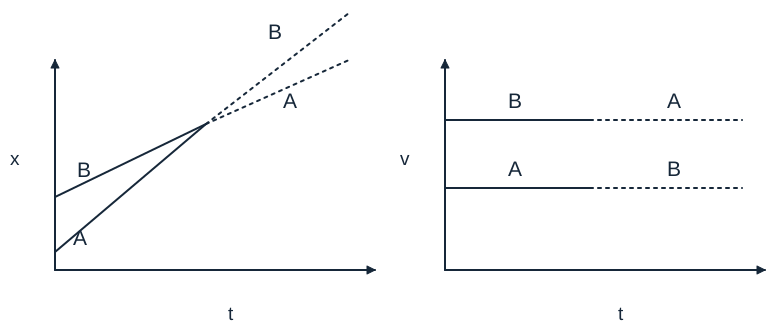
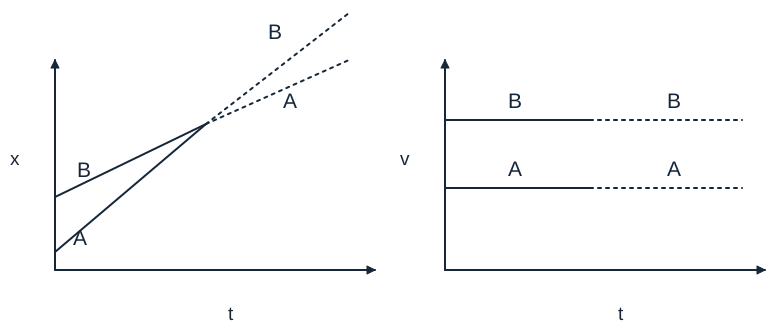
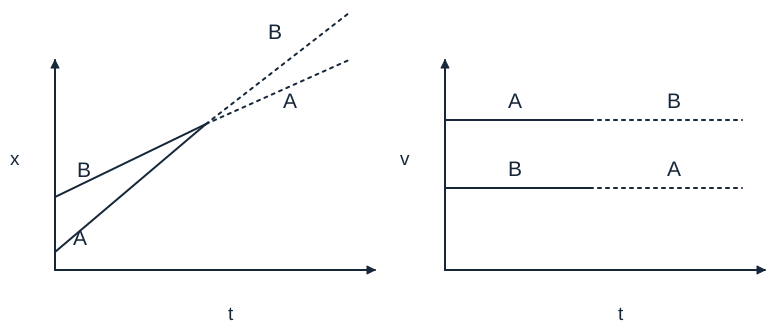
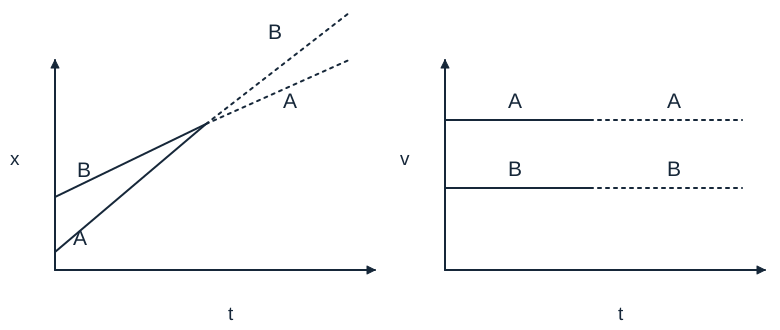
Consider an elastic collision between two particles 𝐴 and 𝐵 of same mass, moving in the same direction. Particle 𝐴 is moving at speed 𝑣𝐴 and particle 𝐵 is moving at speed 𝑣𝐵. In the figures shown, the solid lines represent the motion before the collision and the dotted lines represent the motion after the collision. Which of the following describes the motion of these two particles most accurately?
  1. IAT 2025, Physics, question 1 — option A
  2. IAT 2025, Physics, question 1 — option B
  3. IAT 2025, Physics, question 1 — option C
  4. IAT 2025, Physics, question 1 — option D
Answer & worked solution
Answer A
In a one-dimensional elastic collision between equal masses, the particles exchange velocities. The steeper pre-collision position–time line belongs to faster A. Afterwards A must have B's shallower slope and B must have A's steeper slope, with the same interchange shown in the velocity–time plot. Only A satisfies both descriptions together.

Question 2

IAT 2025 · Physics

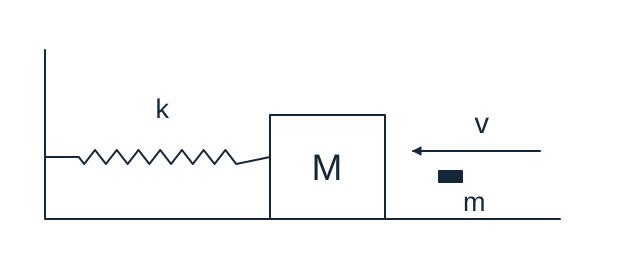
A block of mass 𝑀 lies at rest connected to a massless spring of spring constant 𝑘 on a frictionless surface. A bullet of mass 𝑚 hits the block horizontally with speed 𝑣 as shown in the figure and is completely stuck to the block. What is the maximum compression in the spring resulting from this impact (assuming that at this point the spring is still not fully compressed)?
IAT 2025, Physics, question 2 — question diagram
  1. 𝑚2𝑣2𝑘(𝑀+𝑚)

  2. 𝑚𝑣2𝑘

  3. 𝑀𝑣2𝑘

  4. 𝑚𝑀𝑣2𝑘(𝑀+𝑚)

Answer & worked solution
Answer A
Momentum is conserved during the inelastic impact: (M+m)u=mv(M+m)u=mv. The combined block and bullet then compress the spring until all their post-impact kinetic energy becomes spring energy: 12(M+m)u2=12kx2\frac12(M+m)u^2=\frac12kx^2. Substituting u gives x=mv/k(M+m)x=mv/\sqrt{k(M+m)}, equivalent to A. Initial bullet kinetic energy is not conserved during embedding.

Question 3

IAT 2025 · Physics

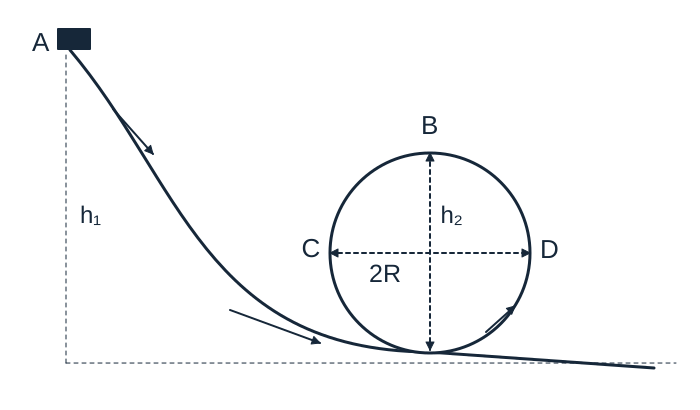
A cart of mass 𝑀 is released from 𝐴, the highest point of a frictionless track, as shown in the figure. The cart travels along the track and enters the semicircular arc 𝐷𝐵𝐶 of radius 𝑅. The heights of the points 𝐴 and 𝐵 are 1 and 2 from the ground, respectively. Which of the following quantities does not play any role in ensuring that the cart does not leave the track?
IAT 2025, Physics, question 3 — question diagram
  1. 𝑀

  2. 1

  3. 2

  4. 𝑅

Answer & worked solution
Answer A
Energy conservation gives the speed at each height through v2=2g(h1h)v^2=2g(h_1-h), independent of cart mass. The contact condition compares weight and the required centripetal force, with M cancelling from both. Heights and curvature radius affect speed and the contact condition; M does not.

Question 4

IAT 2025 · Physics

A circular disk of mass 𝑀 and radius 𝑅 is rotating clockwise with a uniform angular velocity 𝜔 about an axis passing through the centre, normal to the disk. At time 𝑡=0, a torque 𝑇 is applied along the same axis to oppose the rotation of the disk. What is the angular displacement 𝜃 (measured from 𝑡=0 in the clockwise direction) that the disk attains before it starts rotating counterclockwise?

  1. 𝜃=𝜔2𝑀𝑅24𝑇

  2. 𝜃=𝜔2𝑀𝑅28𝑇

  3. 𝜃=𝜔2𝑀𝑅24𝑇

  4. 𝜃=𝜔2𝑀𝑅28𝑇

Answer & worked solution
Answer A
The disk has moment of inertia I=MR2/2I=MR^2/2. Its initial rotational energy is Iω2/2I\omega^2/2. The opposing constant torque removes energy Tθ before the disk stops, so θ=Iω2/(2T)=MR2ω2/(4T)\theta=I\omega^2/(2T)=MR^2\omega^2/(4T). Displacement is positive in the specified clockwise direction up to the stopping point.

Question 5

IAT 2025 · Physics

A metallic cube initially kept at a temperature 𝑇 is emitting black body radiation with a power 𝑃 (energy emitted per unit time). If 𝑇 is increased by 1%, the power being radiated increases by 4.5%. What is the approximate percentage increase in the volume of the cube in this process?

  1. 0.75%

  2. 0.50%

  3. 1.56×10⁶%

  4. 6.25×10⁶%

Answer & worked solution
Answer A
For black-body emission, PAT4P\propto AT^4. To first order, ΔP/PΔA/A+4ΔT/T\Delta P/P\approx\Delta A/A+4\Delta T/T. Hence the area increases by approximately 4.5%4.0%=0.5%4.5\%-4.0\%=0.5\%. A cube has AL2A\propto L^2 and VL3V\propto L^3, so its volume increase is 32(0.5%)=0.75%\frac32(0.5\%)=0.75\%. This uses the small-percentage approximation requested.

Question 6

IAT 2025 · Physics

Consider two pipes 𝐴 and 𝐵 of identical length. 𝐴 has one end closed and one end open. 𝐵 has both ends open. Each tube is immersed in a closed chamber of ideal gas having volume 𝑉. The chamber containing tube 𝐴 is at temperature 𝑇𝐴 and the chamber containing tube 𝐵 is at temperature 𝑇𝐵. The sound frequencies corresponding to the 𝑛𝐴-th harmonic in tube 𝐴 and the 𝑛𝐵-th harmonic in tube 𝐵 are the same. What is the relation between the temperatures 𝑇𝐴 and 𝑇𝐵 ?

  1. 𝑇𝐴=(4𝑛𝐵2𝑛𝐴2)𝑇𝐵

  2. 𝑇𝐴=(4𝑛𝐴2𝑛𝐵2)𝑇𝐵

  3. 𝑇𝐴=(𝑛𝐴24𝑛𝐵2)𝑇𝐵

  4. 𝑇𝐴=(𝑛𝐵24𝑛𝐴2)𝑇𝐵

Answer & worked solution
Answer A
For the same ideal gas, sound speed is proportional to T\sqrt T. An allowed odd harmonic of the closed–open pipe has fA=nAvA/(4L)f_A=n_Av_A/(4L); the open–open pipe has fB=nBvB/(2L)f_B=n_Bv_B/(2L). Equating them gives nATA=2nBTBn_A\sqrt{T_A}=2n_B\sqrt{T_B} and therefore TA=(4nB2/nA2)TBT_A=(4n_B^2/n_A^2)T_B. Here nA denotes the harmonic number, which must be odd for pipe A.

Question 7

IAT 2025 · Physics

Consider two waves, which are given by 𝑦1(𝑥,𝑡)=𝐴sin(𝑘𝑥𝜔𝑡) and 𝑦2(𝑥,𝑡)=3𝐴cos(𝑘𝑥𝜔𝑡), where 𝑘 is the wave number and 𝜔 is the angular frequency. The amplitude of the resultant waveform obtained by the superposition of the two waves is 𝐴𝑠 and its phase difference with 𝑦1 is 𝜙𝑠. What are 𝐴𝑠 and 𝜙𝑠 ?

  1. 𝐴𝑠=2𝐴 and 𝜙𝑠=𝜋3

  2. 𝐴𝑠=2𝐴 and 𝜙𝑠=𝜋6

  3. 𝐴𝑠=𝐴2 and 𝜙𝑠=𝜋3

  4. 𝐴𝑠=𝐴2 and 𝜙𝑠=𝜋6

Answer & worked solution
Answer A
Write the sum as Assin(ψ+ϕs)A_s\sin(\psi+\phi_s), where ψ=kxωt\psi=kx-\omega t. Comparing coefficients gives Ascosϕs=AA_s\cos\phi_s=A and Assinϕs=3AA_s\sin\phi_s=\sqrt3A. Thus As=2AA_s=2A and tanϕs=3\tan\phi_s=\sqrt3, giving a phase lead of π/3.

Question 8

IAT 2025 · Physics

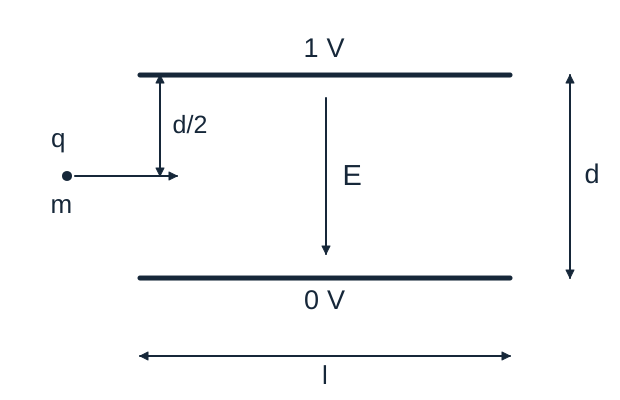
A particle of charge 𝑞=1𝑒 and mass 𝑚 with kinetic energy 𝐾 enters an electric field set up by two parallel plates of length 𝑙 as illustrated in the figure. The potential difference between the two plates is 1 V and their separation is 𝑑. What is the minimum value of 𝐾 (in eV ) for which the particle will not hit either of the plates? [ 𝑒 is the charge of the electron.]

IAT 2025, Physics, question 8 — question diagram
  1. 𝑙22𝑑2

  2. 𝑑22𝑙2

  3. 𝑙2𝑑2

  4. 𝑑2𝑙2

Answer & worked solution
Answer A
The particle enters midway between the plates with horizontal speed v. Its transverse acceleration is e/(md)e/(md) and transit time is l/v. Deflection is y=12[e/(md)](l/v)2=el2/(4dK)y=\frac12[e/(md)](l/v)^2=e l^2/(4dK), where K is in joules. Requiring y ≤ d/2 gives Kel2/(2d2)K\geq e l^2/(2d^2) J, or l2/(2d2)l^2/(2d^2) eV. Equality is the ideal limiting trajectory grazing the edge.

Question 9

IAT 2025 · Physics

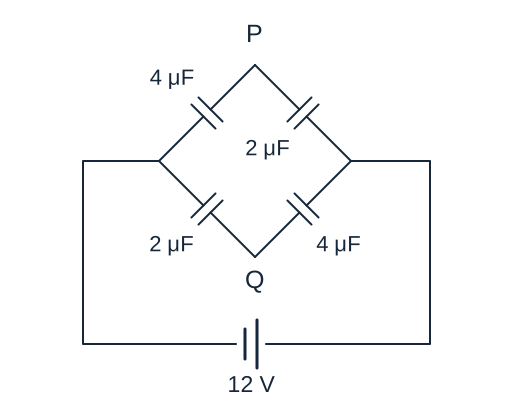
What is the potential difference between the points 𝑃 and 𝑄 in the circuit shown below, once the capacitors are fully charged?
IAT 2025, Physics, question 9 — question diagram
  1. 4 V

  2. 0 V

  3. 8 V

  4. 12 V

Answer & worked solution
Answer A
Each branch contains 4 μF and 2 μF capacitors in series across 12 V, so its series charge is (4×2/6)12=16μC(4\times2/6)12=16\,\mu\mathrm C. The voltage drops are therefore 4 V across 4 μF and 8 V across 2 μF. Because their order is reversed in the two branches, P and Q differ by 84=48-4=4 V in magnitude.

Question 10

IAT 2025 · Physics

A particle of mass 𝑚 and charge 𝑞 moving with a velocity 𝑣=𝑣0(𝑖ˆ+𝑗ˆ𝑘ˆ) is placed in a uniform magnetic field 𝐵=𝐵0(𝑖ˆ+𝑗ˆ+𝑘ˆ). It executes a helical trajectory of radius 𝑟 and pitch 𝑝. Which of the following options is correct?

  1. 𝑟=22𝑚𝑣03𝑞𝐵0 and 𝑝=2𝜋𝑚𝑣03𝑞𝐵0

  2. 𝑟=𝑚𝑣03𝑞𝐵0 and 𝑝=2𝜋𝑚𝑣03𝑞𝐵0

  3. 𝑟=22𝑚𝑣03𝑞𝐵0 and 𝑝=42𝜋𝑚𝑣03𝑞𝐵0

  4. 𝑟=2𝜋𝑚𝑣03𝑞𝐵0 and 𝑝=22𝑚𝑣03𝑞𝐵0

Answer & worked solution
Answer A
The field magnitude is 3B0\sqrt3B_0. The parallel velocity is v=(vB)/B=v0/3v_\parallel=(\vec v\cdot\vec B)/|\vec B|=v_0/\sqrt3, and v=3v02v02/3=8/3v0v_\perp=\sqrt{3v_0^2-v_0^2/3}=\sqrt{8/3}v_0. Hence r=mv/(q3B0)=22mv0/(3qB0)r=mv_\perp/(|q|\sqrt3B_0)=2\sqrt2mv_0/(3|q|B_0) and p=v[2πm/(q3B0)]=2πmv0/(3qB0)p=v_\parallel[2\pi m/(|q|\sqrt3B_0)]=2\pi mv_0/(3|q|B_0). A uses q as the charge magnitude.

Question 11

IAT 2025 · Physics

A charged particle is moving in a circular orbit with radius 𝑟 and orbital angular frequency 𝜔 in the presence of a magnetic field. The orbit is enclosed within a larger circular metallic frame. The frame is concentric and coplanar with the orbit. The radius of the frame is now gradually decreased. Assuming that the particle remains within the frame at all times, what changes to the trajectory of the particle will occur as the frame is being shrunk?

  1. The radius of the orbit will gradually decrease and the frequency will gradually increase.
  2. The radius of the orbit will gradually increase and the frequency will gradually decrease.

  3. The radius of the orbit will remain the same but the frequency will gradually increase.

  4. Both the radius of the orbit and the frequency will remain unchanged.

Answer & worked solution
Answer A · qualification below

Uses the stated slow-change/adiabatic mechanical model.

Shrinking a conducting frame in a perpendicular magnetic field reduces external flux through it. The induced current opposes that reduction, increasing the field through the particle's orbit while the frame shrinks. The cyclotron frequency qB/m|q|B/m therefore rises. In the slowly varying field model, the orbital adiabatic invariant gives p2/Bp_\perp^2/B constant, so r=p/(qB)B1/2r=p_\perp/(|q|B)\propto B^{-1/2} and the orbit contracts. This is the ideal quasistatic interpretation of A; detailed magnitudes depend on the circuit response.

Question 12

IAT 2025 · Physics

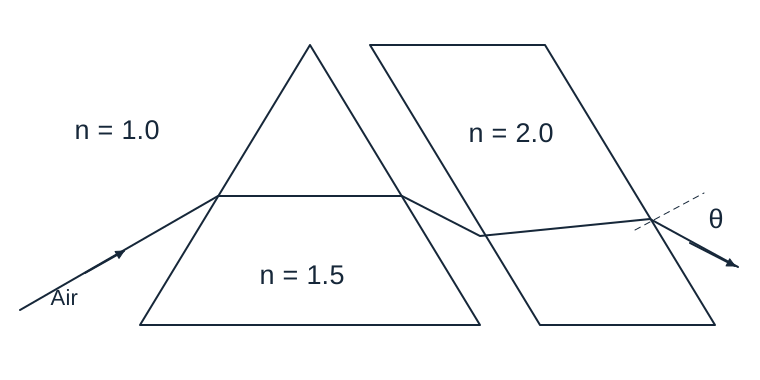
Consider an equilateral prism of refractive index 1.5 and a parallelepiped block of refractive index 2.0 arranged as shown in the figure such that their adjacent faces are parallel. A light ray enters the prism from air at an angle of incidence such that the ray travels through the prism parallel to its base. What is the angle of emergence 𝜃 ?

IAT 2025, Physics, question 12 — question diagram
  1. sin1(3/4)

  2. sin1(1/3)

  3. sin1(1/2)

  4. sin1(3/2)

Answer & worked solution
Answer A
A ray parallel to the base of an equilateral prism meets its sloping face at 30° to the normal. Snell's law at exit gives sine=1.5sin30=3/4\sin e=1.5\sin30^\circ=3/4. The following block has parallel entrance and exit faces, so the outgoing ray in air is parallel to the incoming ray in air. Its net angular effect cancels, leaving θ=sin1(3/4)\theta=\sin^{-1}(3/4).

Question 13

IAT 2025 · Physics

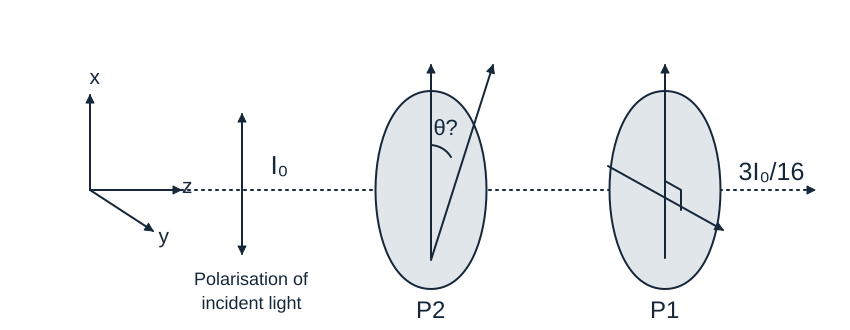
A source produces a light beam of intensity 𝐼0 polarized along the 𝑥-direction. The beam is sent along the 𝑧-direction. It enters a polaroid 𝑃1 with its polaroid axis aligned along the 𝑦-direction so that no light exits the polaroid. When another polaroid 𝑃2 is placed in between the source and 𝑃1, the intensity measured after 𝑃1 is 3𝐼0/16. Which among the following is a possible value of 𝜃, the angle of the polaroid axis measured from the 𝑥-axis?

IAT 2025, Physics, question 13 — question diagram
  1. 60

  2. 15

  3. 45

  4. 75

Answer & worked solution
Answer A
Apply Malus' law twice. The first added polariser transmits I0cos2θI_0\cos^2\theta, and the final y-oriented one transmits a further factor sin2θ\sin^2\theta. Thus I/I0=14sin2(2θ)=3/16I/I_0=\frac14\sin^2(2\theta)=3/16, requiring sin2(2θ)=3/4\sin^2(2\theta)=3/4. Of the listed angles, θ = 60° satisfies this.

Question 14

IAT 2025 · Physics

An electron in the ground state (with energy 𝐸1 ) of a hydrogen atom, absorbs a photon of energy 𝐸𝑎, and gets excited to a higher energy level of principal quantum number 𝑛. What is the value of 𝑛 ?

  1. 𝐸1𝐸1+𝐸𝑎

  2. 𝐸1𝐸1𝐸𝑎

  3. 𝐸𝑎𝐸1𝐸𝑎

  4. 𝐸𝑎𝐸1+𝐸𝑎

Answer & worked solution
Answer A
Hydrogen energies satisfy En=E1/n2E_n=E_1/n^2, where E1 is negative. Absorption gives En=E1+EaE_n=E_1+E_a. Equating these and solving yields n=E1/(E1+Ea)n=\sqrt{E_1/(E_1+E_a)}. For a bound excitation the denominator remains negative and the ratio exceeds one, as required.

Question 15

IAT 2025 · Physics

A particle of mass 𝑚 and charge 𝑞 is accelerated through a distance 𝑑1 by an electric field 𝐸. Another particle of mass 𝑀 and charge 𝑞 is accelerated by the same electric field through a distance 𝑑2. Both the particles emerge with the same de Broglie wavelength 𝜆𝐵. What is the ratio of the distances 𝑑2/𝑑1 ?

  1. 𝑚𝑀

  2. 𝑀𝑚

  3. 𝑚𝑀

  4. 𝑀𝑚

Answer & worked solution
Answer A · qualification below

The intended answer assumes the initial state described in the solution.

Equal de Broglie wavelengths mean equal momentum magnitudes, since p=h/λBp=h/\lambda_B. With both particles starting from rest, electric work gives qEd=p2/(2m)qEd=p^2/(2m). Thus d11/md_1\propto1/m and d21/Md_2\propto1/M, giving d2/d1=m/Md_2/d_1=m/M. Equal final wavelengths alone would not determine this ratio if unrelated initial kinetic energies were allowed.

Read the review method and correction register →

Privacy and analytics

IISER.in is an independent study guide by Mathiit. With your permission, we use Google Analytics through Google Tag Manager to understand visits, paper reading, solution use and clicks to Mathiit.

Analytics uses cookies and information such as the page visited, device, approximate location and referral source. We record the paper year, subject and question number when you use a solution. We do not send the words you type in the paper search, names, email addresses or phone numbers in our study events.

We keep event data for up to 14 months. Advertising personalisation and Google signals are disabled for this setup. Our hosting provider may keep routine security and access logs independently of optional analytics.

Your choice is remembered on this browser for six months. You can change it here at any time. Declining does not affect access to questions or solutions. Links to other sites follow their own privacy practices.

How Google uses data from sites using its services. For a privacy query, contact Mathiit using the details on our About & contact page.