PREVIOUS-YEAR QUESTIONS

IISER IAT 2024 question paper with solutions

60 questions across Biology, Chemistry, Mathematics and Physics. Read the retyped questions, attempt them independently and open each freshly written solution when ready.

Try each question before opening its answer. Answer letters refer to the option order displayed here. A marked qualification identifies a source defect or a modelling assumption; see the explanation before scoring that item.

Open the displayed answer key
SubjectQuestion: answer
Biology1: A · 2: B · 3: D · 4: C · 5: C · 6: A · 7: D · 8: C · 9: D · 10: A · 11: B · 12: A · 13: C · 14: D · 15: B
Chemistry1: D · 2: A · 3: D · 4: C · 5: B · 6: A · 7: D · 8: C · 9: A · 10: B · 11: D · 12: C† · 13: A · 14: D · 15: B
Mathematics1: D · 2: C · 3: A · 4: B · 5: B · 6: C · 7: B · 8: A · 9: D · 10: D · 11: C · 12: B† · 13: A · 14: A† · 15: B
Physics1: C · 2: C · 3: D · 4: A · 5: B · 6: D† · 7: B · 8: A · 9: C · 10: B · 11: B · 12: D · 13: A · 14: C · 15: A

— = no valid listed option. † = read the qualification beside the solution.

Biology

Question 1

IAT 2024 · Biology
What will be the sequence of RNA synthesized using the following DNA template strand? 5-GTCTAGGCTTCTC- 3
  1. 5-GAGAAGCCUAGAC-3'
  2. 5-GUCUAGGCUUCUC- 3
  3. 5-CAGAUCCGAAGAG-3'
  4. 5-CUCUUCGGAUCUG-3'
Answer & worked solution
Answer A
RNA is complementary and antiparallel to the DNA template, using U in place of T. Reading the supplied template backwards and complementing each base gives 5′-GAGAAGCCUAGAC-3′. This is A; copying the template in its stated direction would give the wrong strand.

Question 2

IAT 2024 · Biology
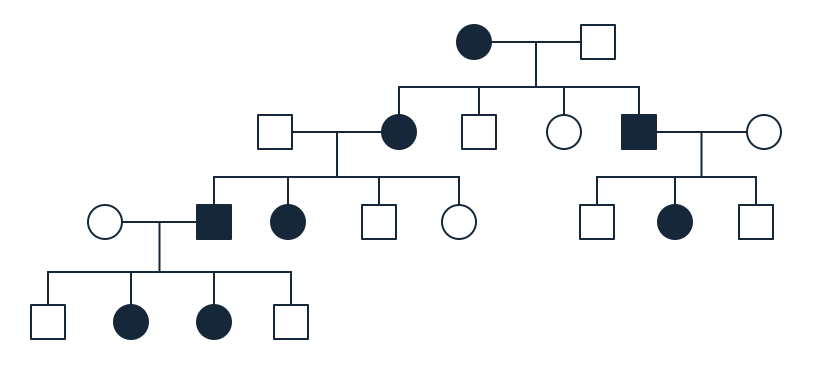
The following pedigree diagram shows the inheritance of a rare genetic disorder (filled shapes depict affected individuals). IAT 2024, Biology, question 2 — question diagram Which of the following is the most likely pattern of inheritance of the disorder?
  1. X-linked recessive
  2. X-linked dominant
  3. Autosomal recessive
  4. Autosomal dominant
Answer & worked solution
Answer B
The trait occurs in successive generations and affects both sexes. In the shown affected-father branches, daughters are affected while sons are not, supporting X-linked dominant transmission. The affected mother can transmit to children of either sex. Together these observations favour B over the recessive and autosomal alternatives.

Question 3

IAT 2024 · Biology

Which of the following proteins plays a direct role in muscle contraction?

  1. Trypsin
  2. Insulin
  3. Myoglobin
  4. Troponin
Answer & worked solution
Answer D
Calcium binds troponin in a skeletal muscle fibre. This changes the position of the troponin–tropomyosin complex and exposes myosin-binding sites on actin, directly permitting contraction. Myoglobin stores oxygen, insulin is a hormone and trypsin is a digestive enzyme; none has this direct regulatory role.

Question 4

IAT 2024 · Biology
Which of the following is NOT derived from the epidermal cell layer in plants?
  1. Subsidiary cells from rice leaf
  2. Trichomes from maize leaf
  3. Casparian strip from rice root
  4. Bulliform cells from grass
Answer & worked solution
Answer C
The Casparian strip is a suberin-rich band in the endodermal cell walls of roots. The endodermis is the inner layer of the cortex rather than the epidermis. Subsidiary cells, trichomes and bulliform cells are epidermal specialisations, so C is the exception.

Question 5

IAT 2024 · Biology

 Match the list of conditions with the list of affected physiological processes. 

Column I Column II
P Allergy i Excess secretion of growth hormone
Q Uremia ii Exaggerated immune response to environmental substances
R Myasthenia gravis iii Autoimmune disorder affecting the neuromuscular junction
S Acromegaly iv Malfunctioning of kidneys which can lead to urea accumulation in the blood

Which of the following combinations is correct?

  1. 𝑃(𝑖𝑣);𝑄(𝑖𝑖𝑖);𝑅(𝑖);𝑆(𝑖𝑖)
  2. 𝑃(𝑖𝑖𝑖);𝑄(𝑖𝑣);𝑅(𝑖);𝑆(𝑖𝑖)
  3. 𝑃(𝑖𝑖);𝑄(𝑖𝑣);𝑅(𝑖𝑖𝑖);𝑆(𝑖)
  4. 𝑃(𝑖𝑖);𝑄(𝑖);𝑅(𝑖𝑣);𝑆(𝑖𝑖𝑖)
Answer & worked solution
Answer C
Allergy is an exaggerated immune response to environmental substances, P–ii. Uremia involves urea accumulation when renal function fails, Q–iv. Myasthenia gravis is autoimmune dysfunction at the neuromuscular junction, R–iii. Excess growth hormone in adults causes acromegaly, S–i. The complete mapping is C.

Question 6

IAT 2024 · Biology
Which of the following statements about meiosis in sexually reproducing plants is INCORRECT?
  1. The end products of meiosis II are haploid gametes.
  2. The four products of meiosis are genetically different.
  3. Meiotic recombination takes place in both males and females
  4. In most flowering plants, only one of the four products of meiosis survives in females.
Answer & worked solution
Answer A
In the plant life cycle, meiosis in spore mother cells produces haploid spores. Gametes subsequently arise within the haploid gametophyte by mitotic development. Thus calling the immediate products of meiosis II gametes is incorrect here; A confuses the plant sequence with the usual animal sequence.

Question 7

IAT 2024 · Biology
Which of the following is routinely performed to detect typhoid?
  1. RT-PCR
  2. ELISA
  3. Gel electrophoresis
  4. Widal test
Answer & worked solution
Answer D
Widal is the textbook agglutination test associated with detecting antibodies against Salmonella Typhi antigens. This identifies D as the exam answer. The question asks for the named test in this syllabus context, not for a stand-alone clinical diagnostic protocol.

Question 8

IAT 2024 · Biology
A population with N = 400 individuals increases in numbers till it reaches an asymptote at K = 500 individuals, K being the carrying capacity. Assuming the intrinsic rate of natural increase (r) to be 0.01, what would be the population growth rate (dN/dt)?
  1. 1
  2. 0.05
  3. 0.8
  4. 0.4

Transcription note: Restored words missing from the secondary transcription using the 2024 paper.

Answer & worked solution
Answer C
Use the logistic growth equation dN/dt=rN(1N/K)dN/dt=rN(1-N/K). At N = 400, K = 500 and r = 0.01, this gives 0.01(400)(1400/500)=4(0.2)=0.80.01(400)(1-400/500)=4(0.2)=0.8. The population has not yet reached carrying capacity, so its growth rate is positive.

Question 9

IAT 2024 · Biology

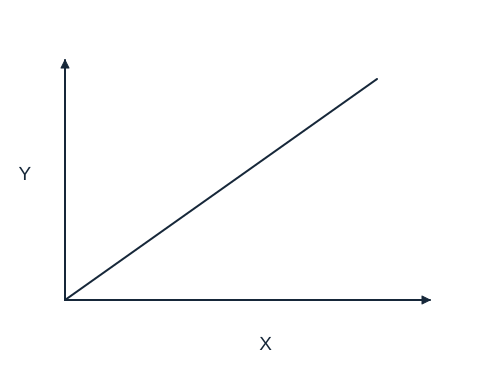
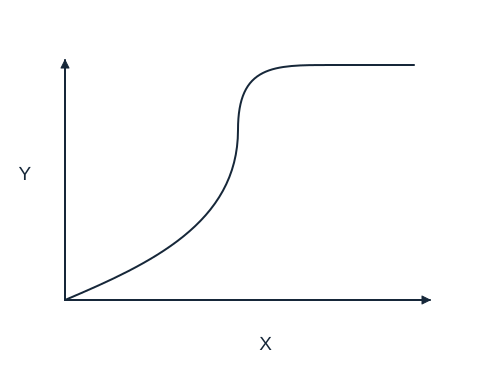
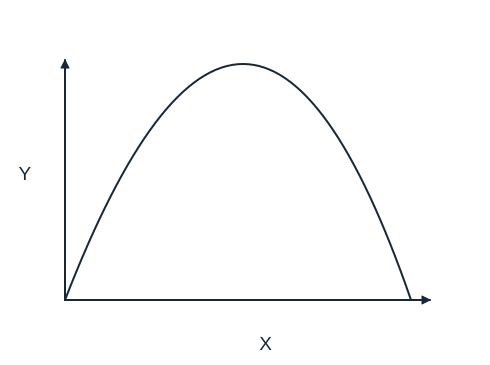
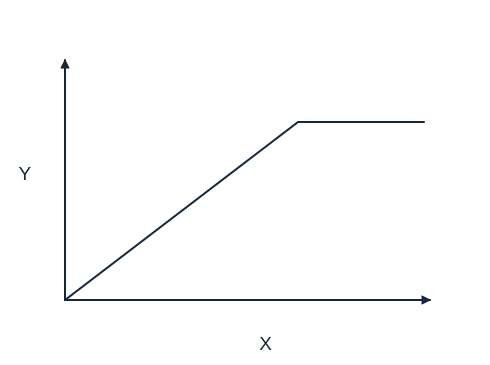
Which of the following graphs represents the correct relationship between light intensity (Xaxis) and the rate of photosynthesis ( 𝑌-axis)?

  1. IAT 2024, Biology, question 9 — option A

  2. IAT 2024, Biology, question 9 — option B

  3. IAT 2024, Biology, question 9 — option C

  4. IAT 2024, Biology, question 9 — option D

Answer & worked solution
Answer D
At low light intensity, increasing light raises the photosynthetic rate because light is limiting. Beyond the saturation region, other factors limit the process and the rate levels off. Diagram D gives the intended rising-then-plateau relationship; unlimited linear increase, a sigmoid, or a decline to zero does not represent this standard comparison.

Question 10

IAT 2024 · Biology

 Match the enzymes in Column I with the cellular compartments in Column II. 

Column I Column II
P Succinate dehydrogenase i Cytoplasm
Q Pyruvate dehydrogenase ii Inner mitochondrial membrane
R Lactate dehydrogenase iii Mitochondrial matrix
S ATP synthase iv Thylakoid membrane
v Inner chloroplast membrane
Which of the following combinations is correct?
  1. 𝑃(𝑖𝑖);𝑄(𝑖𝑖𝑖);𝑅(𝑖);𝑆(𝑖𝑣)
  2. 𝑃(𝑖𝑣);𝑄(𝑖);𝑅(𝑖𝑖𝑖);𝑆(𝑖𝑖)
  3. 𝑃(𝑖𝑖𝑖);𝑄(𝑖𝑖);𝑅(𝑖);𝑆(𝑖𝑣)
  4. 𝑃(𝑖𝑖𝑖);𝑄(𝑖);𝑅(𝑖𝑣);𝑆(𝑖𝑖)
Answer & worked solution
Answer A
Succinate dehydrogenase is Complex II in the inner mitochondrial membrane, P–ii. Pyruvate dehydrogenase acts in the mitochondrial matrix, Q–iii. Lactate dehydrogenase is cytoplasmic, R–i. Photosynthetic ATP synthase is in the thylakoid membrane, S–iv. Mitochondria also contain ATP synthase, but A is the complete correct combination offered.

Question 11

IAT 2024 · Biology

Two species of a flowering plant, 𝑃(2𝑛=20 chromosomes) and 𝑄 ( 2𝑛=30 chromosomes) are reciprocally crossed with each other as male or female as shown below to produce F1 seeds. Which of the following seed tissues from both the F1 seeds ( 𝑅 and 𝑆 ) will have the same chromosome numbers?

IAT 2024, Biology, question 11 — question diagram
  1. Endosperm
  2. Embryo
  3. Embryo and seed coat
  4. Embryo and endosperm
Answer & worked solution
Answer B
P produces gametes with 10 chromosomes and Q with 15. An embryo from either reciprocal cross therefore has 10+15=2510+15=25 chromosomes. Endosperm has two maternal complements and one paternal, giving 35 in one direction and 40 in the other. Seed coat is maternal tissue with 20 or 30. Only the embryos match.

Question 12

IAT 2024 · Biology

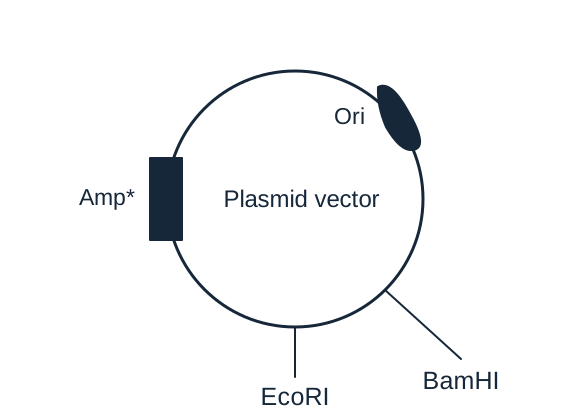
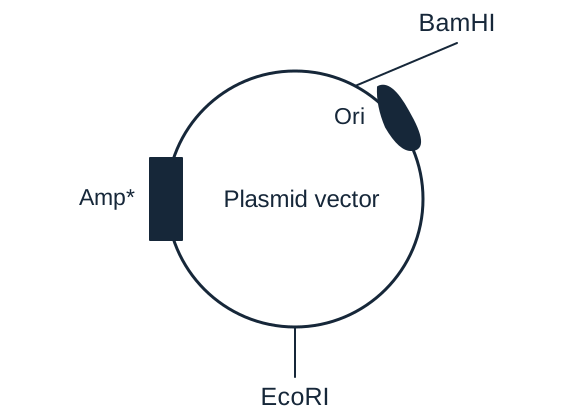
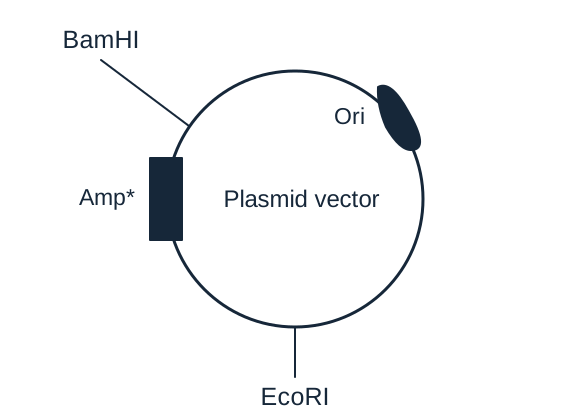
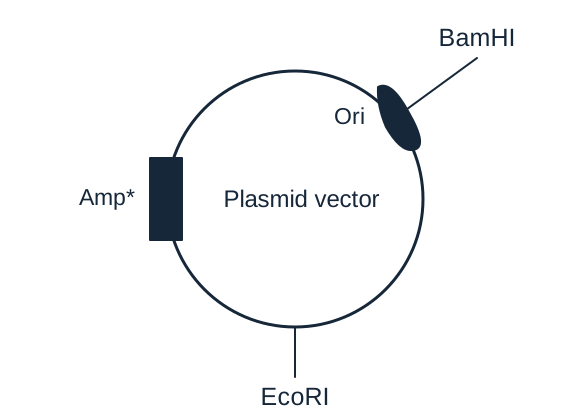
Which of the following plasmid vectors can be used for cloning of a gene, with restriction enzymes BamHI and EcoRI, and ampicillin-containing nutrient agar for selection? [Ori - origin of replication; Amp𝑅 - gene for ampicillin resistance]

  1. IAT 2024, Biology, question 12 — option A
  2. IAT 2024, Biology, question 12 — option B
  3. IAT 2024, Biology, question 12 — option C
  4. IAT 2024, Biology, question 12 — option D
Answer & worked solution
Answer A
A usable recombinant must retain both an intact origin of replication and the ampicillin-resistance gene. In A, BamHI and EcoRI flank a region outside both essential features, so the retained backbone can replicate and support ampicillin selection after insertion. The other arrangements split the necessary features between fragments or cut within the origin.

Question 13

IAT 2024 · Biology

Polymerase chain reaction (PCR) is used to amplify a gene of interest (GOI). If, after 30 cycles of PCR, 1 billion copies of GOI are produced, approximately how many copies of GOI were present at the end of the 20th  cycle?

  1. 10 million
  2. 0.66 billion
  3. 1 million
  4. 0.1 billion
Answer & worked solution
Answer C
Ten further ideal PCR cycles multiply the copy number by 210=10242^{10}=1024. Thus the number at cycle 20 is approximately 109/1024=976562.510^9/1024=976562.5, close to one million. The non-integer numerical result simply reflects the question's rounded final count.

Question 14

IAT 2024 · Biology
Which one of the following statements is correct?
  1. Hemichordata is not a chordate sub-phylum because it has a water vascular system.
  2. Hemichordata is a chordate sub-phylum with a proto-notochord called stomochord.
  3. Hemichordata is a chordate sub-phylum with a proper notochord and gill slits.
  4. Hemichordata is not a chordate sub-phylum, with a proto-notochord called stomochord.
Answer & worked solution
Answer D
Hemichordata is treated as a separate phylum, not a chordate subphylum. It has a stomochord, historically compared with a notochord, but this is not a true chordate notochord. D is the intended choice using the question's terminology; the water vascular system belongs to echinoderms.

Question 15

IAT 2024 · Biology

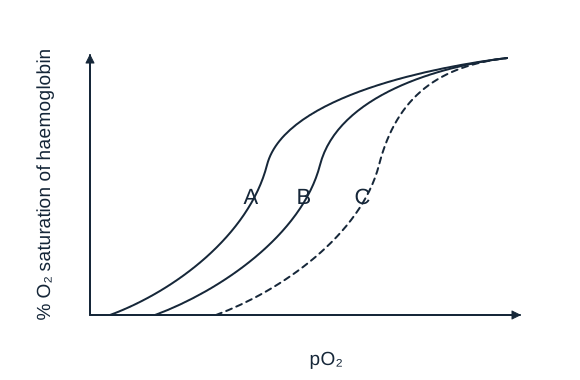
Which of the following statements is correct about the oxygen (O2) dissociation curves A and C relative to curve B ?
IAT 2024, Biology, question 15 — question diagram
  1. Curve C represents favourable O2 association with haemoglobin at low pCO2.
  2. Curve A represents favourable O2 association with haemoglobin at low [H+].
  3. Curve A represents favourable O2 association with haemoglobin at low pH .
  4. Curve C represents favourable O2 association with haemoglobin at high pO2.

Transcription note: Restored low hydrogen-ion concentration in option B from the paper; the secondary source repeated the low-pH distractor.

Answer & worked solution
Answer B
Curve A is shifted left of B, meaning greater haemoglobin oxygen affinity at the same oxygen partial pressure. Lower hydrogen-ion concentration, equivalent to higher pH, favours this shift. Lower pH instead promotes the right shift shown by C. The restored low-[H+] statement in B is therefore correct.

Chemistry

Question 1

IAT 2024 · Chemistry
If an element with 𝑍=120 is discovered, then which group of elements will it belong to?
  1. Noble gases
  2. Halogens
  3. Alkali metals
  4. Alkaline earth metals
Answer & worked solution
Answer D
In the Aufbau model used for this prediction, element 118 closes the 7p shell. The next two electrons occupy 8s, so Z = 120 would have an 8s2 valence configuration and belong to group 2, the alkaline earth metals. This is a predicted placement rather than a claim that the element has been discovered.

Question 2

IAT 2024 · Chemistry
Which one of the following statements is correct about N2,CO, and NO+?
  1. These are isoelectronic and have identical bond order.
  2. These are isoelectronic and have different bond orders.
  3. These are not isoelectronic but have identical bond order.
  4. These are neither isoelectronic nor have identical bond order.
Answer & worked solution
Answer A
N2 has 14 total electrons, CO has 6+8=146+8=14, and NO+ has 7+81=147+8-1=14. Their molecular-orbital occupancies give bond order 3 in each case. Thus they are isoelectronic and have identical bond order, even though their atoms and charge distributions differ.

Question 3

IAT 2024 · Chemistry
Which of the following complexes exhibit(s) magnetic moment close to 2 BM ? [Fe(H2O)6](NO3)2, K2[MnCl4],K4[Mn(CN)6], and [Ni(CO)4]
  1. K4[Mn(CN)6] and [Ni(CO)4]
  2. 𝐾2[MnCl4] and 𝐾4[Mn(CN)6]
  3. [Fe(H2O)6](NO3)2 and K2[MnCl4]
  4. Only 𝐾4[Mn(CN)6]
Answer & worked solution
Answer D
The aqua Fe(II) ion is high-spin d6 with four unpaired electrons; tetrahedral Mn(II) chloride is high-spin d5 with five. Strong-field cyanide makes Mn(II) low-spin d5 with one unpaired electron, giving μ=31.73\mu=\sqrt3\approx1.73 BM, close to 2. Ni(CO)4 is d10 and diamagnetic. Only K4[Mn(CN)6] qualifies.

Question 4

IAT 2024 · Chemistry
According to the VSEPR theory, what are the most stable shapes of XeF4 and SF4, respectively?
  1. See-saw and square planar
  2. Both see-saw
  3. Square planar and see-saw
  4. Both square planar

Transcription note: Restored XeF4; the secondary transcription incorrectly displayed X4F4.

Answer & worked solution
Answer C
XeF4 has four bond pairs and two lone pairs around xenon. The electron-pair arrangement is octahedral, with lone pairs opposite, leaving a square-planar molecular shape. SF4 has four bonds and one equatorial lone pair in a trigonal-bipyramidal arrangement, producing a see-saw shape. Thus C gives the correct order.

Question 5

IAT 2024 · Chemistry

The following complex ions absorb in the ultraviolet-visible region of light. Which one of these shows violet colour?

[CoCl(NH3)5]2+,[Co(H2O)(NH3)5]3+,[Co(NH3)6]3+, and [Co(CN)6]3

  1. [Co(H2O)(NH3)5]3+
  2. [CoCl(NH3)5]2+
  3. [Co(NH3)6]3+
  4. [Co(CN)6]3
Answer & worked solution
Answer B
The chloride ligand produces the smallest splitting among these closely related cobalt(III) complexes. The chloropentaammine ion absorbs in the complementary yellow-green region and appears violet/purple. Replacing chloride by water, ammonia or cyanide shifts the absorption as ligand-field strength increases. The violet complex listed is [CoCl(NH3)5]2+[\mathrm{CoCl(NH_3)_5}]^{2+}.

Question 6

IAT 2024 · Chemistry

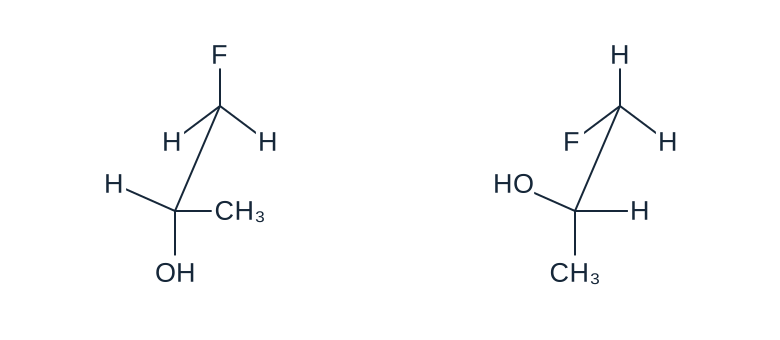
 What is the relationship between the structures depicted below? 

IAT 2024, Chemistry, question 6 — question diagram
  1. Conformational isomers
  2. Structural isomers
  3. Enantiomers
  4. Positional isomers
Answer & worked solution
Answer A
Both drawings have the same atom connectivity and the same configuration at the alcohol-bearing stereocentre. The differing placements result from rotation about a carbon–carbon single bond in the sawhorse representation. They are therefore conformational isomers, not structures with a different bonding order or a mirror-inverted stereocentre.

Question 7

IAT 2024 · Chemistry
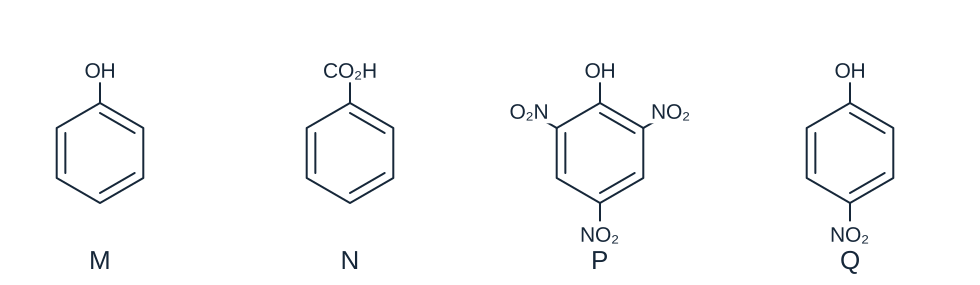
 What is the correct order of acidity for the following compounds?  IAT 2024, Chemistry, question 7 — question diagram
  1. 𝑁>𝑃>𝑄>𝑀
  2. P>Q>N>M
  3. N>P>M>Q
  4. P>N>Q>M
Answer & worked solution
Answer D
P is picric acid, whose three nitro groups strongly stabilise the phenoxide ion, making it the strongest acid. N is benzoic acid, followed by para-nitrophenol Q and then unsubstituted phenol M. Thus the acidity order is P>N>Q>MP>N>Q>M.

Question 8

IAT 2024 · Chemistry

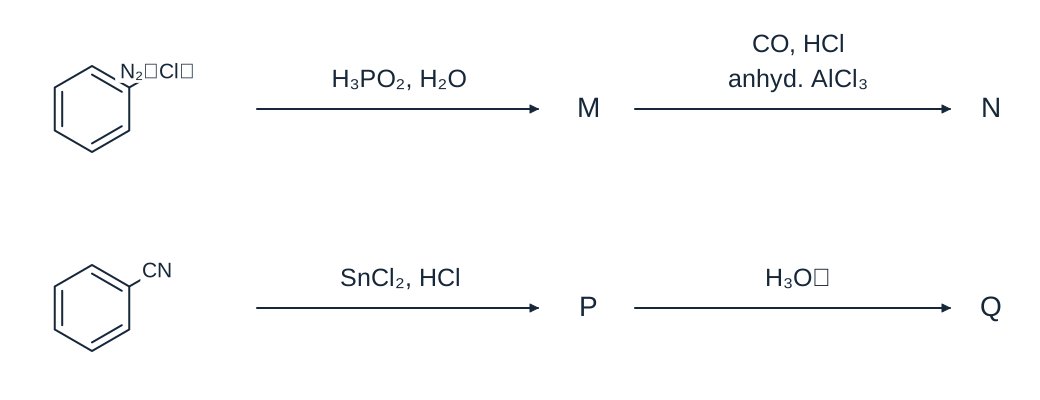
 What are the products N and Q in the following reaction sequences? 

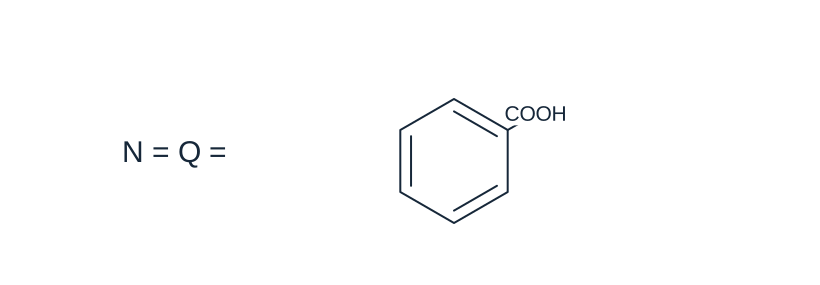
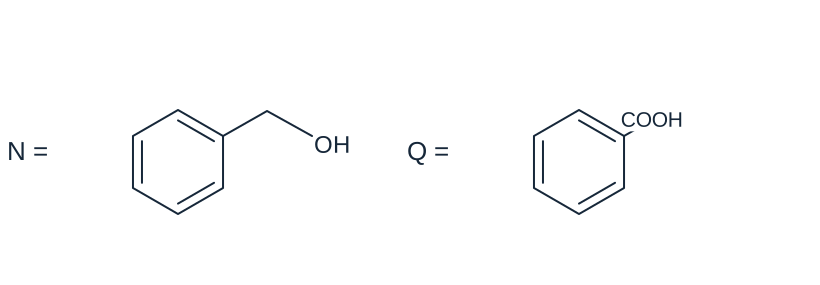
IAT 2024, Chemistry, question 8 — question diagram
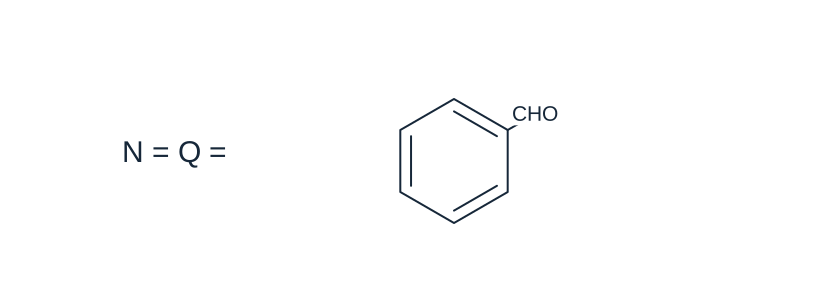
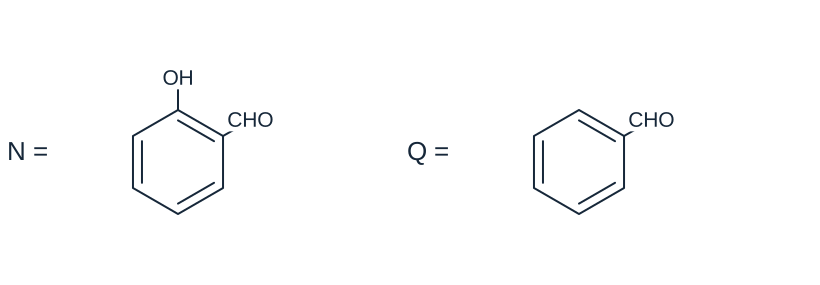
  1. IAT 2024, Chemistry, question 8 — option A
  2. IAT 2024, Chemistry, question 8 — option B
  3. IAT 2024, Chemistry, question 8 — option C
  4. IAT 2024, Chemistry, question 8 — option D
Answer & worked solution
Answer C
Hypophosphorous acid replaces the diazonium group by hydrogen, giving benzene M. Gattermann–Koch formylation with CO/HCl then produces benzaldehyde N. Separately, Stephen reduction of benzonitrile with SnCl2/HCl followed by hydrolysis produces benzaldehyde Q. Therefore N and Q are both benzaldehyde, as in C.

Question 9

IAT 2024 · Chemistry

 What are 𝑋 and 𝑍 in the following sequence of reactions? 

IAT 2024, Chemistry, question 9 — question diagram
  1. IAT 2024, Chemistry, question 9 — option A
  2. IAT 2024, Chemistry, question 9 — option B
  3. IAT 2024, Chemistry, question 9 — option C
  4. IAT 2024, Chemistry, question 9 — option D
Answer & worked solution
Answer A
Mercuric-ion-catalysed hydration of propyne gives an enol that tautomerises to acetone Y. Acetone then undergoes crossed aldol condensation with benzaldehyde Z, followed by dehydration, giving the shown PhCH=CHCOCH3\mathrm{PhCH{=}CHCOCH_3}. Thus X is propyne and Z is benzaldehyde, option A.

Question 10

IAT 2024 · Chemistry

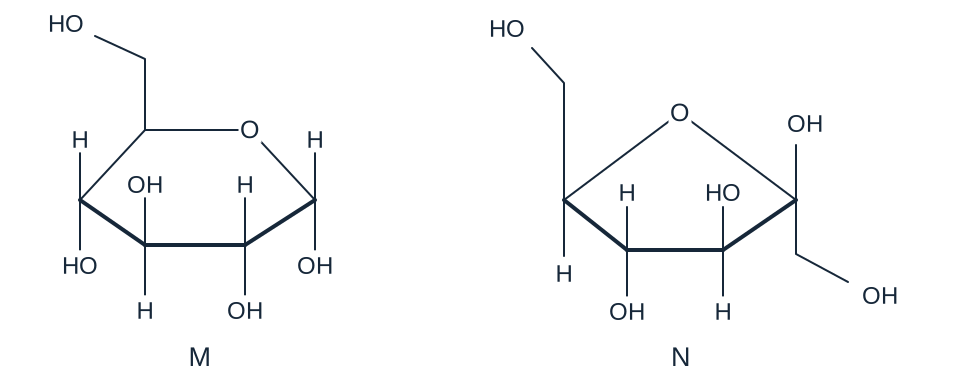
 What are the correct structural descriptions for 𝑀 and 𝑁 ? 

IAT 2024, Chemistry, question 10 — question diagram
  1. M is 𝛽-D-(+)-glucopyranose and N is 𝛽-D-(-)-fructofuranose
  2. M is 𝛼D(+)-glucopyranose and N is 𝛽-D-(-)-fructofuranose
  3. M is 𝛼D(+)-glucopyranose and N is 𝛼D()-fructofuranose
  4. M is 𝛼D(+)-glucofuranose and N is 𝛽-D-(-)-fructopyranose
Answer & worked solution
Answer B
M contains a six-membered glucose ring, so it is glucopyranose. Its anomeric OH is opposite the upward CH2OH group of the D sugar, identifying the alpha anomer. N contains a five-membered fructose ring and its anomeric OH has the beta orientation. The matching description is alpha-D-(+)-glucopyranose and beta-D-(−)-fructofuranose.

Question 11

IAT 2024 · Chemistry
Consider an exothermic reaction: 2 A( s)B(s)+C(g)+D(g). The correct statement about the reaction is
  1. Spontaneous only at very low temperatures
  2. Spontaneous only at very high temperatures
  3. Non-spontaneous at all temperatures
  4. Spontaneous at all temperatures
Answer & worked solution
Answer D
The reaction is exothermic, so ΔH<0\Delta H<0. Formation of two gaseous products from solids gives the positive entropy change assumed in this comparison, ΔS>0\Delta S>0. Therefore ΔG=ΔHTΔS<0\Delta G=\Delta H-T\Delta S<0 at every positive temperature within the stated model, making it spontaneous at all temperatures.

Question 12

IAT 2024 · Chemistry
The minimum energy needed to remove an electron from a metal corresponds to a wavelength of 500 nm . What is the total kinetic energy of all the photoelectrons ejected per second when the entire radiation from a 100 Watt bulb with a wavelength of 300 nm falls on the surface of the metal? [Planck's constant =6.6×1034Js; speed of light =3×10⁸ ms1 ]
  1. 1.6×10¹⁹ J
  2. 2.6×10¹⁹ J
  3. 40 J
  4. 80 J

Transcription note: Restored the minus sign in Planck’s constant, 6.6 × 10⁻³⁴ J s, from the paper.

Answer & worked solution
Answer C · qualification below

Uses the ideal one-photoelectron-per-absorbed-photon model.

A 300 nm photon has energy E=hc/300E=hc/300 nm, while the work function is ϕ=hc/500\phi=hc/500 nm. The fraction of incident photon energy available as photoelectron kinetic energy is 1ϕ/E=1300/500=0.41-\phi/E=1-300/500=0.4. With the ideal one-emitted-electron-per-absorbed-photon assumption, 100 J of radiation per second therefore supplies 40 J of electron kinetic energy per second.

Question 13

IAT 2024 · Chemistry
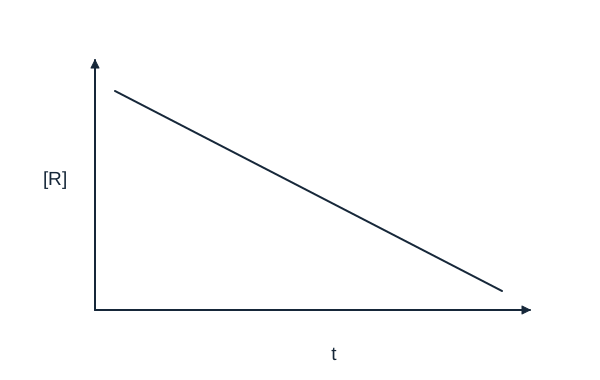
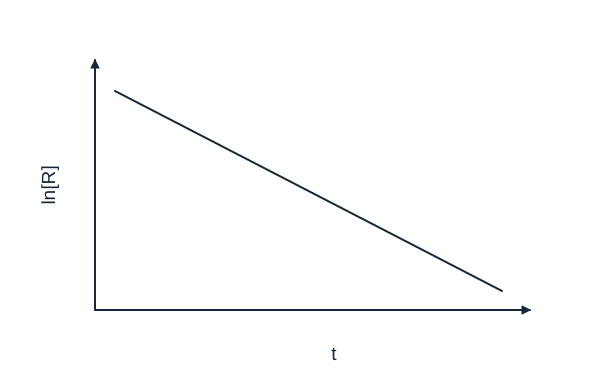
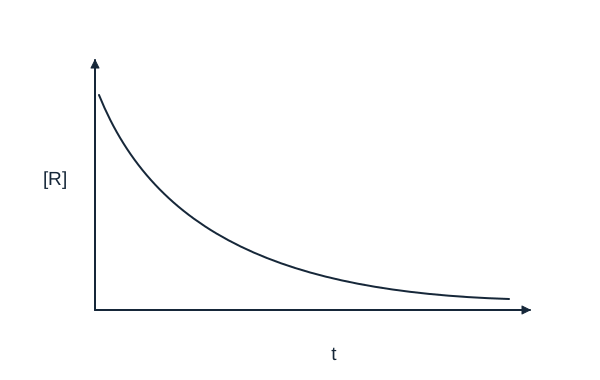
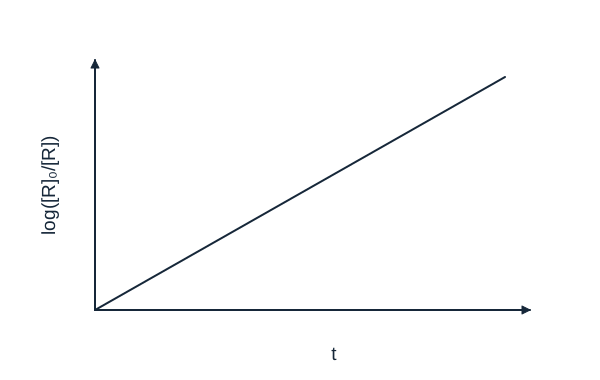
For a reaction 𝑅𝑃 with a rate constant of 3×10³ mol L1 s1, which one of the following plots is correct? (Given [R] ]0 is the initial concentration of 𝑅 and [𝑅] is the concentration of 𝑅 at time t)
  1. IAT 2024, Chemistry, question 13 — option A
  2. IAT 2024, Chemistry, question 13 — option B
  3. IAT 2024, Chemistry, question 13 — option C
  4. IAT 2024, Chemistry, question 13 — option D
Answer & worked solution
Answer A
The rate constant has concentration-per-time units, so the reaction is zero order. Its integrated equation is [R]=[R]0kt[R]=[R]_0-kt until the reactant is exhausted. Concentration versus time is therefore a straight line with slope −k and intercept [R]0, matching A. Logarithmic linear plots would describe first-order kinetics instead.

Question 14

IAT 2024 · Chemistry
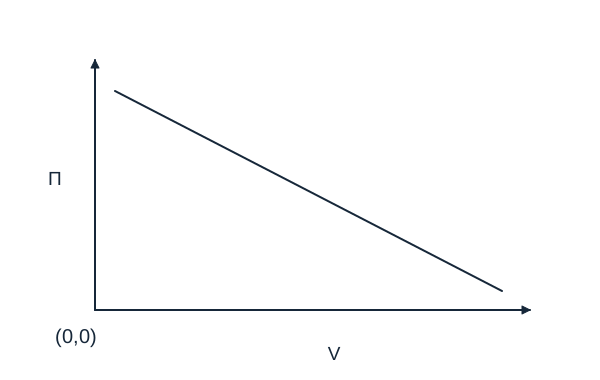
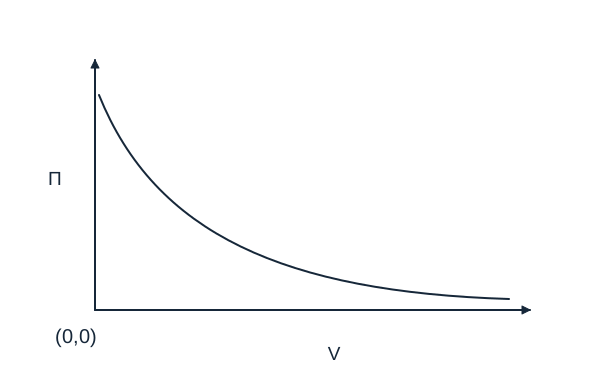
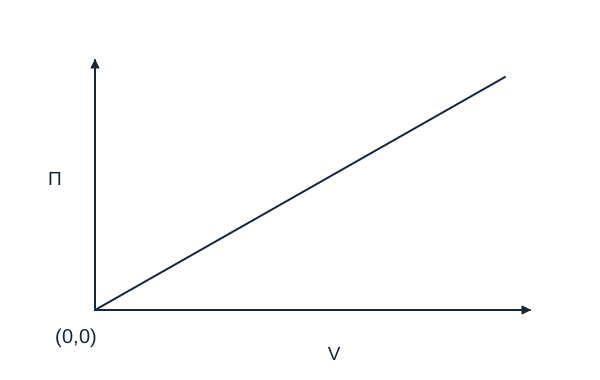
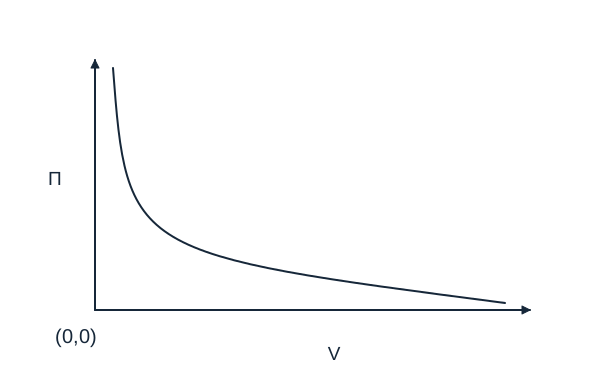
Which one of these plots correctly describes the variation of osmotic pressure ( Π ) of a fixed amount of a solute against the volume (V) of the solution at a fixed temperature?
  1. IAT 2024, Chemistry, question 14 — option A
  2. IAT 2024, Chemistry, question 14 — option B
  3. IAT 2024, Chemistry, question 14 — option C
  4. IAT 2024, Chemistry, question 14 — option D
Answer & worked solution
Answer D
For fixed solute amount and temperature, the ideal dilute-solution law is ΠV=nRT\Pi V=nRT. Thus Π=nRT/V\Pi=nRT/V, a rectangular hyperbola with both coordinate axes as asymptotes. D depicts this inverse relation; in particular osmotic pressure does not remain finite at V = 0 in the mathematical model.

Question 15

IAT 2024 · Chemistry

Consider the following data for KCl solution at a particular temperature. What is the value of the limiting molar conductivity?

 Concentration (mol L1) Molar Conductivity (S cm2 mol1)1×104149.19×104147.1

  1. 149.2 S cm2 mol1
  2. 150.1 S cm2 mol1
  3. 151.1 S cm2 mol1
  4. 152.1 S cm2 mol1
Answer & worked solution
Answer B
For a strong electrolyte at low concentration, Λm=Λm0Kc\Lambda_m=\Lambda_m^0-K\sqrt c. The square roots of the two concentrations are 0.01 and 0.03. Hence K=(149.1147.1)/(0.030.01)=100K=(149.1-147.1)/(0.03-0.01)=100. Extrapolating to zero concentration gives Λm0=149.1+100(0.01)=150.1 Scm2mol1\Lambda_m^0=149.1+100(0.01)=150.1\ \mathrm{S\,cm^2\,mol^{-1}}.

Mathematics

Question 1

IAT 2024 · Mathematics

Consider the following lines in the 𝑋𝑌-plane:

𝐿1:5𝑥2𝑦=1

𝐿2 : The line passing through (0,1) and (100,101),

𝐿3 : The line passing through (1,11) and parallel to the vector ıˆ+2ȷˆ.

Let 𝐴=(𝐿1𝐿2)(𝐿2𝐿3)(𝐿3𝐿1). What is the total number of elements of 𝐴 ?

  1. 0
  2. 1
  3. 2
  4. 3
Answer & worked solution
Answer D
The three lines are y=(5x1)/2y=(5x-1)/2, y=x+1y=x+1 and y=2x+13y=-2x+13. Their slopes differ, so each pair intersects. The first two meet at (1,2), which is not on the third line; therefore the three lines are not concurrent and produce three distinct pairwise intersection points.

Question 2

IAT 2024 · Mathematics
Let 𝐴 be the set of points in the 𝑋𝑌-plane which are equidistant from 𝑃(1,0) and 𝑄(1,0). Let 𝐵 be the set of points in the 𝑋𝑌-plane which are equidistant from 𝐴 and 𝑄. If (5,𝑦) is a point in 𝐵, then what is the value of 𝑦2 ?
  1. 1
  2. 4
  3. 9
  4. 16
Answer & worked solution
Answer C
Points equidistant from P and Q form the perpendicular bisector x = 0. For (5,y), distance to this line is 5, while distance to Q = (1,0) is 16+y2\sqrt{16+y^2}. Equating them gives 25=16+y225=16+y^2, so y2=9y^2=9.

Question 3

IAT 2024 · Mathematics

Consider the lines 𝐿1 and 𝐿2 given below:

𝐿1:𝑥=2+𝜆,𝑦=3+2𝜆,𝑧=4+3𝜆𝐿2:𝑥=4+𝜆,𝑦=4,𝑧=4+𝜆

If (2,3,4) is the point of 𝐿1 that is closest to 𝐿2, then which point of 𝐿2 is closest to 𝐿1 ?

  1. (3,4,3)

  2. (3,4,4)

  3. (5,4,5)

  4. (4,4,4)

Answer & worked solution
Answer A
A point on L2 is (4+t,4,4+t)(4+t,4,4+t). Its displacement from (2,3,4) is (2+t,1,t)(2+t,1,t). At the shortest connector this is perpendicular to L2's direction (1,0,1), giving 2+2t=02+2t=0 and t = −1. The point is (3,4,3), and the connector (1,1,−1) is also perpendicular to L1's direction (1,2,3), confirming the common perpendicular.

Question 4

IAT 2024 · Mathematics
Let 𝑎1,𝑎2,𝑎3, be a sequence of real numbers. Let 𝑠𝑛=𝑎1+𝑎2++𝑎𝑛. If 2𝑠𝑛= 𝑛(𝑐+𝑎𝑛) for some real number 𝑐 and for all 𝑛=1,2,3,, then which one of the following statements is Correct?
  1. 𝑎1,2𝑎2,3𝑎3, is an Arithmetic Progression.
  2. 𝑎1,𝑎2,𝑎3, is an Arithmetic Progression.
  3. 𝑎1,2𝑎2,3𝑎3, is a Geometric Progression.
  4. 𝑎1,𝑎2,𝑎3, ...is a Geometric Progression.
Answer & worked solution
Answer B
At n = 1, the identity gives a1=ca_1=c. Subtract its version at n−1 from the one at n to obtain (n2)an=(n1)an1c(n-2)a_n=(n-1)a_{n-1}-c for n ≥ 3. Equivalently, (anc)/(n1)=(an1c)/(n2)(a_n-c)/(n-1)=(a_{n-1}-c)/(n-2). This ratio is constant from n = 2 onward, so an=c+(n1)(a2c)a_n=c+(n-1)(a_2-c), an arithmetic progression.

Question 5

IAT 2024 · Mathematics
Let 𝑓:𝐑𝐑 be a strictly decreasing function with |𝑓(𝑡)|<𝜋/2 for all 𝑡𝐑. Let 𝑔:[0,𝜋] R be a function defined by 𝑔(𝑡)=sin(𝑓(𝑡)). Which one of the following statements is Correct?
  1. 𝑔 is increasing on [0,𝜋].
  2. 𝑔 is decreasing on [0,𝜋].
  3. 𝑔 is increasing on (0,𝜋/2) and decreasing on (𝜋/2,𝜋).
  4. 𝑔 is decreasing on (0,𝜋/2) and increasing on (𝜋/2,𝜋).
Answer & worked solution
Answer B
Sine is strictly increasing on (π/2,π/2)(-\pi/2,\pi/2), the interval containing every value of f. Composing this increasing function with the strictly decreasing f preserves the decreasing order: if s < t, then f(s)>f(t)f(s)>f(t) and sinf(s)>sinf(t)\sin f(s)>\sin f(t). Thus g decreases on the whole specified interval.

Question 6

IAT 2024 · Mathematics
Let 𝑓,𝑔:𝑅𝑅 be functions. If 𝑔 is continuous, then which one of the following cases implies that 𝑓 is continuous?
  1. 𝑔(𝑥)=(𝑓(𝑥))2
  2. 𝑔(𝑥)=|𝑓(𝑥)|
  3. 𝑔(𝑥)=(𝑓(𝑥))3
  4. 𝑔(𝑥)=sin(𝑓(𝑥))
Answer & worked solution
Answer C
In C, f(x)=g(x)3f(x)=\sqrt[3]{g(x)}. The real cube-root function is continuous everywhere, so a continuous g forces f to be continuous. Squaring, absolute value and sine can hide jumps in f because those maps are not one-to-one, so the other cases do not force continuity.

Question 7

IAT 2024 · Mathematics
What is the largest area of a rectangle, whose sides are parallel to the coordinate axes, that can be inscribed under the graph of the curve 𝑦=1𝑥2 and above the 𝑥-axis?
  1. 233
  2. 433
  3. 13
  4. 43
Answer & worked solution
Answer B
At half-width x, a maximal rectangle has symmetric endpoints ±x and height 1x21-x^2. Its area is A(x)=2x(1x2)A(x)=2x(1-x^2) for 0 ≤ x ≤ 1. Differentiation gives A=26x2A'=2-6x^2, so the interior maximum occurs at x=1/3x=1/\sqrt3. The area is then 4/(33)4/(3\sqrt3); the endpoint areas are zero.

Question 8

IAT 2024 · Mathematics
Let 𝑀 be the set of all 3×3 matrices with real entries. Consider the relation 𝑅 on 𝑀 given by 𝑅={(𝐴,𝐵)𝑀×𝑀:det(𝐴𝐵) is an integer }. Which one of the following statements is Correct?
  1. 𝑅 is reflexive and symmetric, but not transitive.
  2. 𝑅 is reflexive, but neither symmetric nor transitive.
  3. 𝑅 is an equivalence relation.
  4. 𝑅 is symmetric and transitive, but not reflexive.
Answer & worked solution
Answer A
Reflexivity follows from det(AA)=0\det(A-A)=0. For 3×3 matrices, det(BA)=det(AB)\det(B-A)=-\det(A-B), so integrality is symmetric. Transitivity fails: take A=0A=0, B=diag(1,0,0)B=\operatorname{diag}(1,0,0) and C=diag(1,1,1/2)C=\operatorname{diag}(1,1,1/2). Then det(A−B) and det(B−C) are zero, but det(A−C) = −1/2 is not an integer.

Question 9

IAT 2024 · Mathematics
What is the value of 23𝐶0+23𝐶2+23𝐶4++23𝐶22 ?
  1. 223
  2. 2221
  3. 223+1
  4. 222
Answer & worked solution
Answer D
Add the binomial expansions of (1+1)23(1+1)^{23} and (11)23(1-1)^{23}. Odd-index terms cancel and even-index terms double. Hence the required sum is (223+0)/2=222(2^{23}+0)/2=2^{22}.

Question 10

IAT 2024 · Mathematics
Let 𝑓:𝑄𝑄 be a function such that 𝑓(𝑥+𝑦)=𝑓(𝑥)+𝑓(𝑦) for all 𝑥,𝑦𝐐, and 𝑓(1)= 10. Which one of the following statements is Correct?
  1. 𝑓 is neither injective nor surjective
  2. 𝑓 is injective but not surjective
  3. 𝑓 is surjective but not injective
  4. 𝑓 is bijective
Answer & worked solution
Answer D
Additivity gives f(0) = 0, f(n) = 10n for integers, and qf(p/q)=f(p)=10pqf(p/q)=f(p)=10p. Thus f(x)=10xf(x)=10x for every rational x. Multiplication by nonzero 10 is injective on the rationals, and any rational y is the image of y/10, so f is also surjective.

Question 11

IAT 2024 · Mathematics
Let 𝐼=𝑒𝜋/2𝑒𝜋/2(sin2(log(𝑥))+sin(log(𝑥2)))𝑑𝑥. What is the value of 𝐼 ?
  1. 0
  2. 𝜋𝑒𝜋22
  3. 𝑒𝜋/2𝑒𝜋/2
  4. 𝑒𝜋1
Answer & worked solution
Answer C
Put u=logxu=\log x, so dx=eududx=e^u du and the limits become ±π/2. An antiderivative of eu(sin2u+sin2u)e^u(\sin^2u+\sin2u) is 12eu(1cos2u)\frac12e^u(1-\cos2u), as differentiation verifies. At both endpoints cos 2u = −1, so evaluation gives eπ/2eπ/2e^{\pi/2}-e^{-\pi/2}.

Question 12

IAT 2024 · Mathematics

Consider the following subset of the 𝑋𝑌-plane.

𝑆={(|𝑧i𝑧|,|𝑧|2):𝑧 is a complex number }

Which one of the following statements is correct?

  1. 𝑆 is a circle
  2. 𝑆 is a parabola.
  3. 𝑆 is an ellipse but not a circle
  4. 𝑆 is a hyperbola.
Answer & worked solution
Answer B · qualification below

The locus is only the right-hand half of the named parabola.

Let r=z0r=|z|\geq0. The coordinates are X=(1i)z=2rX=|(1-i)z|=\sqrt2r and Y=r2Y=r^2, giving Y=X2/2Y=X^2/2. The locus is the right-hand part of a parabola because X is non-negative. B identifies the intended conic; strictly, S is this half-parabola rather than the entire parabola.

Question 13

IAT 2024 · Mathematics
A ship sets off on a voyage with three engines, labelled 𝐴,𝐵, and 𝐶, which work independently. The ship can complete the voyage only if at least two of these engines keep working. The probability that engine 𝐴 breaks down is 1/4, that engine 𝐵 breaks down is 1/4, and that engine 𝐶 breaks down is 1/2. What is the probability that the ship can complete the voyage?
  1. 3/4
  2. 1/2
  3. 1/32
  4. 1/4
Answer & worked solution
Answer A
If A and B both work, the voyage succeeds regardless of C, with probability (3/4)2=9/16(3/4)^2=9/16. If exactly one of A and B works, probability 2(3/4)(1/4)=6/162(3/4)(1/4)=6/16, C must also work, contributing another (6/16)(1/2)=3/16(6/16)(1/2)=3/16. Total success probability is 12/16=3/412/16=3/4.

Question 14

IAT 2024 · Mathematics
Consider the differential equation cos(𝑦)𝑑𝑦𝑑𝑥+1𝑥sin(𝑦)=𝑥,(𝑥>0); given that, 𝑦=𝜋2 at 𝑥=3. Which one of the following is the value of 𝑦 at 𝑥=32 ?
  1. 𝜋6
  2. 𝜋3
  3. 𝜋2
  4. 𝜋4
Answer & worked solution
Answer A · qualification below

The initial point is a limiting branch endpoint with unbounded derivative.

Set u=sinyu=\sin y, so the equation becomes u+u/x=xu'+u/x=x. Multiplying by x and integrating gives xu=x3/3+Cxu=x^3/3+C. The specified point gives C = 0, hence siny=x2/3\sin y=x^2/3. At x=3/2x=\sqrt{3/2}, this is 1/2; the listed value on the principal branch is π/6. The initial point is a branch endpoint with unbounded dy/dx, so it is interpreted as a limiting condition, not a finite-slope solution point of the original equation.

Question 15

IAT 2024 · Mathematics

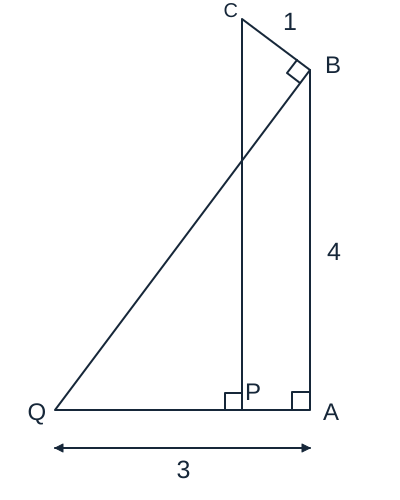
In the given figure, the angles 𝐵𝐴𝑄=𝐶𝑃𝑄=𝐶𝐵𝑄=𝜋2; and the lengths 𝑄𝐴=3 units, 𝐴𝐵= 4 units, and 𝐵𝐶=1 unit. What is the length of 𝑃𝑄 ?

IAT 2024, Mathematics, question 15 — question diagram
  1. 2 unit
  2. 2.2 unit
  3. 2 unit
  4. 32 unit
Answer & worked solution
Answer B
Choose Q = (0,0), A = (3,0) and B = (3,4). Since QB has length 5, a unit vector perpendicular to QB towards C is (−4/5,3/5). With BC = 1, C = (11/5,23/5). P is vertically below C on QA, so PQ=11/5=2.2PQ=11/5=2.2 units.

Physics

Question 1

IAT 2024 · Physics
On a circular track, two cyclists, Abhijit and Vani, start moving in opposite directions from a point. Abhijit moves with a constant speed. Vani starts with a constant acceleration from rest. They meet again on the track with the same speed. Which of the following is correct?
  1. Abhijit travelled the same distance travelled by Vani.
  2. Abhijit travelled half the distance travelled by Vani.
  3. Abhijit travelled double the distance travelled by Vani.
  4. Abhijit travelled 4/3 of the distance travelled by Vani.
Answer & worked solution
Answer C
Let their common speed at reunion be v and the elapsed time t. Abhijit travels vt. Vani starts from rest with uniform acceleration and reaches v, so her average speed is v/2 and she travels vt/2. Therefore Abhijit covers twice Vani's distance.

Question 2

IAT 2024 · Physics

Consider a simple pendulum undergoing simple harmonic motion with a time period 𝑇, and a fixed amplitude 𝜃0 of angular oscillation. Its angular momentum about the point of suspension exhibits an oscillatory behaviour with an amplitude 𝐴. Which of the following relations between 𝐴 and 𝑇 is correct?

  1. 𝐴𝑇1
  2. 𝐴𝑇2
  3. 𝐴𝑇3
  4. 𝐴𝑇4
Answer & worked solution
Answer C
For a pendulum of bob mass m and length L, the angular-momentum amplitude is A=mL2θ0ω=mL2θ0(2π/T)A=mL^2\theta_0\omega=mL^2\theta_0(2\pi/T). At fixed m, g and angular amplitude, T=2πL/gT=2\pi\sqrt{L/g} gives LT2L\propto T^2. Thus AT4/T=T3A\propto T^4/T=T^3.

Question 3

IAT 2024 · Physics
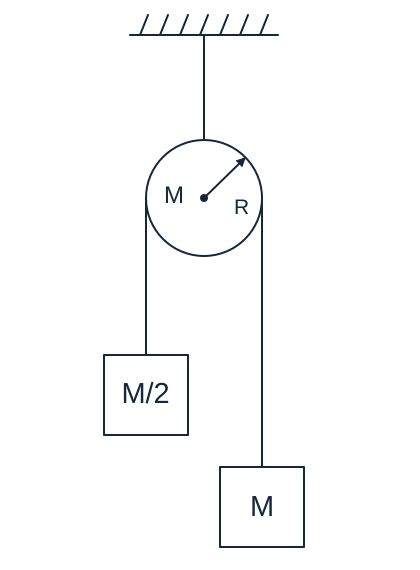
An inextensible cord of negligible mass passes over the rim of a solid disc of mass 𝑀 and radius 𝑅. The disc is free to rotate about an axis passing through the centre perpendicular to the plane of the screen, as shown in the figure. Two blocks of masses 𝑀 and M/2 are attached to the two free ends of the cord. Assume that there is no slipping of the cord on the disc. The acceleration due to gravity is 𝑔. What is the value of the angular acceleration of the disc? IAT 2024, Physics, question 3 — question diagram
  1. 𝑔/𝑅
  2. 𝑔/2𝑅
  3. 𝑔/3𝑅
  4. 𝑔/4𝑅

Transcription note: Removed an accidental accent on M in the secondary transcription; masses are M and M/2.

Answer & worked solution
Answer D
For an Atwood system with a massive pulley, a=(m2m1)g/(m1+m2+I/R2)a=(m_2-m_1)g/(m_1+m_2+I/R^2). Here the masses are M and M/2 and the solid disk has I=MR2/2I=MR^2/2. Therefore a=(M/2)g/(2M)=g/4a=(M/2)g/(2M)=g/4. No slipping gives angular acceleration a/R=g/(4R)a/R=g/(4R).

Question 4

IAT 2024 · Physics
Consider the motion of a particle along the 𝑥-axis. The position of the particle varies with time as 𝑥(𝑡)=sin2(𝜔𝑡)cos3(𝜔𝑡), where 𝜔 is a constant. What is the time period of the motion?
  1. 2𝜋𝜔
  2. 2𝜋3𝜔
  3. 2𝜋5𝜔
  4. 2𝜋15𝜔
Answer & worked solution
Answer A
Writing u=ωtu=\omega t, the function is sin2ucos3u=cos3ucos5u\sin^2u\cos^3u=\cos^3u-\cos^5u. Its cosine expansion contains nonzero terms at frequencies ω, 3ω and 5ω. The common fundamental period is 2π/ω2\pi/\omega. A shift by π/ω reverses the sign of the position and is not a full period.

Question 5

IAT 2024 · Physics

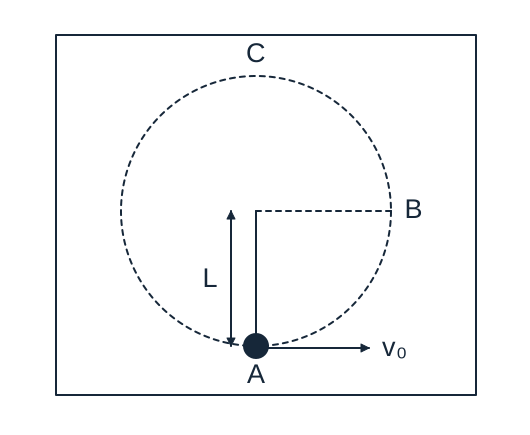
A solid bob of a material having density twice that of water is suspended with a massless and inextensible string of length 𝐿. The whole set-up is placed inside a water-filled tank. The bob is imparted a horizontal velocity 𝑉0 at the lowest point A , while the other end of the string is fixed, such that the bob completes a semi-circular trajectory in the vertical plane. The string becomes slack only when the bob reaches the topmost point C. Assume that the effects of viscosity and water currents are negligible. The acceleration due to gravity is 𝑔. What is the expression for 𝑉0 ?

IAT 2024, Physics, question 5 — question diagram
  1. 5𝑔𝐿
  2. (5/2)𝑔𝐿
  3. 2𝑔𝐿
  4. (3/2)𝑔𝐿
Answer & worked solution
Answer B
The bob's density is twice the water density, so buoyancy reduces its effective downward weight to mg/2. At the top, just-zero tension requires vC2/L=g/2v_C^2/L=g/2. Rising through 2L costs effective potential energy (mg/2)(2L)(mg/2)(2L), so v02=vC2+2gL=5gL/2v_0^2=v_C^2+2gL=5gL/2. Hence v0=5gL/2v_0=\sqrt{5gL/2}.

Question 6

IAT 2024 · Physics
Consider a solid sphere of radius 𝑅 floating in a pond with half of the sphere submerged. The sphere is pushed vertically downwards at the topmost point and released, such that it executes a simple harmonic motion. Acceleration due to gravity is 𝑔. What is the time period of oscillation?
  1. 2𝜋2𝑅𝑔
  2. 2𝜋𝑅𝑔
  3. 2𝜋3𝑅2𝑔
  4. 2𝜋2𝑅3𝑔
Answer & worked solution
Answer D · qualification below

Small oscillations; fluid inertia and drag are neglected.

At equilibrium, the sphere displaces half its volume, so m=ρw(2πR3/3)m=\rho_w(2\pi R^3/3). A small vertical displacement x changes displaced volume by approximately πR2x\pi R^2x, giving restoring constant k=ρwgπR2k=\rho_wg\pi R^2. Thus T=2πm/k=2π2R/(3g)T=2\pi\sqrt{m/k}=2\pi\sqrt{2R/(3g)}. The result is for small oscillations, neglecting fluid inertia and drag as in the exam model.

Question 7

IAT 2024 · Physics
One mole of an ideal gas of volume 𝑉 and temperature 𝑇 is allowed to expand adiabatically to volume 2𝑉 while doing no external work. The universal gas constant is 𝑅. What is the pressure of the gas after expansion?
  1. 𝑅𝑇𝑉
  2. 𝑅𝑇2𝑉
  3. 2𝑅𝑇𝑉
  4. 𝑅𝑇4𝑉
Answer & worked solution
Answer B
The expansion is adiabatic and does no external work, so the first law gives no change in internal energy. For an ideal gas internal energy depends only on temperature, so T remains unchanged. The final pressure of one mole in volume 2V is P=RT/(2V)P=RT/(2V).

Question 8

IAT 2024 · Physics
Two identical boxes contain the same ideal gas. Let (𝑛1,𝜆1,𝑇1) and (𝑛2,𝜆2,𝑇2) be the number density, mean free path and temperature of the gas in the first and the second box, respectively. One of the boxes is emptied into the other one. What will be the mean free path 𝜆 and temperature 𝑇 of the gas now?
  1. 𝜆=𝜆1𝜆2𝜆1+𝜆2,𝑇=𝑛1𝑇1+𝑛2𝑇2𝑛1+𝑛2
  2. 𝜆=𝑛1𝜆1+𝑛2𝜆2𝑛1+𝑛2,𝑇=𝑛1𝑇1+𝑛2𝑇2𝑛1+𝑛2
  3. 𝜆=𝑛1𝜆1+𝑛2𝜆2𝑛1+𝑛2,𝑇=𝑇1𝑇2
  4. 𝜆=𝜆1𝜆2𝜆1+𝜆2,𝑇=𝑇1𝑇2

Transcription note: Corrected a typographical transcription error against the 2024 paper; physical data are unchanged.

Answer & worked solution
Answer A
After both samples occupy one of the original equal-volume boxes, number density is n1+n2n_1+n_2. With the same molecular collision cross-section, 1/λn1/\lambda\propto n, so 1/λ=1/λ1+1/λ21/\lambda=1/\lambda_1+1/\lambda_2. Conservation of ideal-gas internal energy gives the particle-weighted temperature T=(n1T1+n2T2)/(n1+n2)T=(n_1T_1+n_2T_2)/(n_1+n_2). These are the relations in A under the insulated, no-net-external-work mixing model.

Question 9

IAT 2024 · Physics

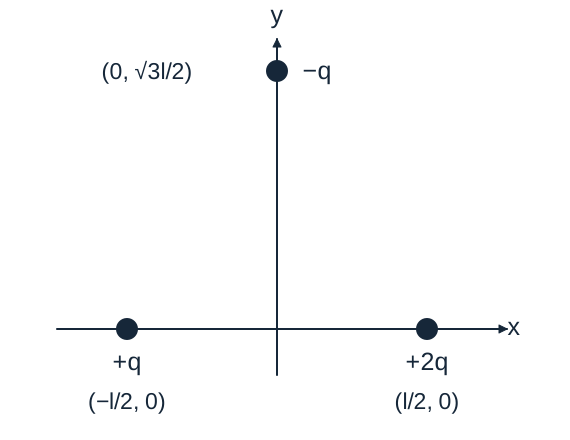
Consider two point charges +𝑞 and +2𝑞 fixed on the 𝑥𝑦 plane at (/2,0) and (+/2,0) respectively. Another point charge 𝑞 having mass 𝑚 is released from rest at (0,(3/2)) on the 𝑥𝑦 plane, as shown in the figure The permittivity of free space is 𝜖0. What is the acceleration of the charge 𝑞 at the time of release?

IAT 2024, Physics, question 9 — question diagram
  1. 𝑞28𝜋𝜖0𝑚𝑙2(3ıˆ3ȷˆ)
  2. 𝑞28𝜋𝜖0𝑚𝑙2(ıˆ3ȷˆ)
  3. 𝑞28𝜋𝜖0𝑚𝑙2(ıˆ33ȷˆ)
  4. 𝑞28𝜋𝜖0𝑚𝑙2(33ıˆȷˆ)
Answer & worked solution
Answer C
Both separations from the released charge to the fixed charges are l. The attractive force from +q is kq2/l2kq^2/l^2 along (1/2,3/2)(−1/2,−\sqrt3/2), and from +2q is twice this along (1/2,3/2)(1/2,−\sqrt3/2). Adding and dividing by m gives a=q2(i^33j^)/(8πε0ml2)\vec a=q^2(\hat i-3\sqrt3\hat j)/(8\pi\varepsilon_0ml^2).

Question 10

IAT 2024 · Physics

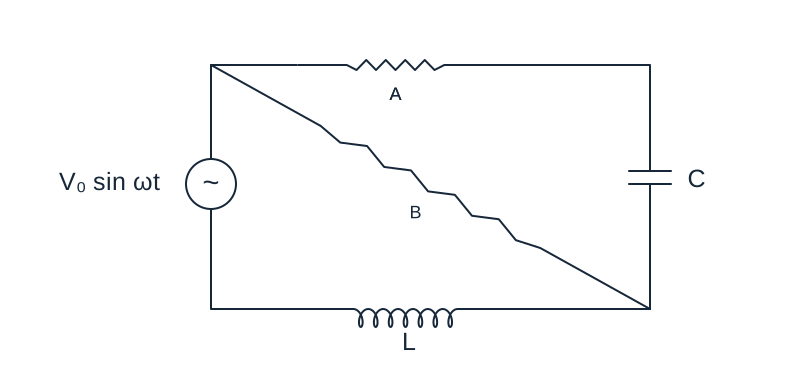
Consider the circuit diagram as shown in the figure. The source has a voltage 𝑉=𝑉0sin𝜔𝑡. Both the resistors 𝐴 and 𝐵 have the same resistance. The capacitor and the inductor have capacitance 𝐶 and inductance 𝐿, respectively. For some frequency 𝜔, and certain initial charge in the capacitor, the current through the resistor 𝐴 is in phase with the source. What is the value of 𝜔 ?

IAT 2024, Physics, question 10 — question diagram

  1. 1𝐿𝐶
  2. 12𝐿𝐶
  3. 12𝐿𝐶
  4. 13𝐿𝐶
Answer & worked solution
Answer B
Let each resistor be R, capacitive reactance X=1/(ωC)X=1/(\omega C) and inductive reactance Y=ωLY=\omega L. If IA is the current through A, the parallel-branch voltage is (RiX)IA(R-iX)I_A and the inductor carries IA(2iX/R)I_A(2-iX/R). Thus V/IA=R+YX/R+i(2YX)V/I_A=R+YX/R+i(2Y-X). In-phase current requires 2Y=X2Y=X, yielding ω=1/2LC\omega=1/\sqrt{2LC}.

Question 11

IAT 2024 · Physics
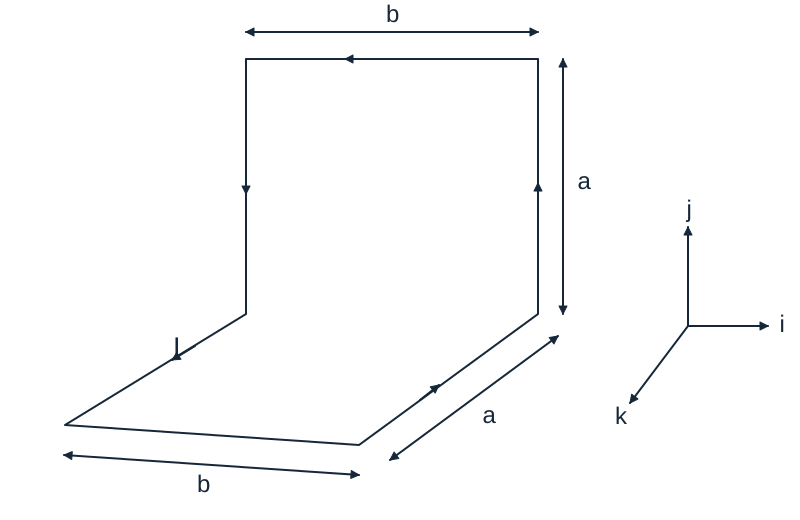
A conducting wire carrying a steady current 𝐼 is shaped as shown in the figure below. All connected straight segments meet at right angles. What is the magnetic moment of the current loop? IAT 2024, Physics, question 11 — question diagram
  1. Iab(ȷˆ𝑘ˆ)
  2. Iab(ȷˆ+𝑘ˆ)
  3. 2I𝑎𝑏(ȷˆ+𝑘ˆ)
  4. Iab(kˆȷˆ)

Transcription note: Corrected a typographical transcription error against the 2024 paper; physical data are unchanged.

Answer & worked solution
Answer B
For a non-planar loop, magnetic moment is current times the vector area. Projecting the loop onto the planes normal to j and k gives area ab in each, with positive orientation from the indicated current; the i projection vanishes. Consequently μ=Iab(j^+k^)\vec\mu=Iab(\hat j+\hat k). Its magnitude is 2Iab\sqrt2Iab, but that factor must not be multiplied into each component again.

Question 12

IAT 2024 · Physics

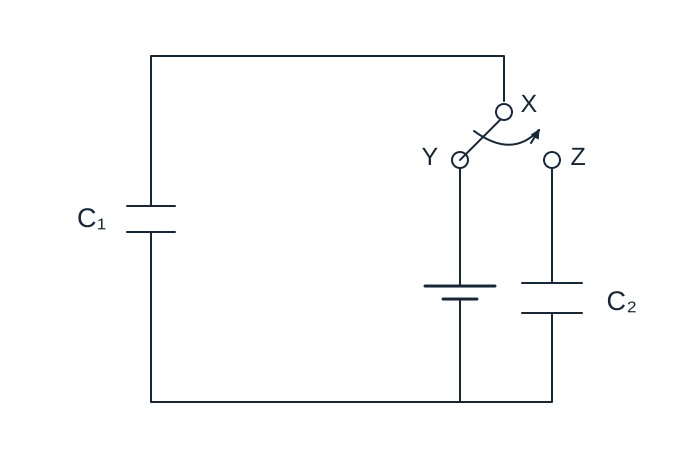
Consider the shown circuit. The capacitors 𝐶1 and 𝐶2 have capacitances 2𝜇 F and 8𝜇 F, respectively. The switch can connect point 𝑋 to either 𝑌 or 𝑍. Initially 𝑋𝑌 is connected until the capacitor is fully charged by the battery. Then the switch connects 𝑋 and 𝑍, and the final charges on C1 and C2 are 𝑄1 and 𝑄2, respectively. What is the value of the ratio 𝑄2𝑄1+𝑄2 ?

IAT 2024, Physics, question 12 — question diagram
  1. 1/2
  2. 1/4
  3. 1/5
  4. 4/5

Transcription note: Corrected a typographical transcription error against the 2024 paper; physical data are unchanged.

Answer & worked solution
Answer D
Once X is connected to Z, the two capacitors share a common final voltage. Thus Q1=C1VfQ_1=C_1V_f and Q2=C2VfQ_2=C_2V_f. The unknown final voltage cancels in the requested fraction: Q2/(Q1+Q2)=C2/(C1+C2)=8/(2+8)=4/5Q_2/(Q_1+Q_2)=C_2/(C_1+C_2)=8/(2+8)=4/5.

Question 13

IAT 2024 · Physics
Atomic masses of two oxygen isotopes 816O^{16}_{8}\mathrm O and 818O^{18}_{8}\mathrm O are 15.99491 u and 17.99916 u, respectively, where u is the atomic mass unit. Masses of proton and neutron are given by 1.00727 u and 1.00866 u, respectively. The speed of light is cc. What is the difference between the binding energies of 818O^{18}_{8}\mathrm O and 816O^{16}_{8}\mathrm O nuclei in units of uc2uc^2?
  1. 0.01307
  2. 2.00425
  3. 0.99559
  4. 3.01291

Transcription note: Restored the missing word and numerical typography from the 2024 paper.

Answer & worked solution
Answer A
The two isotopes have the same proton and electron counts, so those mass contributions cancel in the binding-energy difference. The heavier isotope has two additional neutrons. Therefore ΔB/c2=2mn[m(18O)m(16O)]=2(1.00866)(17.9991615.99491)=0.01307\Delta B/c^2=2m_n-[m(^{18}O)-m(^{16}O)]=2(1.00866)-(17.99916-15.99491)=0.01307 u.

Question 14

IAT 2024 · Physics
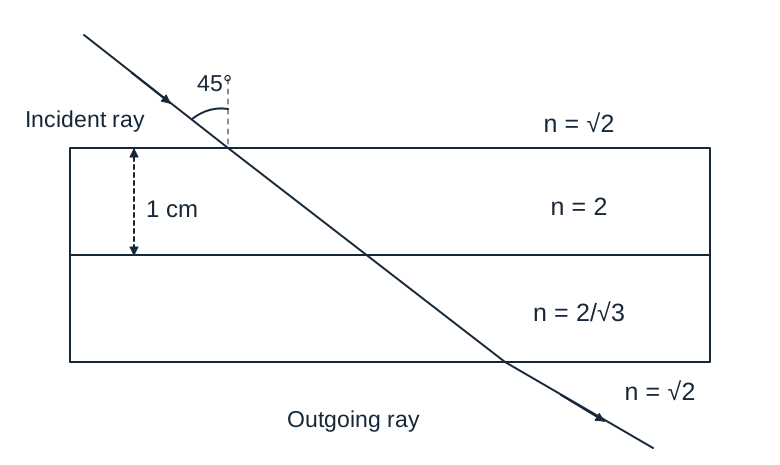
The refractive indices (𝑛) of two transparent slabs are 2 and 2/3. They are attached together and placed in a third transparent medium of refractive index 2, as shown in the figure. The thickness of the upper slab is 1 cm. A monochromatic light ray is incident on the upper slab at 45. What would be the thickness in cm of the lower slab such that the lateral shift of the ray after passing through both the slabs is zero? IAT 2024, Physics, question 14 — question diagram
  1. 1/2
  2. 1/2
  3. 1/3
  4. 3/2

Transcription note: Corrected a typographical transcription error against the 2024 paper; physical data are unchanged.

Answer & worked solution
Answer C
Across the parallel interfaces, nsinθn\sin\theta is constant and equals 2sin45=1\sqrt2\sin45^\circ=1. The angles in the upper and lower slabs are therefore 30° and 60°. If the lower thickness is h cm, zero displacement relative to the unrefracted ray requires 1tan30+htan60=(1+h)tan451\tan30^\circ+h\tan60^\circ=(1+h)\tan45^\circ. Solving gives h=1/3h=1/\sqrt3 cm.

Question 15

IAT 2024 · Physics

Two monochromatic sources emit light at wavelengths 𝜆 and 𝜆/2. The stopping potentials for a photosensitive material using these two sources are found to be 1 V and 3 V , respectively. What is the work function of the material?

  1. 1 eV
  2. 1.25 eV
  3. 1.5 eV
  4. 2 eV
Answer & worked solution
Answer A
Let the photon energy at wavelength λ be E and the work function be φ, in eV. The stopping potentials give Eϕ=1E-\phi=1 and 2Eϕ=32E-\phi=3. Subtracting yields E = 2 eV, then φ = 1 eV.

Read the review method and correction register →

Privacy and analytics

IISER.in is an independent study guide by Mathiit. With your permission, we use Google Analytics through Google Tag Manager to understand visits, paper reading, solution use and clicks to Mathiit.

Analytics uses cookies and information such as the page visited, device, approximate location and referral source. We record the paper year, subject and question number when you use a solution. We do not send the words you type in the paper search, names, email addresses or phone numbers in our study events.

We keep event data for up to 14 months. Advertising personalisation and Google signals are disabled for this setup. Our hosting provider may keep routine security and access logs independently of optional analytics.

Your choice is remembered on this browser for six months. You can change it here at any time. Declining does not affect access to questions or solutions. Links to other sites follow their own privacy practices.

How Google uses data from sites using its services. For a privacy query, contact Mathiit using the details on our About & contact page.