
Try each question before opening its answer. Answer letters refer to the option order displayed here. A marked qualification identifies a source defect or a modelling assumption; see the explanation before scoring that item.
Open the displayed answer key
| Subject | Question: answer |
|---|---|
| Biology | 1: B · 2: C · 3: A · 4: A · 5: A · 6: C · 7: A · 8: C · 9: A · 10: A · 11: B · 12: B · 13: A · 14: A · 15: A |
| Chemistry | 1: A · 2: C · 3: C · 4: D · 5: B · 6: A · 7: D · 8: A · 9: A · 10: D · 11: A · 12: B · 13: D · 14: C · 15: C |
| Mathematics | 1: B · 2: D · 3: D · 4: C · 5: D · 6: D · 7: B · 8: A · 9: D · 10: D · 11: A · 12: A · 13: D · 14: C · 15: A |
| Physics | 1: C · 2: C · 3: D · 4: B · 5: A · 6: B · 7: A† · 8: D · 9: D · 10: A · 11: B† · 12: C · 13: B† · 14: D · 15: C |
— = no valid listed option. † = read the qualification beside the solution.
Biology
Question 1
IAT 2026 · BiologyIf cell wall was used as the only criterion for classifying organisms, then Mycoplasma would have belonged to which one of the following groups?
Answer & worked solution
Answer B
Mycoplasma cells lack a cell wall. If that single feature were used, the absence of a wall would place them with animals among the listed choices. Their actual classification remains bacterial; the question deliberately replaces normal classification with a one-feature rule.
Question 2
IAT 2026 · BiologyWhich one of the following choices matches the organs in column I with their vascular system arrangement described in column II?
| Column I | Column II | ||
|---|---|---|---|
| P. | Dicot root | i. | Radial, open, diarch to tetrarch |
| Q. | Dicot stem | ii. | Ring, conjoint, open |
| R. | Monocot root | iii. | Radial, closed, polyarch |
| S. | Monocot stem | iv. | Scattered, conjoint, closed |
Answer & worked solution
Answer C
Dicot roots have radial vascular bundles with a small number of xylem groups, matching i. Dicot stems have conjoint open bundles arranged in a ring, matching ii. Monocot roots are polyarch and match iii; monocot stems have scattered conjoint closed bundles and match iv. The sequence is P–i, Q–ii, R–iii, S–iv.
Question 3
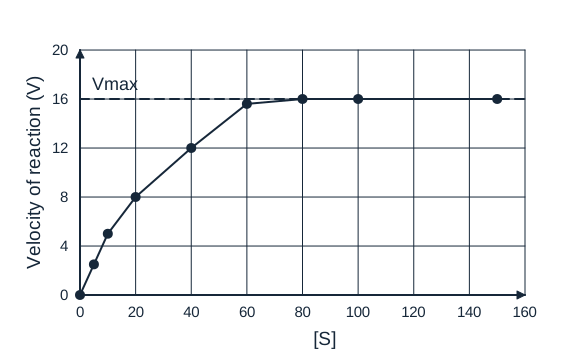
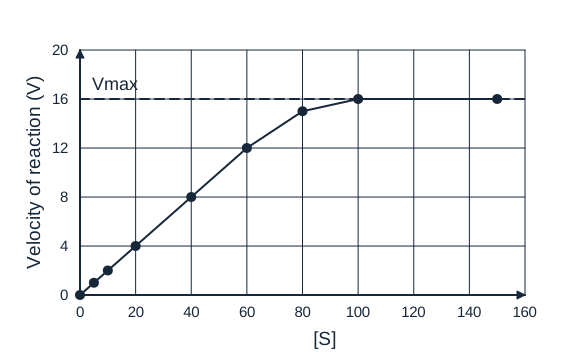
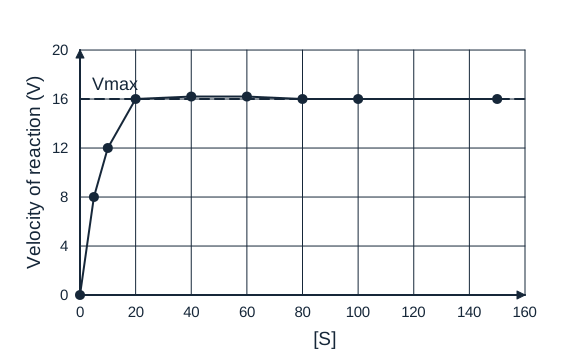
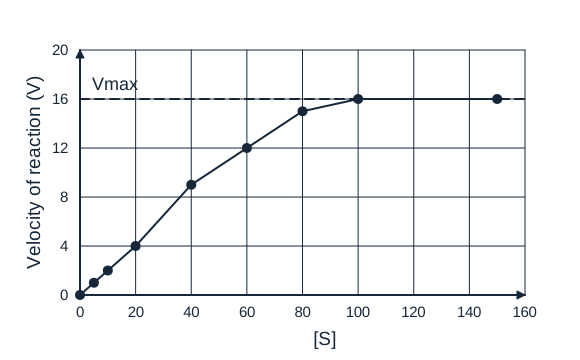
IAT 2026 · BiologyFor which one of the following enzyme activity plots, will the of the enzyme for substrate 'S' be 20? [S] indicates substrate concentration.
Answer & worked solution
Answer A
For Michaelis–Menten kinetics, . Thus when . Read the plateau at approximately 16 units and locate half of it, 8 units: graph A reaches that rate at the stated substrate concentration of 20. The other plots do not satisfy both the plateau and half-maximum condition.
Question 4
IAT 2026 · BiologyWhich of the following processes result in development of a proton gradient across the thylakoid membrane during photosynthesis?
i. Release of protons into the lumen of the thylakoid by plastoquinone
ii. Consumption of protons in the stroma during the reduction of
iii. Release of protons into the lumen of the thylakoid by ATP synthase
iv. Release of protons into the lumen of the thylakoid by water splitting reaction
i. Release of protons into the lumen of the thylakoid by plastoquinone
ii. Consumption of protons in the stroma during the reduction of
iii. Release of protons into the lumen of the thylakoid by ATP synthase
iv. Release of protons into the lumen of the thylakoid by water splitting reaction
Answer & worked solution
Answer A
A proton gradient increases when protons are released into the thylakoid lumen, moved from stroma to lumen during electron transport, or removed from the stroma during NADPH formation. These are the effects described in i, ii and iv. ATP synthase instead lets protons flow back to the stroma, dissipating the gradient while making ATP; it is not a gradient-building step.
Question 5
IAT 2026 · BiologyWhich one of the following correctly describes the mode of action of Follicle Stimulating Hormone (FSH) and estrogen?
Answer & worked solution
Answer A
FSH is a peptide hormone and acts through a receptor at the cell membrane, with cAMP as a second messenger. Estrogen is a steroid hormone that can bind an intracellular receptor; the hormone–receptor complex regulates transcription. Only A assigns these mechanisms to the correct hormones.
Question 6
IAT 2026 · BiologyFor which one of the following parents, their children will NOT have the same blood group phenotype as either of the parents?
Answer & worked solution
Answer C
An AB parent has genotype and an O parent has genotype ii. The first parent contributes either or , while the second always contributes i. Children therefore have A or B blood groups, with neither AB nor O produced by this cross. Match these offspring groups to C.
Question 7
IAT 2026 · BiologyIn which one of the following cases, will an anti-Rh antibody treatment prevent erythroblastosis foetalis?
Answer & worked solution
Answer A
In the standard Rh-incompatibility scenario, an Rh-negative mother can become sensitised after exposure to Rh-positive fetal blood. A later Rh-positive fetus may then be affected by maternal anti-Rh antibodies. Giving anti-Rh immunoglobulin after the first Rh-positive delivery removes fetal Rh-positive cells from the maternal circulation before active sensitisation develops. That preventive combination is A; an Rh-positive mother does not create this incompatibility.
Question 8
IAT 2026 · BiologyWhich one of the following correctly describes the sequence of events leading to muscle contraction following acetylcholine release at the neuromuscular junction?
Answer & worked solution
Answer C
Acetylcholine initiates muscle excitation, leading to calcium release into the sarcoplasm. Calcium binding moves the troponin–tropomyosin complex so that myosin-binding sites on actin become accessible. Filament sliding shortens the sarcomere and draws the Z lines inward. The correct sequence is increased calcium, unmasking, inward Z-line movement.
Question 9
IAT 2026 · BiologyA female child is born with all the primary oocytes required during her lifetime. At which one of the following stages of cell division are these oocytes found at birth?
Answer & worked solution
Answer A
Primary oocytes enter meiosis during fetal development and then arrest in prophase I, specifically the diplotene stage. They do not complete meiosis I before birth. Therefore the stage asked for is prophase I, option A.
Question 10
IAT 2026 · BiologyWhich of the following schematics correctly depict a lac operon that can be negatively regulated?
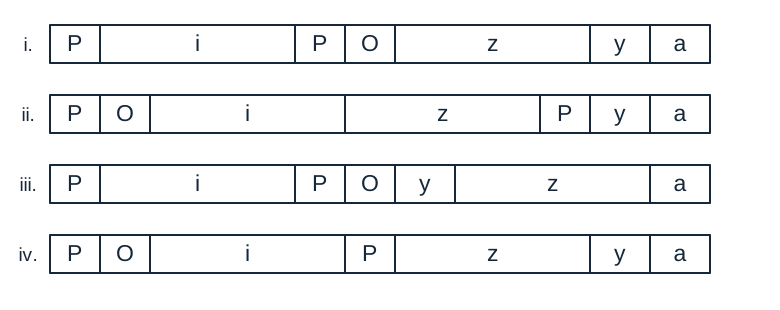
Answer & worked solution
Answer A
For inducible control of the structural genes, the operator must be positioned so that repressor binding can block transcription from the promoter serving those genes. In the supplied arrangements, i and iii place the controlling operator with that transcription unit. The placements in ii and iv do not provide the stated control of the complete structural-gene set. Hence the matching choice is A.
Question 11
IAT 2026 · BiologyWhich one of the following is the correct sequence of the coding strand of the given gene?
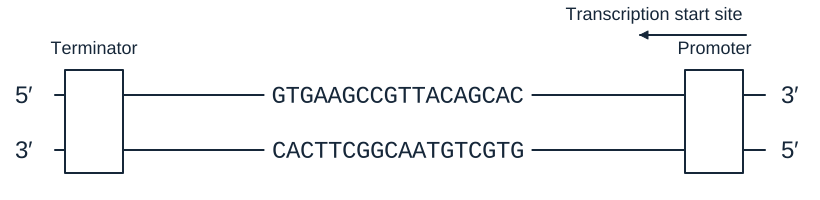
Answer & worked solution
Answer B
Identify the coding strand as the strand complementary and antiparallel to the template. The lower strand in the diagram is therefore read from right to left to obtain its 5′→3′ sequence. That gives 5′-GTGCTGTAACGGCTTCAC-3′, which is B. Reading the same strand left to right would reverse the required orientation.
Question 12
IAT 2026 · BiologyThe following pedigree diagram shows the inheritance of a rare genetic disorder in a family (filled shapes depict affected individuals). Which one of the following is the most likely pattern of inheritance of the disorder?
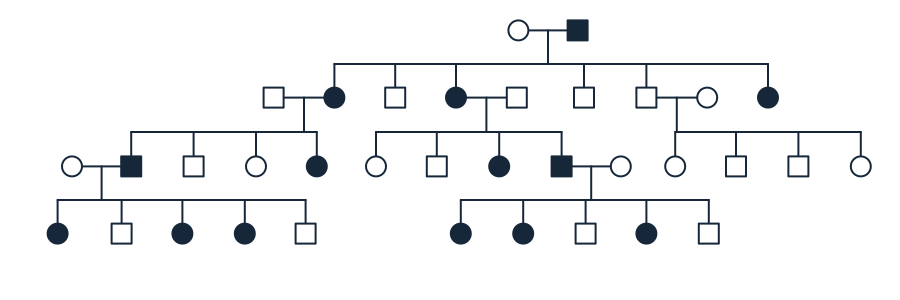
Answer & worked solution
Answer B
The pedigree shows affected fathers transmitting the trait to daughters but not to sons. That rules out Y-linkage and is the characteristic paternal transmission pattern of an X-linked dominant trait. Transmission through affected females is also compatible with this model, giving B.
Question 13
IAT 2026 · BiologyWhich one of the following molecules can be used for RNA interference?




Answer & worked solution
Answer A
The structure contains uracil rather than thymine and ribose sugars with the RNA hydroxyl pattern. It is shown as a paired, double-stranded molecule. Those two observations together identify double-stranded RNA, option A. Double-stranded RNA can be processed into small interfering RNAs that guide silencing of a complementary messenger RNA.
Question 14
IAT 2026 · BiologyThe pBR322 cloning vector has genes coding for tetracycline and ampicillin resistance. A foreign DNA to be cloned is inserted into the tetracycline resistance gene and the recombinant plasmid is then transformed into E. coli cells. Which one of the following choices is the most likely outcome of this cloning reaction?
Answer & worked solution
Answer A
Insertion into the tetracycline-resistance region disrupts that marker while leaving the ampicillin-resistance region intact. Recombinant cells therefore grow in ampicillin but fail to grow in tetracycline. This is the insertional-inactivation pattern in A.
Question 15
IAT 2026 · BiologyThe graphs below depict the number of individuals of two organisms, named P and Q, when grown independently, and together. Based on these growth patterns, which one of the following statements is correct?
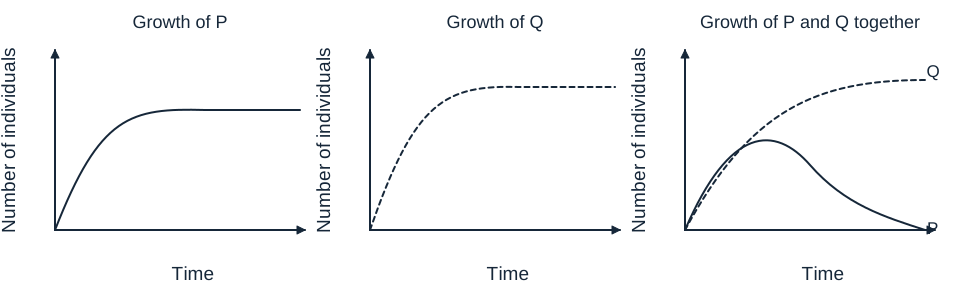
Answer & worked solution
Answer A
Compare the separate-population curves with the mixed-culture outcome: P declines when Q is present, while Q can benefit from P as a resource. Among the interactions listed, Q acting as predator on P best matches this direction of effect. The graph supports the choice among the given alternatives; it is not, by itself, a universal proof of the feeding mechanism.
Chemistry
Question 1
IAT 2026 · ChemistryWhat is the ratio of the velocity of an electron in the fourth orbit of to the velocity of the electron in the second orbit of ?
Answer & worked solution
Answer A
In the Bohr model for a one-electron ion, . For in n = 4, ; for in n = 2, . Their velocities are equal, so the ratio is 1:1.
Question 2
IAT 2026 · ChemistryWhat is the order of bond energy between C=S C=Te, and between Cl–Cl F–F?
Answer & worked solution
Answer C
C=S has more effective orbital overlap than C=Te because tellurium is much larger, so C=S has the greater bond energy. F–F is unusually weak because the small fluorine atoms bring lone pairs into strong repulsion; Cl–Cl is stronger. Both comparisons are combined in C.
Question 3
IAT 2026 · ChemistryWhich one of the following molecules shows an increase in bond order after loss of an electron from the highest occupied molecular orbital?
Answer & worked solution
Answer C
Removing an electron from an antibonding orbital raises bond order by one-half; removing one from a bonding orbital lowers it. The highest occupied orbital of F2 is antibonding, whereas the relevant HOMOs of B2, C2 and N2 are bonding. Thus F2 shows the required increase.
Question 4
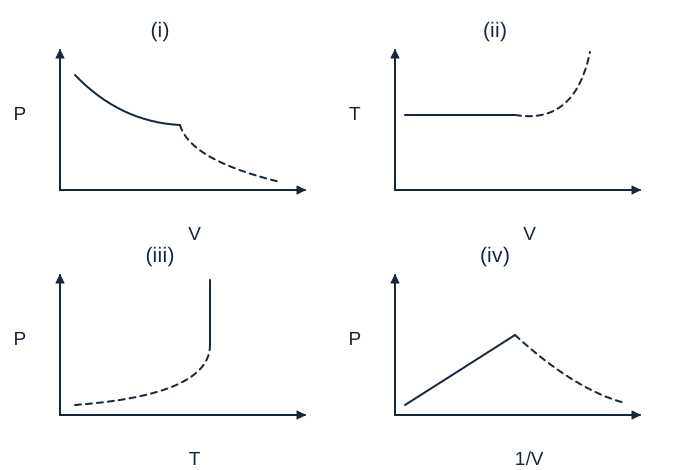
IAT 2026 · ChemistryAn ideal gas goes through a reversible isothermal expansion (solid line) followed by a reversible adiabatic expansion (dashed line). Which of the following diagram(s) closely depict(s) the entire process?
Answer & worked solution
Answer D
During isothermal expansion, T stays constant and P decreases as . The following adiabatic expansion cools the gas and obeys , with a steeper fall than the isotherm in a P–V plot. These conditions are satisfied by i and iii. Diagram ii incorrectly makes temperature rise in the adiabatic expansion; iv does not trace the required expansion branch in P versus 1/V.
Question 5
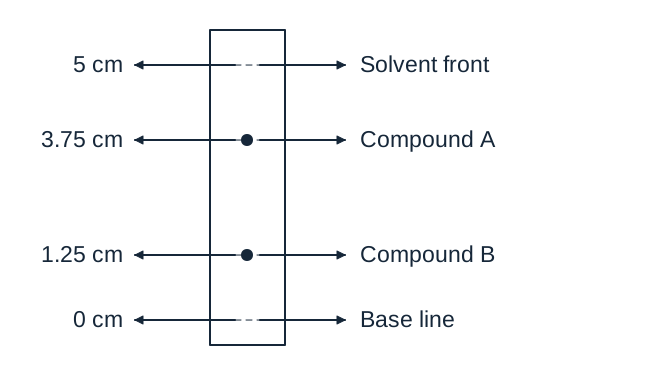
IAT 2026 · ChemistryConsider the following silica-gel based thin-layer chromatogram of compounds A and B. Which one of the following statements is correct?
Answer & worked solution
Answer B
The solvent front moves 5 cm. Hence and . Silica gel is polar, so the compound more strongly retained by it moves less far. B is therefore more polar, and A has .
Question 6
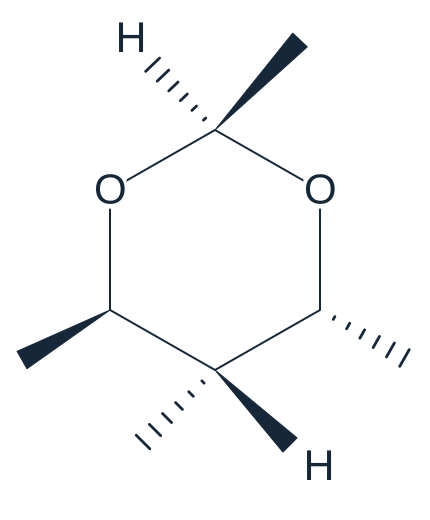
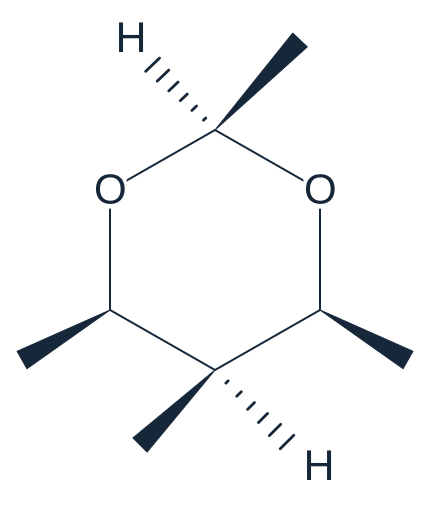
IAT 2026 · ChemistryWhich one of the following molecules is chiral?
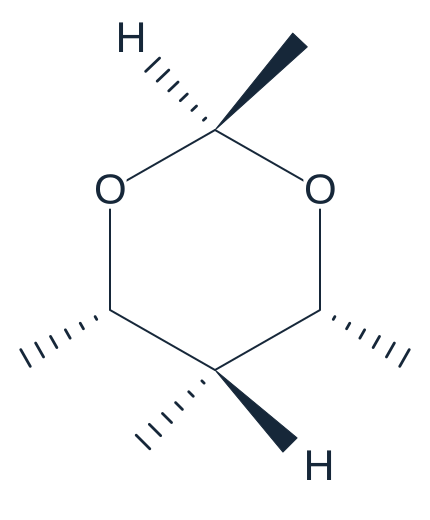
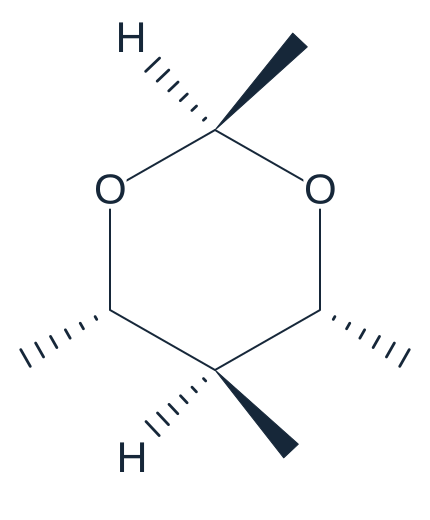
Answer & worked solution
Answer A
Compare the two sides of each ring while retaining the wedge-and-dash orientations. In B, C and D the matching left and right substituent arrangements permit an internal reflection symmetry. A has opposite orientations on the two side carbons and lacks that symmetry; its mirror image cannot be superposed by rotating the whole molecule. A is the chiral member.
Question 7
IAT 2026 · ChemistryFor two pure volatile liquids X and Y, attractive intermolecular interactions of both X-X and Y-Y are weaker than those of X-Y. The total vapour pressure of an equimolar solution of X and Y is . The vapour pressure of pure X and pure Y are and , respectively. Which one of the following relations is correct?
Answer & worked solution
Answer D
Stronger X–Y attractions hold molecules in the liquid more effectively than the interactions in either pure liquid. The solution therefore shows negative deviation from Raoult's law. For an equimolar ideal solution the pressure would be ; the actual total pressure is lower, giving D.
Question 8
IAT 2026 · ChemistryThe rate constant of a reaction at 600 K with an activation energy of kJ mol is s. What is the temperature at which the half-life of the reaction becomes 152 s? [Consider pre-exponential factor and activation energy to be independent of temperature. J Kmol]
Answer & worked solution
Answer A
The units indicate first-order kinetics, so the target rate constant is . Apply . With , this gives K. This higher temperature is consistent with the much shorter half-life.
Question 9
IAT 2026 · ChemistryMetal-ligand -bond formation in and requires electron-pair donation between metal and ligand orbitals. Which one of the following represents the direction of electron-pair donation?
Answer & worked solution
Answer A
CO is a π-acceptor: filled metal d orbitals donate into vacant CO π* orbitals in the carbonyl. In permanganate, filled oxygen orbitals donate π electron density towards the electron-deficient Mn(VII) centre. The π-donation directions are therefore metal → ligand for and ligand → metal for .
Question 10
IAT 2026 · ChemistryWhich one of the following octahedral complexes has the highest spin-only magnetic moment?
Answer & worked solution
Answer D
Determine oxidation states first. The complexes contain Co(II), V(III), Fe(III) and Cr(II), giving d7, d2, d5 and d4 respectively. The aqua/hydroxo Cr(II) complex is weak-field high-spin d4 with four unpaired electrons, BM. This exceeds high-spin Co(II)'s three, V(III)'s two, and the strong-field Fe(III) complex's low-spin count of one.
Question 11
IAT 2026 · ChemistryWhich one is an INCORRECT statement with regard to the following reaction?

Answer & worked solution
Answer A
The tertiary halide undergoes the SN1 process described by the other statements. Its slow step is C–Br ionisation, so the rate is proportional to tert-butyl bromide concentration and independent of hydroxide concentration. Adding water makes the solvent more favourable for stabilising the ions and increases, rather than decreases, the ionisation rate. A is the incorrect statement.
Question 12
IAT 2026 · ChemistryWhat are the numbers of protons () and electrons (), respectively, required for the reduction of to under an aqueous acidic condition?
Answer & worked solution
Answer B
Balance oxygen with seven water molecules and hydrogen with fourteen protons. Then balance charge with six electrons: . There are therefore 14 protons and 6 electrons per dichromate ion.
Question 13
IAT 2026 · ChemistryWhat are X and P in the following reaction sequence?
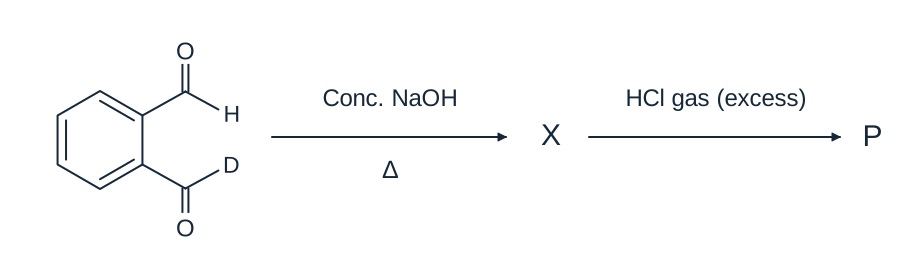
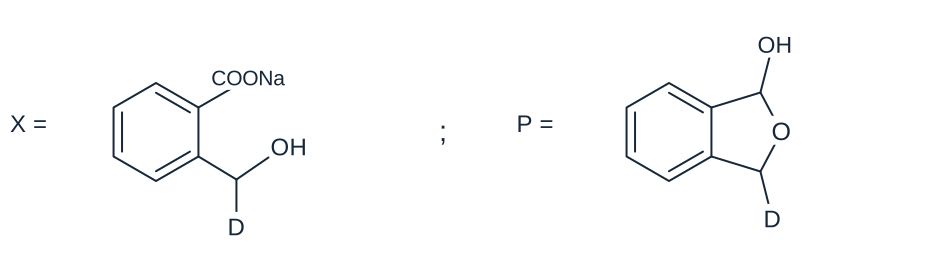
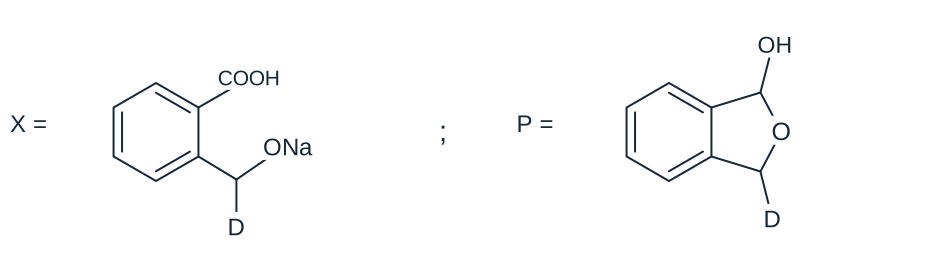
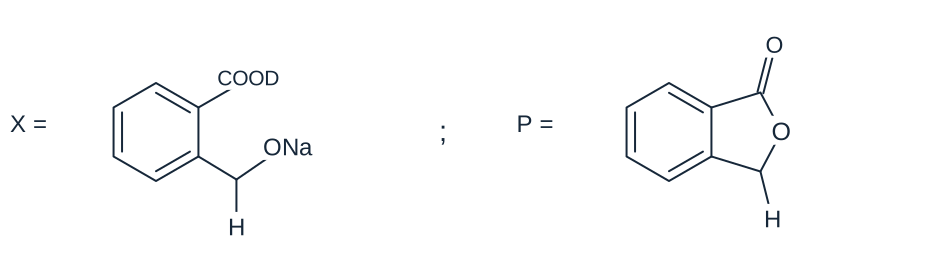
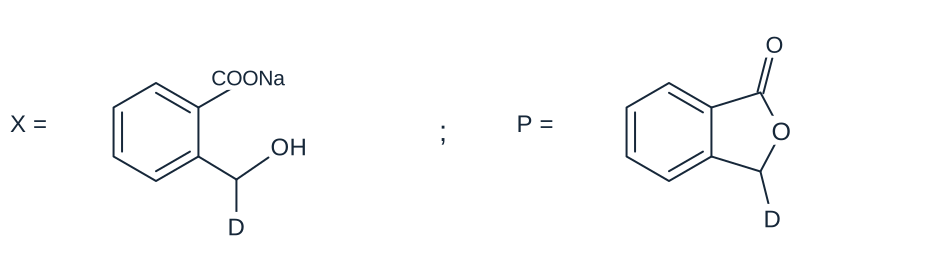
Answer & worked solution
Answer D
The neighbouring aldehyde groups undergo an intramolecular Cannizzaro reaction. Transfer of H from the CHO group is favoured over transfer of D, so that group is oxidised to carboxylate while the labelled aldehyde is reduced to CH(D)OH. Acidification converts the salt to the hydroxy acid, which closes to the five-membered lactone. D shows both the carboxylate/alcohol intermediate and the lactone retaining D on the reduced carbon.
Question 14
IAT 2026 · Chemistry100 mL of 1.0 M aqueous NaOH solution was diluted to 1.0 L by adding water. Half of this solution was discarded. A new 100 mL of 0.5 M aqueous NaOH solution was added to the remaining solution. What is the concentration of the final aqueous NaOH solution?
Answer & worked solution
Answer C
Initially there are mol NaOH. Dilution changes the volume, not the amount; discarding half then leaves 0.050 mol in 0.500 L. The added solution contributes mol. Final concentration is M, approximately 0.17 M.
Question 15
IAT 2026 · ChemistryWhat is the order of for the following molecules in an aqueous medium?
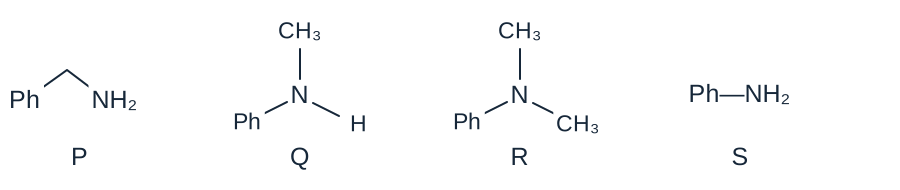
Answer & worked solution
Answer C
A smaller pKb means a stronger base. In benzylamine P, nitrogen's lone pair is separated from the phenyl ring by CH2 and is not delocalised into the ring, making P much more basic. In the aniline series, methyl donation gives the aqueous order R > Q > S in basicity for these listed compounds. Reversing that order for pKb gives .
Mathematics
Question 1
IAT 2026 · MathematicsLet be a quadratic polynomial such that . What is the coefficient of in ?
Answer & worked solution
Answer B
With roots +1 and −1, the quadratic has the form , where a is nonzero. There is no linear term, so the coefficient of x is zero.
Question 2
IAT 2026 · MathematicsConsider the following sets of points in the complex plane
and
.
Which of the following statements is TRUE?
and
.
Which of the following statements is TRUE?
Answer & worked solution
Answer D
The points of A are fifth roots of unity and repeat when n increases by 5, so A contains exactly five points. Equality of two points of B would require for an integer k. Irrationality of π forces k = 0 and n = m. Thus B has infinitely many distinct points.
Question 3
IAT 2026 · MathematicsLet be two integers such that . What is the total number of functions
such that are all distinct?
such that are all distinct?
Answer & worked solution
Answer D
Assign distinct images to the first l inputs in ways. Each of the remaining r−l inputs can map independently to any of r values, contributing . Multiplication gives , which is D.
Question 4
IAT 2026 · MathematicsLet be a geometric progression of positive integers such that and for all positive integers . What is the value of ?
Answer & worked solution
Answer C
Let the common ratio be q. The recurrence gives , so . Positivity excludes q = −1, leaving q = 2. The first five terms are 3, 6, 12, 24 and 48, whose sum is 93.
Question 5
IAT 2026 · MathematicsLet . What is the remainder when is divided by 100?
Answer & worked solution
Answer D
Since n is even, . Also and n is a multiple of 5, so . Finally n is a multiple of 10, making . The required remainder is .
Question 6
IAT 2026 · MathematicsConsider the data of scores obtained by students in an examination. If the score of every student is increased by 2 marks, then which of the following statements is TRUE?
Answer & worked solution
Answer D
Adding 2 to every score also adds 2 to the mean. Each deviation remains , so the average absolute deviation about the mean is unchanged. Variance and deviation about the median are translation-invariant for the same reason, rather than increasing by 2.
Question 7
IAT 2026 · MathematicsFor a matrix , whose elements are real numbers, denote by the product , where is a positive integer. Define , , , for all and
, for all .
Which of the following statements is TRUE for all ?
, for all .
Which of the following statements is TRUE for all ?
Answer & worked solution
Answer B
From the initial Fibonacci values, . Direct multiplication gives . Multiply by to obtain for every m ≥ 3. This is B; in particular the determinant alternates with m and is not always −1.
Question 8
IAT 2026 · MathematicsLet be the function given by
.
What is the number of points where is NOT differentiable?
.
What is the number of points where is NOT differentiable?
Answer & worked solution
Answer A
Split at the candidate breakpoints 1, 2 and 3. The function simplifies to for x < 1, for 1 < x < 2 and also for 2 < x < 3, and for x > 3. Slopes change at 1 and 3 but agree across 2. Thus there are exactly two non-differentiable points.
Question 9
IAT 2026 · MathematicsFor real numbers and , consider the function given by
How many pairs are there for which is continuous at every point of ?
How many pairs are there for which is continuous at every point of ?
Answer & worked solution
Answer D
Continuity at −1 requires , giving . Continuity at +1 requires . Substitution yields , whose discriminant is . There is no real a, hence no real pair (a,b).
Question 10
IAT 2026 · MathematicsLet be the set of all the circles in a plane. If
,
then which of the following statements is TRUE?
,
then which of the following statements is TRUE?
Answer & worked solution
Answer D
Every circle intersects itself, and intersection is symmetric. Transitivity fails: two separated circles can each intersect a larger third circle without intersecting one another. For example, two unit circles with centres 4 units apart are disjoint, while a circle centred midway with radius 2 intersects both. Hence R is reflexive and symmetric, but not transitive.
Question 11
IAT 2026 · MathematicsConsider the function defined by . Which of the following statements is NOT TRUE?
Answer & worked solution
Answer A
Use to obtain . This is positive on , vanishes at , and changes sign on shifting x by π/2. It is not increasing throughout : its derivative at is . Thus A is false.
Question 12
IAT 2026 · MathematicsWhat is the value of ?
Answer & worked solution
Answer A
Compare the two expressions through . The smaller is on [−1,0], on [0,1], and on [1,2]. Their integrals are respectively , and . Adding them gives −1.
Question 13
IAT 2026 · MathematicsConsider the points , and . Which of the following statements is TRUE?
Answer & worked solution
Answer D
In coordinates, A = (4,1,3), B = (0,2,0) and C = (−4,3,−3). Their midpoint check gives . Therefore B lies on segment AC and all three points are collinear.
Question 14
IAT 2026 · MathematicsLet be the line joining and and let be the line joining and . What is the angle between and ?
Answer & worked solution
Answer C
Direction vectors are and . Their dot product is 12 and their lengths are and . Thus , giving the acute angle 30°.
Question 15
IAT 2026 · MathematicsSuppose there are two boxes and , each having 3 red and 4 black balls. One ball is drawn at random from . If it is red, 4 red balls are put into , otherwise 3 black balls are put into . Then one ball is randomly drawn from . If this ball is red, what is the conditional probability that the ball drawn from was also red?
Answer & worked solution
Answer A
Let R1 denote a red draw from the first box and R2 a red draw from the second. We have , and . Bayes' rule gives .
Physics
Question 1
IAT 2026 · PhysicsThe acceleration of a point particle is given by the equation
where denotes position and denotes time. Which of the following relations show the correct dimensions for and ?
where denotes position and denotes time. Which of the following relations show the correct dimensions for and ?
Answer & worked solution
Answer C
Each term on the right must have acceleration dimensions . Since has dimensions , α must have dimensions . Since velocity has dimensions , β must have dimensions . Both are independent of mass, as in C.
Question 2
IAT 2026 · PhysicsThe position of a particle of mass 1 kg at time is given by , where is in seconds and the coefficients have the proper units for to be in metres. What is the component of the angular momentum (with respect to the origin) in kg ms along the vector ?
Answer & worked solution
Answer C
Differentiate position to obtain . With unit mass, . The unit vector along is , so the scalar component is .
Question 3
IAT 2026 · PhysicsA planet is revolving in a circular orbit with a time period around the center of a star solely under the gravity of the star. Suppose the distance between the star and the planet is halved. The individual radii of the star and the planet are also halved, keeping their uniform mass densities unchanged. What will be the time period of the new orbit of the planet?
Answer & worked solution
Answer D
For an orbit controlled by the star, . Halving the star's radius at unchanged density reduces M to M/8, while orbital radius becomes r/2. Therefore . The planet's mass does not enter this expression.
Question 4
IAT 2026 · PhysicsAn exotic spherical jellyfish has a bulk modulus . Close to the surface of the sea (depth ), its radius is . When it dives to a depth (), its radius is reduced by . Given the density of the incompressible sea water , and the uniform acceleration due to gravity such that , what is ?
Answer & worked solution
Answer B
The pressure increase is . In the small-strain bulk-modulus relation, . Therefore , giving . Its leading term is , consistent with a small positive shrinkage.
Question 5
IAT 2026 · PhysicsConsider two Carnot engines of efficiencies and . The first engine absorbs heat from a heat reservoir and releases heat to a heat reservoir . The second engine takes heat from and releases heat to a heat reservoir . If , what is the net efficiency of this combination of the two Carnot engines?
Answer & worked solution
Answer A
The first engine passes on . The second rejects . Overall efficiency is .
Question 6
IAT 2026 · PhysicsA jar is filled with two monoatomic non-interacting gases and with total masses and , respectively. The molar mass of is double the molar mass of . If the jar is kept at temperature , what is the ratio of the total pressure of the combined gas to the partial pressure due to the gas ?
Answer & worked solution
Answer B
Partial pressure is proportional to mole number at fixed volume and temperature. If A has molar mass 2μ and B has μ, then . Thus .
Question 7
IAT 2026 · PhysicsA simple pendulum of length , mass and electric charge on its bob is oscillating with a time period under uniform gravity which is in the direction. Upon applying a uniform electric field (where is a unit vector in the plane of oscillation), the time period of the pendulum decreases. Which of the following statements is NOT correct?
Answer & worked solution
Answer A · qualification below
The expected branch assumes a weak upward electric force.
For small oscillations about equilibrium, , where . The intended hanging, weak-field case in A has an upward electrical force, reducing the restoring acceleration and increasing the period; the other choices reinforce gravity's magnitude. A is therefore the keyed answer. The wording omits a strength restriction: if the upward electrical acceleration exceeds 2g, a new upward equilibrium can also have a shorter period. This limitation must accompany the conventional answer.
Question 8
IAT 2026 · PhysicsA sphere and a cube of equal masses on a horizontal frictionless floor, are confined between two vertical walls, as shown in the figure. The cube is attached to the wall by a massless spring. At the equilibrium position of the spring, the sphere just touches the cube. The cube is moved towards the left by a small amount from its equilibrium position, compressing the spring and is released at . The system keeps returning to its initial configuration as that of with a time period . If all the collisions are elastic, which of the following statements is correct?
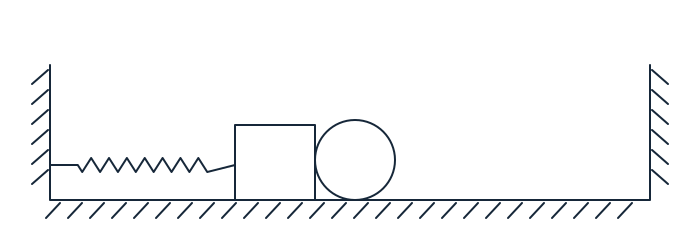
Answer & worked solution
Answer D
Let and let D be the sphere's fixed one-way free-travel distance to the right wall. At first contact, the cube has speed ; equal-mass elastic collision transfers that speed to the sphere and leaves the cube at rest. The sphere's round trip takes . The two spring-motion quarter cycles together take , so decreases as l increases.
Question 9
IAT 2026 · PhysicsThree infinite plane sheets which have uniform positive surface charge densities , and , are arranged parallel to each other with a separation of as shown in the figure. A spherical Gaussian surface of radius has its center on the middle sheet. Which of the following statements regarding the electric flux through the left hemisphere and the electric flux through the right hemisphere of the Gaussian surface is correct?
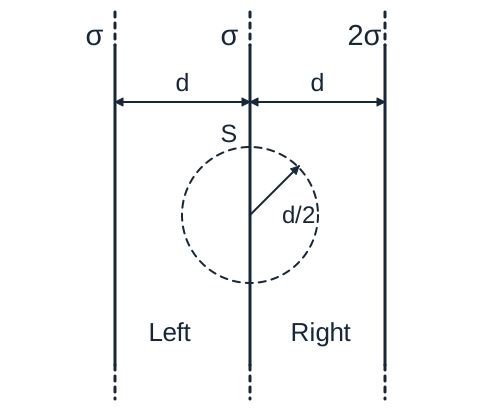
Answer & worked solution
Answer D
Take rightward field as positive. In the left half of the sphere, the three sheet contributions sum to . In the right half they sum to zero. The leftward field has positive outward flux through the left hemisphere, while the right flux is zero. Thus .
Question 10
IAT 2026 · PhysicsA particle of mass and electric charge starts from rest under the influence of a uniform external electric field to travel a distance in time . If the particle had mass , it would take time to travel the same distance. What is the ratio ?
Answer & worked solution
Answer A
The acceleration magnitude is . Starting from rest over distance d gives , hence . Holding the other quantities fixed yields .
Question 11
IAT 2026 · PhysicsA long solenoid of initial radius is put in a region of uniform magnetic field with the axis of the solenoid aligned along the magnetic field. The solenoid is a part of a closed circuit that has no initial current running through it. If the radius of the solenoid starts increasing at a uniform rate, how do the magnetic field strength and the associated magnetic energy inside the solenoid change?
Answer & worked solution
Answer B · qualification below
The answer uses the ideal flux-conserving solenoid model; see the qualification below.
As the solenoid expands, the externally applied flux tends to increase, so the induced current opposes it. In the ideal flux-conserving circuit model underlying the key, , giving . For fixed solenoid length, . Both decrease, so B is correct. This concerns the total internal field, not the magnitude of the induced field alone. A general resistive-circuit treatment needs circuit parameters not specified in the question.
Question 12
IAT 2026 · PhysicsA spherical concave mirror of focal length 10 cm and a double convex lens of focal length 5 cm are arranged on the common principal axis as shown in the figure. A small object is placed on the principal axis between the focal points and of the mirror and the lens, respectively. If two real and mutually inverted images are formed by the lens at the same location on the principal axis, what is the distance of the object from the mirror on the principal axis?
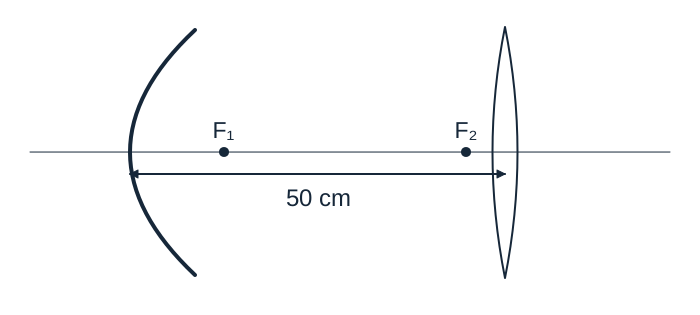
Answer & worked solution
Answer C
The lens maps a given object position to a unique image position. Thus the direct rays and the mirror-reflected rays can form images at the same location only if the mirror's intermediate image coincides with the object. A concave mirror does that at its centre of curvature, cm. The mirror reverses that intermediate image, so the two lens images have opposite orientations as required.
Question 13
IAT 2026 · PhysicsAn experimental study of the photoelectric effect involves a metal of work function . What is the smallest wavelength of the incident photon to photoemit an electron of mass which has the same de Broglie wavelength as that of the incident photon? [Given is the Planck's constant, is the speed of light, and ]
Answer & worked solution
Answer B · qualification below
The formal nonrelativistic result has a self-consistency limitation at the stated short wavelength.
Using the nonrelativistic photoelectric equation and equal wavelengths gives . Solving the quadratic in gives . The plus sign in the denominator gives the smaller wavelength, option B, matching the exam key. There is a model limitation: for this branch implies momentum near 2mc, so a nonrelativistic kinetic-energy formula is not physically self-consistent. The stated answer is the formal exam-model result.
Question 14
IAT 2026 · PhysicsConsider normal incidence of a monochromatic beam of photons of power on a flat surface. Of the incident beam, 10% gets absorbed, 10% gets transmitted, and the rest is reflected by the flat surface. If is the speed of light, what is the force exerted on the flat surface by the beam?
Answer & worked solution
Answer D
Absorption transfers the incident momentum, reflection reverses it and transfers twice as much, and unchanged transmission transfers none. With reflected fraction 0.8, . Absorbed photons transfer their energy and momentum to the surface; they should not be described as stationary photons.
Question 15
IAT 2026 · PhysicsThe three numbers: (number of protons, number of neutrons, the radius) characterize a nucleus. What is the value of for two nuclei characterized by and ?
Answer & worked solution
Answer C
The nuclear-radius model gives , with A equal to protons plus neutrons. The mass numbers are 1 and 8, so .
Read the review method and correction register →
Continue exploringIAT 2025 solved paper
Back to home